

CAUTION : Try solving the problem yourself for at least 5–10 minutes before clicking the AI Assistant. In the exam hall, you will be on your own.
Q.No:1 GATE-2012
A \({Ge}\) semiconductor is doped with acceptor impurity concentration of \(10^{15} atoms/cm^3\). For the given hole mobility of \(1800 cm^2/V-s\), the resistivity of this material is
(A)
\(0.288 \Omega cm\)
(B)
\(0.698 \Omega cm\)
(C)
\(3.472 \Omega cm\)
(D)
\(6.944 \Omega cm\)
Check Answer
Option C
Q.No:2 GATE-2012
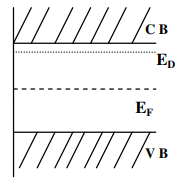
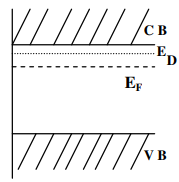
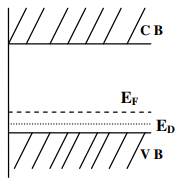
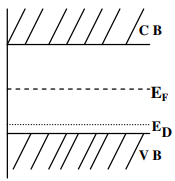
Identify the CORRECT energy band diagram for Silicon doped with Arsenic. Here \(CB, VB, E_D\) and \(E_F\) are conduction band, valence band, impurity level and Fermi level, respectively.




Check Answer
Option Marks to All
Q.No:3 GATE-2012
The dispersion relation for a one dimensional monatomic crystal with lattice spacing \(a\), which interacts via nearest neighbour harmonic potential is given by
\[
\omega=A\left|\sin{\frac{Ka}{2}}\right|,
\]
where \(A\) is a constant of appropriate unit.
The group velocity at the boundary of the first Brillouin zone is
(A)
\(0\)
(B)
\(1\)
(C)
\(\sqrt{\frac{Aa^2}{2}}\)
(D)
\(\frac{1}{2}\sqrt{\frac{Aa^2}{2}}\)
Check Answer
Option A
Q.No:4 GATE-2012
The dispersion relation for a one dimensional monatomic crystal with lattice spacing \(a\), which interacts via nearest neighbour harmonic potential is given by
\[
\omega=A\left|\sin{\frac{Ka}{2}}\right|,
\]
where \(A\) is a constant of appropriate unit.
The force constant between the nearest neighbour of the lattice is (\(M\) is the mass of the atom)
(A)
\(\frac{MA^2}{4}\)
(B)
\(\frac{MA^2}{2}\)
(C)
\(MA^2\)
(D)
\(2MA^2\)
Check Answer
Option A
Q.No:5 GATE-2013
A phosphorous doped silicon semiconductor (doping density: \(10^{17}/cm^3\)) is heated from \(100^{\circ}C\) to \(200^{\circ}C\). Which one of the following statements is CORRECT?
(A)
Position of Fermi level moves towards conduction band
(B)
Position of dopant level moves towards conduction band
(C)
Position of Fermi level moves towards middle of energy gap
(D)
Position of dopant level moves towards middle of energy gap
Check Answer
Option C
Q.No:6 GATE-2013
The total energy of an ionic solid is given by an expression \(E=-\frac{\alpha e^2}{4\pi \varepsilon_0 r}+\frac{B}{r^9}\) where \(\alpha\) is Madelung constant, \(r\) is the distance between the nearest neighbours in the crystal and \(B\) is a constant. If \(r_0\) is the equilibrium separation between the nearest neighbours then the value of \(B\) is
(A)
\(\frac{\alpha e^2 r_0^8}{36\pi \epsilon_0}\)
(B)
\(\frac{\alpha e^2 r_0^8}{4\pi \epsilon_0}\)
(C)
\(\frac{2\alpha e^2 r_0^{10}}{9\pi \epsilon_0}\)
(D)
\(\frac{\alpha e^2 r_0^{10}}{36\pi \epsilon_0}\)
Check Answer
Option A
Q.No:7 GATE-2014
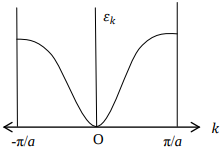
The energy, \(\varepsilon_k\) for band electrons as a function of the wave vector, \(k\) in the first Brillouin zone (\(-\pi/a\leq k\leq \pi/a\)) of a one dimensional monatomic lattice is shown as (\(a\) is lattice constant)

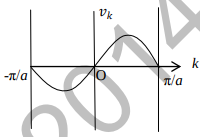
The variation of the group velocity \(v_k\) is most appropriately represented by




Check Answer
Option B
Q.No:8 GATE-2014
The donor concentration in a sample of \(n\)-type silicon is increased by a factor of \(100\). The shift in the position of the Fermi level at \(300 K\), assuming the sample to be non degenerate is ___________meV. (\(k_B T=25 meV\) at \(300 K\))
Check Answer
Ans 114-117
Q.No:9 GATE-2015
In a Hall effect experiment, the Hall voltage for an intrinsic semiconductor is negative. This is because (symbols carry usual meaning)
(A)
\(n\approx p\)
(B)
\(n>p\)
(C)
\(\mu_e>\mu_h\)
(D)
\(m_e^*>m_h^*\)
Check Answer
Option C
Q.No:10 GATE-2015
The binding energy per molecule of \({Na Cl}\) (lattice parameter is \(0.563 nm\)) is \(7.95 eV\). The repulsive term of the potential is of the form \(\frac{K}{r^9}\), where \(K\) is a constant. The value of the Madelung constant is _________ (upto three decimal places) (Electron charge \(e=-1.6\times 10^{-19} C; \varepsilon_0=8.854\times 10^{-12} C^2 N^{-1} m^{-2}\))
Check Answer
Ans 1.745-1.751
Q.No:11 GATE-2015
The band gap of an intrinsic semiconductor is \(E_g=0.72 eV\) and \(m_h^*=6m_e^*\). At \(300 K\), the Fermi level with respect to the edge of the valence band (in eV) is at _________ (upto three decimal places) \(k_B=1.38\times 10^{-23} JK^{-1}\)
Check Answer
Ans 0.394-0.395
Q.No:12 GATE-2016
The number density of electrons in the conduction band of a semiconductor at a given temperature is \(2\times 10^{19} m^{-3}\). Upon lightly doping this semiconductor with donor impurities, the number density of conduction electrons at the same temperature becomes \(4\times 10^{20} m^{-3}\). The ratio of majority to minority charge carrier concentration is _________.
Check Answer
Ans 400
Q.No:13 GATE-2016
The energy vs. wave vector \((E-k)\) relationship near the bottom of a band for a solid can be approximated as \(E=A(ka)^2+B(ka)^4\), where the lattice constant \(a=2.1\) Angstrom. The values of \(A\) and \(B\) are \(6.3\times 10^{-19} J\) and \(3.2\times 10^{-20} J\), respectively. At the bottom of the conduction band, the ratio of the effective mass of the electron to the mass of free electron is ___________. (Give your answer upto two decimal places) (Take \(\hbar=1.05\times 10^{-34} J-s, \text{mass of free electron}=9.1\times 10^{-31} kg\))
Check Answer
Ans 0.20-0.24
Q.No:14 GATE-2017
The atomic mass and mass density of Sodium are \(23\) and \(0.968 g cm^{-3}\), respectively. The number density of valence electrons is __________ \(\times 10^{22} cm^{-3}\). (Up to two decimal places.) (Avogadro number, \(N_A=6.022\times 10^{23}\)).
Check Answer
Ans 2.50-2.55
Q.No:15 GATE-2017
Consider a one-dimensional lattice with a weak periodic potential \(U(x)=U_0\cos{\left(\frac{2\pi x}{a}\right)}\). The gap at the edge of the Brillouin zone \(\left(k=\frac{\pi}{a}\right)\) is:
(A)
\(U_0\)
(B)
\(\frac{U_0}{2}\)
(C)
\(2U_0\)
(D)
\(\frac{U_0}{4}\)
Check Answer
Option A
Q.No:16 GATE-2018
The energy dispersion for electrons in one dimensional lattice with lattice parameter \(a\) is given by \(E(k)=E_0-\frac{1}{2}W\cos{ka}\), where \(W\) and \(E_0\) are constants. The effective mass of the electron near the bottom of the band is
(A)
\(\frac{2\hbar^2}{Wa^2}\)
(B)
\(\frac{\hbar^2}{Wa^2}\)
(C)
\(\frac{\hbar^2}{2Wa^2}\)
(D)
\(\frac{\hbar^2}{4Wa^2}\)
Check Answer
Option A
Q.No:17 GATE-2018
A \(p\)-doped semiconductor slab carries a current \(I=100 mA\) in a magnetic field \(B=0.2 T\) as shown. One measures \(V_y=0.25 mV\) and \(V_x=2 mV\). The mobility of holes in the semiconductor is __________ \(m^2 V^{-1} s^{-1}\) (up to two decimal places).


Check Answer
Ans 1.55-1.58
Q.No:18 GATE-2019
A particle of mass \(m\) moves in a lattice along the \(x\)-axis in a periodic potential \(V(x)=V(x+d)\) with periodicity \(d\). The corresponding Brillouin zone extends from \(-k_0\) to \(k_0\) with these two \(k\)-points being equivalent. If a weak force \(F\) in the \(x\)-direction is applied to the particle, it starts a periodic motion with time period \(T\). Using the equation of motion \(F=\frac{dp_{\text{crystal}}}{dt}\) for a particle moving in a band, where \(p_{\text{crystal}}\) is the crystal momentum of the particle, the period \(T\) is found to be (\(h\) is Planck constant)
(A)
\(\sqrt{\frac{2md}{F}}\)
(B)
\(2\sqrt{\frac{2md}{F}}\)
(C)
\(\frac{2h}{Fd}\)
(D)
\(\frac{h}{Fd}\)
Check Answer
Option D
Q.No:19 GATE-2019
In a certain two-dimensional lattice, the energy dispersion of the electrons is
\[
\varepsilon(\vec{k})=-2t\left[\cos{k_x a}+2\cos{\frac{1}{2}k_x a}\cos{\frac{\sqrt{3}}{2}k_y a}\right]
\]
where \(\vec{k}=(k_x, k_y)\) denotes the wave vector, \(a\) is the lattice constant and \(t\) is a constant in units of eV. In this lattice the effective mass tensor \(m_{ij}\) of electrons calculated at the center of the Brillouin zone has the form \(m_{ij}=\frac{\hbar^2}{ta^2}\begin{pmatrix}\alpha&0\\0&\alpha\end{pmatrix}\). The value of \(\alpha\) (rounded off to three decimal places) is _________
Check Answer
Ans 0.333
Q.No:20 GATE-2020
Consider a one-dimensional non-magnetic crystal with one atom per unit cell. Assume that the valence electrons
(i) do not interact with each other and
(ii) interact weakly with the ions.
If \(n\) is the number of valence electrons per unit cell, then at \(0 K\),
(A)
the crystal is metallic for any value of \(n\)
(B)
the crystal is non-metallic for any value of \(n\)
(C)
the crystal is metallic for even values of \(n\)
(D)
the crystal is metallic for odd values of \(n\)
Check Answer
Option D
Q.No:21 GATE-2021
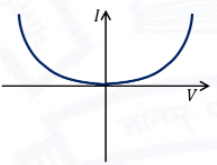
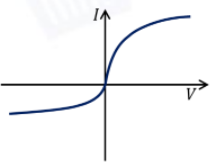
As shown in the figure, two metal-semiconductor junctions are formed between an n-type semiconductor \(S\) and metal \(M\). The work functions of \(S\) and \(M\) are \(\varphi_S\) and \(\varphi_M\), respectively with \(\varphi_M>\varphi_S\).

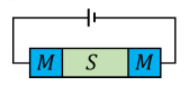
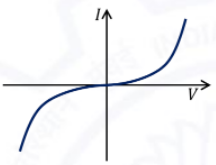
The \(I\)-\(V\) characteristics (on linear scale) of the junctions is best represented by




Check Answer
Option A
Q.No:22 GATE-2021
Choose the correct statement from the following.
(A)
Silicon is a direct band gap semiconductor.
(B)
Conductivity of metals decreases with increase in temperature.
(C)
Conductivity of semiconductors decreases with increase in temperature.
(D)
Gallium Arsenide is an indirect band gap semiconductor.
Check Answer
Option B
Q.No:23 GATE-2021
The donor concentration in a sample of n-type silicon is increased by a factor of \(100\). Assuming the sample to be non-degenerate, the shift in the Fermi level (in meV) at \(300 K\) (rounded off to the nearest integer) is ___________.
\(({\it Given:}\) \(k_B T=25 meV\) at \(300 K\))
Check Answer
Ans 115-116
Q.No:24 GATE-2021
In a semiconductor, the ratio of the effective mass of hole to electron is \(2:11\) and the ratio of average relaxation time for hole to electron is \(1:2\). The ratio of the mobility of the hole to electron is
(A)
\(4:9\)
(B)
\(4:11\)
(C)
\(9:4\)
(D)
\(11:4\)
Check Answer
Option D
Q.No:25 GATE-2022
In a Hall effect experiment on an intrinsic semiconductor, which of the following statements are correct?
(A)
Hall voltage is always zero
(B)
Hall voltage is negative if the effective mass of holes is larger than those of electrons
(C)
Hall coefficient can be used to estimate the carrier concentration in the semiconductor
(D)
Hall voltage depends on the mobility of the carriers
Check Answer
Option D
Q.No:26 GATE-2022
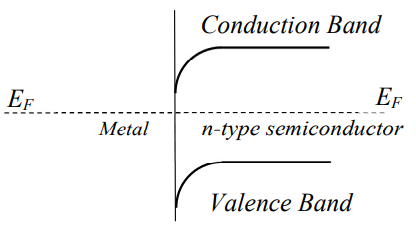
A junction is formed between a metal on the left and an \(n\)-type semiconductor on the right. Before forming the junction, the Fermi level \(E_F\) of the metal lies below that of the semiconductor. Then which of the following schematics are correct for the bands and the \(I\)-\(V\) characteristics of the junction?




Check Answer
Option A,C
Q.No:27 GATE-2023
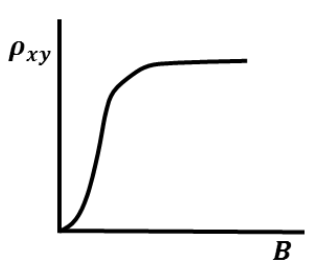
The Hall experiment is carried out with a non-magnetic semiconductor. The
current I is along the x-axis and the magnetic field B is along the z-axis. Which
one of the following is the CORRECT representation of the variation of the magnitude of the Hall resistivity \(\rho_{xy}\) as a function of the magnetic field?


Check Answer
Option B
Q.No:28 GATE-2023
A compound consists of three ions \(X, Y\) and \(Z\). The \(Z\) ions are arranged in an FCC arrangement. The \(X\) ions occupy \(\frac{1}{6}\) of the tetrahedral voids and the \(Y\) ions occupy \(\frac{1}{3}\) of the octahedral voids. Which one of the following is the CORRECT chemical formula of the compound?
(A)
\(XY_2Z_4\)
(B)
\(XYZ_3\)
(C)
\(XYZ_2\)
(D)
\(XYZ_4\)
Check Answer
Option B
Q.No:29 GATE-2023
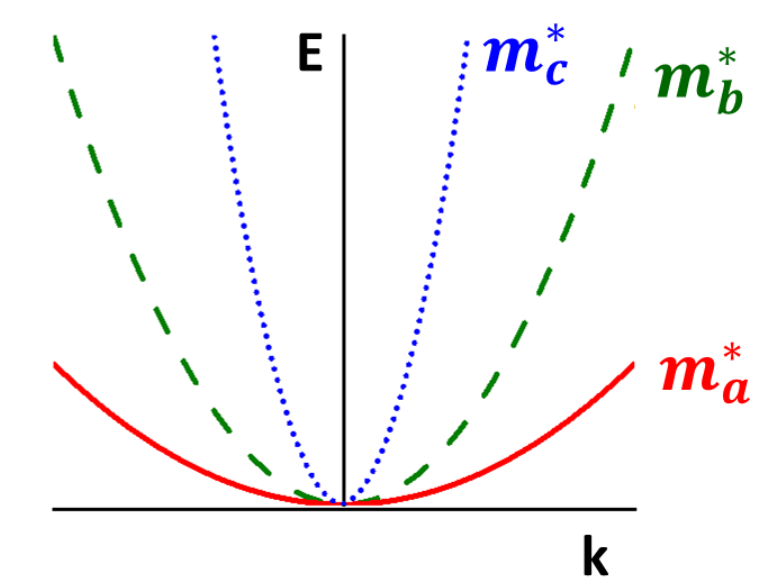
For nonrelativistic electrons in a solid, different energy dispersion relations (with effective masses \(m_a ^*, m_b ^*\) and \(m_c ^*\)) are schematically shown in the plots. Which one of the following options is \textbf{CORRECT}?

(A)
\(m_a ^*=m_b ^*=m_c ^*\)
(B)
\(m_b ^*>m_c ^*>m_a ^*\)
(C)
\(m_c ^*>m_b ^*>m_a ^*\)
(D)
\(m_a ^*>m_b ^*>m_c ^*\)
Check Answer
Option D
Q.No:30 GATE-2023
Graphene is a two dimensional material, in which carbon atoms are arranged in a honeycomb lattice with lattice constant \(a\). As shown in the figure, \(\vec{a}_1\) and \(\vec{a}_2\) are two lattice vectors. Which one of the following is the area of the first Brillouin
zone for this lattice?


(A)
\(\frac{8\pi^2}{3\sqrt{3} a^2}\)
(B)
\(\frac{4\pi^2}{3\sqrt{3} a^2}\)
(C)
\(\frac{8\pi^2}{\sqrt{3} a^2}\)
(D)
\(\frac{4\pi^2}{\sqrt{3} a^2}\)
Check Answer
Option A
Q.No:31 GATE-2023
A neutron beam with a wave vector \(\vec{k}\) and an energy 20.4 meV diffracts from a crystal with an outgoing wave vector \(\vec{k} '\). One of the diffraction peaks is observed for the reciprocal lattice vector \(\vec{G}\) of magnitude 3.14 Angstrom\(^{-1}\). What is the diffraction
angle in degrees (rounded off to the nearest integer) that \(\vec{k}\) makes with the plane? (Use mass of neutron = \(1.67 \times 10^{-27}\) Kg)
(A)
15
(B)
30
(C)
45
(D)
60
Check Answer
Option B
Q.No:32 GATE-2023
In the first Brillouin zone of a rectangular lattice (lattice constants \(a= 6 \hspace{1mm} \text{Angstrom}\) and \(b= 4 \hspace{1mm} \text{Angstrom}\)), three incoming phonons with the same wave vector \(\langle 1.2 \hspace{1mm} \text{Angstrom}^{-1} , 0.6 \hspace{1mm} \text{Angstrom}^{-1}\rangle\) interact to give one phonon. Which one of the following is the CORRECT wave vector of the resulting phonon?
(A)
\(\langle 2.56 \hspace{1mm} \text{Angstrom}^{-1} , 0.23 \hspace{1mm} \text{Angstrom}^{-1}\rangle\)
(B)
\(\langle 3.60 \hspace{1mm} \text{Angstrom}^{-1} , 1.80 \hspace{1mm} \text{Angstrom}^{-1}\rangle\)
(C)
\(\langle 0.48 \hspace{1mm} \text{Angstrom}^{-1} , 0.23 \hspace{1mm} \text{Angstrom}^{-1}\rangle\)
(D)
\(\langle 3.60 \hspace{1mm} \text{Angstrom}^{-1} , -0.80 \hspace{1mm} \text{Angstrom}^{-1}\rangle\)
Check Answer
Option C
Q.No:33 GATE-2023
For a covalently bonded solid consisting of ions of mass \(m\), the binding potential can be assumed to be given by
\[U(r)=-\epsilon (\frac{r}{r_0}) e^{-\frac{r}{r_0}}\]
where \(\epsilon\) and \(r_0\) are positive constants. What is the Einstein frequency of the solid in Hz ?
(A)
\(\frac{1}{2\pi} \sqrt{\frac{\epsilon e}{mr_0 ^2}}\)
(B)
\(\frac{1}{2\pi} \sqrt{\frac{\epsilon }{mer_0 ^2}}\)
(C)
\(\frac{1}{2\pi} \sqrt{\frac{2\epsilon }{mer_0 ^2}}\)
(D)
\(\frac{1}{2\pi} \sqrt{\frac{\epsilon e}{2mr_0 ^2}}\)
Check Answer
Option B
Q.No:34 GATE-2024
The temperature dependence of the electrical conductivity (\( \sigma \)) of three intrinsic semiconductors A, B and C is shown in figure.

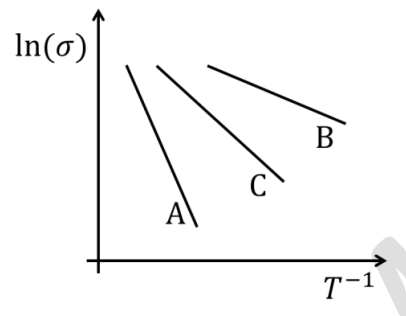
Let \( E_A \), \( E_B \) and \( E_C \) be the bandgaps of A, B and C, respectively. Which one of the following relations is correct?
(A) \( E_C > E_A > E_B \)
(B) \( E_B > E_C > E_A \)
(C) \( E_A > E_B > E_C \)
(D) \( E_A > E_C > E_B \)
Check Answer
Option D
Q.No:35 GATE-2024
An extrinsic semiconductor shown in figure carries a current of \(2 \text{ mA}\) along its length parallel to \(+x\) axis.

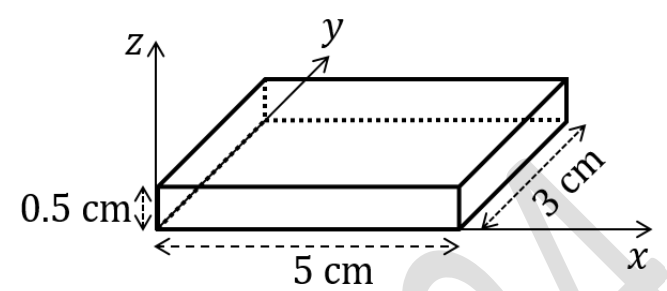
When the majority charge carrier concentration is \( 12.5 \times 10^{13} \text{ cm}^{-3} \) and the sample is exposed to a constant magnetic field applied along the \( +z \) direction, a Hall voltage of \( 20 \text{ mV} \) is measured with the negative polarity at \( y = 0 \) plane. Take the electric charge as \( 1.6 \times 10^{-19} \text{ C} \). The concentration of minority charge carrier is negligible. Which of the following statement is/are true?
(A) The majority charge carrier is electron
(B) The magnitude of the applied magnetic field is \(1 \text{ Tesla}\)
(C) The electric field corresponding to the Hall voltage is in the \(+y\) direction
(D) The magnitude of Hall coefficient is \(50,000 \text{ m}^3 \text{C}^{-1}\)
Check Answer
Option A
Q.No:36 GATE-2025
As per the Drude model of metals, the electrical resistance of a metallic wire of
length \(L\) and cross-sectional area \(A\) is
(Consider \(\tau\) as the relaxation time, \(m\) as the electron mass,
\(n\) as the carrier concentration and \(e\) as the electronic charge.)
A) \(\frac{mL}{n e^{2} A \tau}\)
B) \(\frac{2mL}{n e^{2} A \tau}\)
C) \(\frac{mL}{2 n e^{2} A \tau}\)
D) \(\frac{mL}{4 n e^{2} A \tau}\)
Check Answer
Option A
Q.No:37 GATE-2025
Consider one mole of a monovalent metal at absolute zero temperature, obeying the
free electron model. Its Fermi energy is \(E_F\).
The energy corresponding to the filling of \(\frac{N_A}{2}\) electrons, where
\(N_A\) is the Avogadro number, is \(2^{\,n} E_F\).
The value of \(n\) is
A) \(-\frac{2}{3}\)
B) \(+\frac{2}{3}\)
C) \(-\frac{1}{3}\)
D) \(-1\)
Check Answer
Option A
Q.No:38 GATE-2026
For the energy dispersion of an electron in a one-dimensional solid
\(
E(k)=E_0-2\gamma\cos(ka),
\)
the ratio of the effective mass of the electron in the solid to the free electron mass \((m_e)\) at \(k=0\) is \(R_0\). Taking
\(
\gamma = 0.5\ \text{eV}
\quad \text{and} \quad
a = 0.5\ \text{nm},
\)
the value of \(R_0\) (rounded off to two decimal places) is \(\_\_\_\_\_\).
\((
\hbar = 1.054 \times 10^{-34}\ \text{J.s},
m_e = 9.1 \times 10^{-31}\ \text{kg},\)
\(\text{electron charge} = 1.6 \times 10^{-19}\ \text{C})\)
Check Answer
Ans 0.30-0.32
Q.No:39 GATE-2026
The dispersion \((E(k))\) of the conduction band (CB) and valence band (VB) for a semiconductor are shown schematically in the figure. Considering the possibility of an electron making a transition from the bottom of the CB to the top of the VB, which of the following options is/are correct?

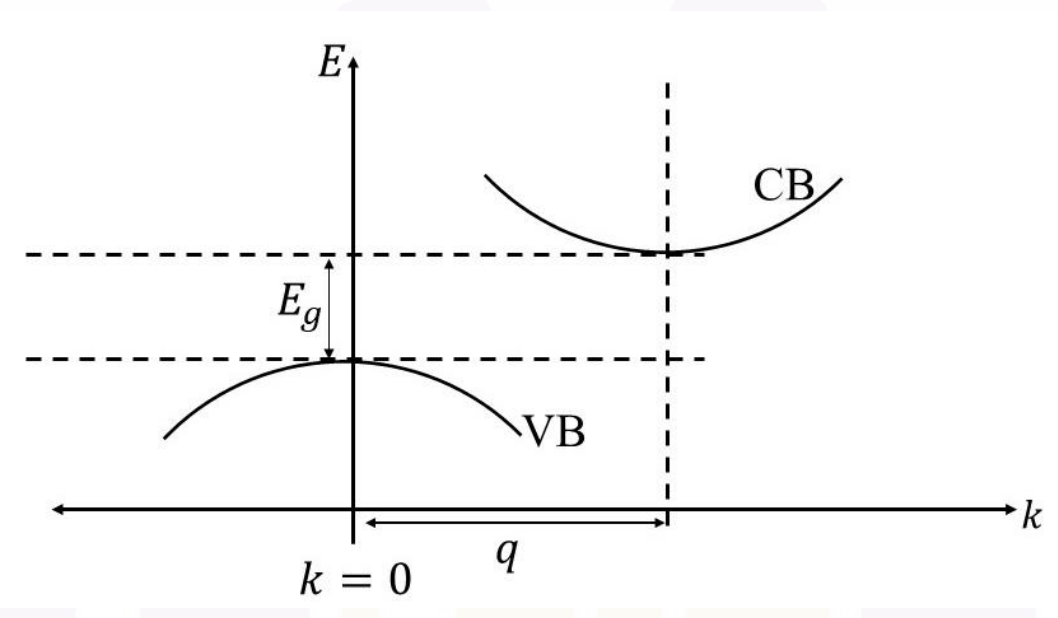
A) The transition is forbidden.
B) A photon can be emitted with an energy exactly equal to \(E_g\).
C) A photon can be emitted with an energy less than \(E_g\).
D) A phonon can be created with a crystal momentum \(\hbar q\).