

CAUTION : Try solving the problem yourself for at least 5–10 minutes before clicking the AI Assistant. In the exam hall, you will be on your own.
Q.No:1 CSIR Dec-2015
A particle moves in three-dimensional space in a central potential \(V(r)=kr^4\), where \(k\) is a constant. The angular frequency \(\omega\) for a circular orbit depends on its radius \(R\) as
(1)
\(\omega \propto R\)
(2)
\(\omega \propto R^{-1}\)
(3)
\(\omega \propto R^{1/4}\)
(4)
\(\omega \propto R^{-2/3}\)
Check Answer
Option 1
Q.No:2 CSIR Dec-2016
Consider circular orbits in a central force potential \(V(r)=-\frac{k}{r^n}\), where \(k> 0\) and \(0< n< 2\). If the time period of a circular orbit of radius \(R\) is \(T_1\) and that of radius \(2R\) is \(T_2\), then \(T_2/T_1\) is
(1)
\(2^{\frac{n}{2}}\)
(2)
\(2^{\frac{2}{3}n}\)
(3)
\(2^{\frac{n}{2}+1}\)
(4)
\(2^n\)
Check Answer
Option 3
Q.No:3 CSIR Dec-2017
Consider a set of particles which interact by a pair potential \(V=ar^6\), where \(r\) is the inter-particle separation and \(a>0\) is a constant. If a system of such particles has reached virial equilibrium, the ratio of the kinetic to the total energy of the system is
(1)
\(1/2\)
(2)
\(1/3\)
(3)
\(3/4\)
(4)
\(2/3\)
Check Answer
Option 3
Q.No:4 CSIR June-2018
Which of the following figures best describes the trajectory of a particle moving in a repulsive central potential \(V(r)=a/r\) (\(a> 0\) is a constant)?


Check Answer
Option 3
Q.No:5 CSIR June-2018
A particle of mass \(m\) moves in a central potential \(V(r)=-\frac{k}{r}\) in an elliptic orbit \(r(\theta)=\frac{a(1-e^2)}{1+e\cos{\theta}}\), where \(0\leq \theta< 2\pi\) and \(a\) and \(e\) denote the semi-major axis and eccentricity, respectively. If its total energy is \(E=-\frac{k}{2a}\), the maximum kinetic energy is
(1)
\(E(1-e^2)\)
(2)
\(E\frac{(e+1)}{(e-1)}\)
(3)
\(E/(1-e^2)\)
(4)
\(E\frac{(1-e)}{(1+e)}\)
Check Answer
Option 2
Q.No:6 CSIR Dec-2018
In the attractive Kepler problem described by the central potential \(V(r)=-k/r\) (where \(k\) is a positive constant), a particle of mass \(m\) with a non-zero angular momentum can never reach the centre due to the centrifugal barrier. If we modify the potential to
\[
V(r)=-\frac{k}{r}-\frac{\beta}{r^3}
\]
one finds that there is a critical value of the angular momentum \(\ell_c\) below which there is no centrifugal barrier. This value of \(\ell_c\) is
(1)
\([12km^2 \beta]^{1/2}\)
(2)
\([12km^2 \beta]^{-1/2}\)
(3)
\([12km^2 \beta]^{1/4}\)
(4)
\([12km^2 \beta]^{-1/4}\)
Check Answer
Option 3
Q.No:7 CSIR June-2019
Assume that the earth revolves in a circular orbit around the sun. Suppose the gravitational constant \(G\) varies slowly as a function of time. In particular, it decreases to half its initial value in the course of one million years. Then during this time the
(1)
radius of the earth's orbit will increase by a factor of two
(2)
total energy of the earth remains constant
(3)
orbital angular momentum of the earth will increase
(4)
radius of the earth's orbit remains the same
Check Answer
Option 1
Q.No:8 CSIR Feb-2022
A particle, thrown with a speed \(v\) from the earth's surface, attains a maximum height \(h\)
(measured from the surface of the earth). If \(v\) is half the escape velocity and \(R\) denotes the
radius of earth, then \(h/R\) is
(1)
\(2/3\)
(2)
\(1/3\)
(3)
\(1/4\)
(4)
\(1/2\)
Check Answer
Option 2
Q.No:9 CSIR Feb-2022
A particle in two dimensions is found to trace an orbit \(r(\theta)=r_0\theta^2\) . If it is moving under
the influence of a central potential \(V(r)=c_1r^{-a}+c_2r^{-b}\), where \(r_0\) , \(c_1\) and \(c_2\) are constants of
appropriate dimensions, the values of \(a\) and \(b\) , respectively, are
(1)
\(2\) and \(4\)
(2)
\(2\) and \(3\)
(3)
\(3\) and \(4\)
(4)
\(1\) and \(3\)
Check Answer
Option 2
Q.No:10 CSIR Feb-2022
A satellite of mass \(m\) orbits around earth in an elliptic trajectory of semi-major axis \(a\) . At
a radial distance \(r=r_0\) , measured from the centre of the earth, the kinetic energy is equal to half
the magnitude of the total energy. If \(M\) denotes the mass of the earth and the total energy is \(-\frac{GMm}{2a}\), the value of \(r_0/a\) is nearest to
(1)
\(1.33\)
(2)
\(1.48\)
(3)
\(1.25\)
(4)
\(1.67\)
Check Answer
Option 1
Q.No:11 CSIR Dec-2023
A particle moves in a circular orbit under a force field given by \( \vec{F}(\vec{r}) = -\frac{k}{r^2} \hat{r} \), where \( k \) is a positive constant. If the force changes suddenly to
\[
\vec{F}(\vec{r}) = -\frac{k}{2r^2} \hat{r},
\]
the shape of the new orbit would be
(a) parabolic
(b) circular
(c) elliptical
(d) hyperbolic
Check Answer
Option a
Q.No:12 CSIR Dec-2023
A particle of mass \( m \) is moving in a 3-dimensional potential
\[
\Phi(r) = -\frac{k}{r} - \frac{k'}{3r^3}, \quad k, k' > 0.
\]
For the particle with angular momentum \( l \), the necessary condition to have a stable circular orbit is
1) \( kk' < \frac{l^4}{4m^2} \)
2) \( kk' > \frac{l^4}{4m^2} \)
3) \( kk' < \frac{l^4}{m^2} \)
4) \( kk' > \frac{l^4}{m^2} \)
Check Answer
Option a
Q.No:13 CSIR Dec-2023
A particle of mass \( m \) is moving in a stable circular orbit of radius \( r_0 \) with angular momentum \( L \). For a potential energy \( V(r) = \beta r^k \) (\( \beta > 0 \) and \( k > 0 \)), which of the following options is correct?
1) \( k = 3 \), \( r_0 = \left(\frac{3L^2}{5m\beta}\right)^{1/5} \)
2) \( k = 2 \), \( r_0 = \left(\frac{L^2}{2m\beta}\right)^{1/4} \)
3) \( k = 2 \), \( r_0 = \left(\frac{L^2}{4m\beta}\right)^{1/4} \)
4) \( k = 3 \), \( r_0 = \left(\frac{5L^2}{3m\beta}\right)^{1/5} \)
Check Answer
Option 2
Q.No:14 CSIR June-2023
The minor axis of Earth's elliptical orbit divides the area within it into two halves. The eccentricity of the orbit is \(0.0167\). The difference in time spent by Earth in the two halves is closest to
1) \(3.9\) days
2) \(4.8\) days
3) \(12.3\) days
4) \(0\) days
Check Answer
Option 1
Q.No:15 CSIR June-2024
A particle of mass \(m\) is moving in a potential \(V(r) = -\frac{k}{r}\), where \(k\) is a positive constant. If \(\vec{L}\) and \(\vec{p}\) denote the angular momentum and linear momentum respectively, the value of \(\alpha\) for which \(\vec{A} = \vec{L} \times \vec{p} + \alpha m k \hat{r}\) is a constant of motion, is
1) \(-2\)
2) \(-1\)
3) \(2\)
4) \(1\)
Check Answer
Option 4
Q.No:16 CSIR June-2024
A body of mass \(m\) is acted upon by a central force \(\vec{f}(\vec{r}) = -k \vec{r}\), where \(k\) is a positive constant. If the magnitude of the angular momentum is \(l\), then the total energy for a circular orbit is
1) \(2 \sqrt{\frac{k l^2}{m}}\)
2) \(\frac{1}{2} \sqrt{\frac{k l^2}{m}}\)
3) \(\frac{3}{2} \sqrt{\frac{k l^2}{m}}\)
4) \(\sqrt{\frac{k l^2}{m}}\)
Check Answer
Option 4
Q.No:17 CSIR June-2025
Consider the Earth to be a free rigid body symmetric about its north–south (\(z\)) axis.
If the principal moments of inertia satisfy \(I_z = 1.003\, I_x\), then the angular
velocity (in the body-fixed frame) precesses about the \(z\)-axis.
The period of this precession is nearly:
1) 167 days
2) 333 days
3) 556 days
4) 667 days
Check Answer
Option 2
Q.No:1 GATE-2012
In a central force field, the trajectory of a particle of mass \(m\) and angular momentum \(L\) in plane polar coordinates is given by,
\[
\frac{1}{r}=\frac{m}{L^2}(1+\varepsilon\cos{\theta})
\]
where, \(\varepsilon\) is the eccentricity of the particle's motion. Which one of the following choices for \(\varepsilon\) gives rise to a parabolic trajectory?
(A)
\(\varepsilon=0\)
(B)
\(\varepsilon=1\)
(C)
\(0<\varepsilon<1\)
(D)
\(\varepsilon>1\)
Check Answer
Option B
Q.No:2 GATE-2014
A planet of mass \(m\) moves in a circular orbit of radius \(r_0\) in the gravitational potential \(V(r)=-\frac{k}{r}\), where \(k\) is a positive constant. The orbital angular momentum of the planet is
(A)
\(2r_0 km\)
(B)
\(\sqrt{2r_0 km}\)
(C)
\(r_0 km\)
(D)
\(\sqrt{r_0 km}\)
Check Answer
Option D
Q.No:3 GATE-2015
A satellite is moving in a circular orbit around the Earth. If \(T, V\) and \(E\) are its average kinetic, average potential and total energies, respectively, then which one of the following options is correct?
(A)
\(V=-2T; E=-T\)
(B)
\(V=-T; E=0\)
(C)
\(V=-T/2; E=T/2\)
(D)
\(V=-3T/2; E=-T/2\)
Check Answer
Option A
Q.No:4 GATE-2015
Consider the motion of the Sun with respect to the rotation of the Earth about its axis. If \(\vec{F}_c\) and \(\vec{F}_{C_0}\) denote the centrifugal and the Coriolis forces, respectively, acting on the Sun, then
(A)
\(\vec{F}_c\) is radially outward and \(\vec{F}_{C_0}=\vec{F}_c\)
(B)
\(\vec{F}_c\) is radially inward and \(\vec{F}_{C_0}=-2\vec{F}_c\)
(C)
\(\vec{F}_c\) is radially outward and \(\vec{F}_{C_0}=-2\vec{F}_c\)
(D)
\(\vec{F}_c\) is radially outward and \(\vec{F}_{C_0}=2\vec{F}_c\)
Check Answer
Option C
Q.No:5 GATE-2016
A particle moving under the influence of a central force \(\vec{F}(\vec{r})=-k\vec{r}\) (where \(\vec{r}\) is the position vector of the particle and \(k\) is a positive constant) has non-zero angular momentum. Which of the following curves is a possible orbit for this particle?
(A)
A straight line segment passing through the origin.
(B)
An ellipse with its center at the origin.
(C)
An ellipse with one of the foci at the origin.
(D)
A parabola with its vertex at the origin.
Check Answer
Option B
Q.No:6 GATE-2018
An interstellar object has speed \(v\) at the point of its shortest distance \(R\) from a star of much larger mass \(M\). Given \(v^2=2 GM/R\), the trajectory of the object is
(A)
circle
(B)
ellipse
(C)
parabola
(D)
hyperbola
Check Answer
Option C
Q.No:7 GATE-2020
A particle is moving in a central force field given by \(\vec{F}=-\frac{k}{r^3}\hat{r}\), where \(\hat{r}\) is the unit vector pointing away from the center of the field. The potential energy of the particle is given by
(A)
\(\frac{k}{r^2}\)
(B)
\(\frac{k}{2r^2}\)
(C)
\(-\frac{k}{r^2}\)
(D)
\(-\frac{k}{2r^2}\)
Check Answer
Option D
Q.No:8 GATE-2021
Consider a spherical galaxy of total mass \(M\) and radius \(R\), having a uniform matter distribution. In this idealized situation, the orbital speed \(v\) of a star of mas \(m\) (\(m\ll M\)) as a function of the distance \(r\) from the galactic centre is best described by
{\it \(G\) is the universal gravitational constant}


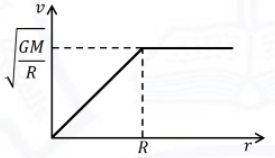


Check Answer
Option A
Q.No:9 GATE-2022
A particle of unit mass moves in a potential \(V(r)=-V_0 e^{-r^2}\). If the angular momentum of the particle is \(L=0.5 \sqrt{V_0}\), then which of the following statements are true?
A)
There are two equilibrium points along the radial coordinate
B)
There is one stable equilibrium point at \(r_1\) and one unstable equilibrium point at \(r_2>r_1\)
C)
There are two stable equilibrium points along the radial coordinate
D)
There is only one equilibrium point along the radial coordinate
Check Answer
Option A,B
Q.No:10 GATE-2026
An \(\alpha\) particle moves towards a fixed nucleus carrying charge \(Ze\), with initial speed \(v_0\) and impact parameter \(b\). Starting from a large distance from the nucleus, its distance of closest approach is \(r_m\) and its speed there is \(v_m\). Then which of the following options is/are correct?
\( \left(k = \frac{1}{4\pi\epsilon_0} \text{ and } r_0 = \frac{kZe^2}{mv_0^2}\right) \)
\( \left(k = \frac{1}{4\pi\epsilon_0} \text{ and } r_0 = \frac{kZe^2}{mv_0^2}\right) \)
A) \(v_0 b = v_m r_m\)
B) \(v_0 b = 2 v_m r_0\)
C) For \(\frac{b}{r_0} \ll 1\),\(r_m = 4r_0 + \frac{b^2}{2r_0}
\) ignoring higher order corrections in \(\frac{b}{r_0}\)
D) For \(\frac{b}{r_0} \ll 1\),\(r_m = 4r_0 + \frac{b^2}{8r_0}\) ignoring higher order corrections in \(\frac{b}{r_0}\)