CAUTION : Try solving the problem yourself for at least 5–10 minutes before clicking the AI Assistant. In the exam hall, you will be on your own.
Q.No:37 JAM-2019
A classical particle has total energy \(E\). The plot of potential energy (U) as a function of distance (r) from the centre of force located at \(r=0\) is shown in the figure. Which of the regions are forbidden for the particle?


(A)
\(I\) and \(II\)
(B)
\(II\) and \(IV\)
(C)
\(I\) and \(IV\)
(D)
\(I\) and \(III\)
Check Answer
Option D
Q.No:38 JAM-2019
The mass per unit length of a rod (length 2 m) varies as \(\rho=3x\) kg/m. The moment of inertia (in kg \(m^2\)) of the rod about a perpendicular-axis passing through the tip of the rod (at \(x = 0\))
(A)
10
(B)
12
(C)
14
(D)
16
Check Answer
Option B
Q.No:39 JAM-2019
If the motion of a particle is described by \(x=5 \hspace{1mm} cos (8\pi t),y=5 \hspace{1mm} sin (8\pi t), z=5t\), then the
trajectory of the particle is
(A)
Circular
(B)
Elliptical
(C)
Helical
(D)
Spiral
Check Answer
Option C
Q.No:40 JAM-2019
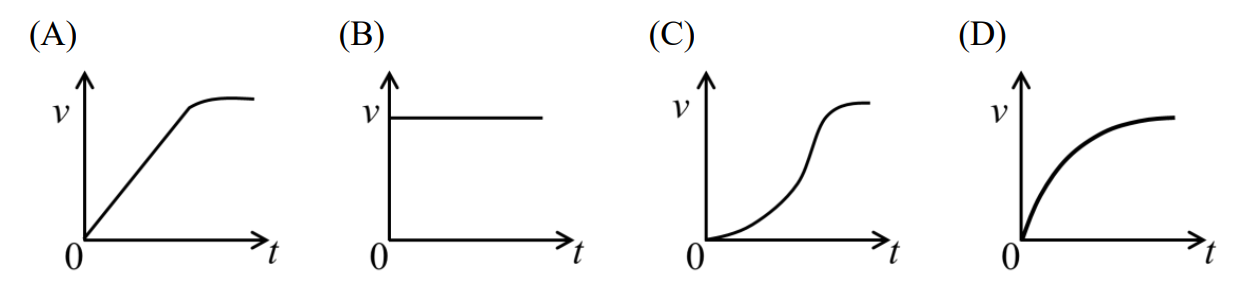
A ball of mass \(m\) is falling freely under gravity through a viscous medium in which the drag force is proportional to the instantaneous velocity \(v\) of the ball. Neglecting the buoyancy
force of the medium, which one of the following figures best describes the variation of \(v\) as a function of time t?

Check Answer
Option D
Q.No:41 JAM-2019
Consider an object moving with a velocity \(\vec{v}\) in a frame which rotates with a constant angular velocity \(\vec{\omega}\). The Coriolis force experienced by the object is
(A)
along \(\vec{v}\)
(B)
along \(\vec{\omega}\)
(C)
perpendicular to both \(\vec{v}\) and \(\vec{\omega}\)
(D)
always directed towards the axis of rotation
Check Answer
Option C
Q.No:42 JAM-2019
For an underdamped harmonic oscillator with velocity \(v(t)\),
(A)
Rate of energy dissipation varies linearly with \(v(t)\)
(B)
Rate of energy dissipation varies as square of \(v(t)\)
(C)
The reduction in the oscillator frequency, compared to the undamped case, is independent of \(v(t)\)
(D)
For weak damping, the amplitude decays exponentially to zero
Check Answer
Option B,C,D
Q.No:43 JAM-2019
Consider a classical particle subjected to an attractive inverse-square force field. The total energy of the particle is \(E\) and the eccentricity is \(\epsilon\). The particle will follow a parabolic orbit if
(A)
\(E>0\) and \(\epsilon =1\)
(B)
\(E<0\) and \(\epsilon <1\)
(C)
\(E=0\) and \(\epsilon =1\)
(D)
\(E<0\) and \(\epsilon =1\)
Check Answer
Option C
Q.No:44 JAM-2019
If the diameter of the Earth is increased by \(4\%\) without changing the mass, then the length of the day is _________ hours.
(Take the length of the day before the increment as 24 hours. Assume the Earth to be a sphere with uniform density.)
(Round off to 2 decimal places)
Check Answer
Ans 25.95-25.97
Q.No:45 JAM-2020
For a particle moving in a central potential, which one of the following statements is correct?
(A)
The motion is restricted to a plane due to the conservation of angular momentum.
(B)
The motion is restricted to a plane due to the conservation of energy only.
(C)
The motion is restricted to a plane due to the conservation of linear momentum.
(D)
The motion is not restricted to a plane.
Check Answer
Option A
Q.No:46 JAM-2020
A wheel is rotating at a frequency \(f_0\) Hz about a fixed vertical axis. The wheel stops in \(t_0\) seconds, with constant angular deceleration. The number of turns covered by the wheel before it comes to
rest is given by:
(A)
\(f_0 t_0\)
(B)
\(2f_0 t_0\)
(C)
\(f_0 t_0/2\)
(D)
\(f_0 t_0/\sqrt{2}\)
Check Answer
Option C
Q.No:47 JAM-2020
Two planets \(P_1\) and \(P_2\) having masses M1 and M2 revolve around the Sun in elliptical orbits, with time periods \(T_1\) and \(T_2\), respectively. The minimum and maximum distances of planet \(P_1\) from the Sun are \(R\) and \(3R\), respectively, whereas for planet \(P_2\) these are \(2R\) and \(4R\), respectively, where \(R\) is a constant. Assuming \(M_1\) and \(M_2\) are much smaller than the mass of the Sun, the magnitude of \(\frac{T_2}{T_1}\) is
(A)
\(\frac{2}{3}\sqrt{\frac{2M_1}{3M_2}}\)
(B)
\(\frac{3}{2}\sqrt{\frac{3M_2}{2M_1}}\)
(C)
\(\frac{3}{2}\sqrt{\frac{3}{2}}\)
(D)
\(\frac{2}{3}\sqrt{\frac{2}{3}}\)
Check Answer
Option C
Q.No:48 JAM-2020
A thin rod of uniform density and length \(2\sqrt{3}\) m is undergoing small oscillations about a pivot point. The time period of oscillation \((T_m)\) is minimum when the distance of the pivot point from the
center-of-mass of the rod is \(x_m\) Which of the following is/are correct?
(Assume acceleration due to gravity g= 10 m/\(s^2\))
(A)
\(x_m\)=1 m
(B)
\(x_m= \frac{\sqrt{3}}{2}\) m
(C)
\(T_m= \frac{2\pi}{\sqrt{3}}\) s
(D)
\(T_m= \frac{2\pi}{\sqrt{5}}\) s
Check Answer
Option A,D
Q.No:49 JAM-2020
An object executes simple harmonic motion along the x-direction with angular frequency \(\omega\) and
amplitude \(a\). The speed of the object is 4 cm/s and 2 cm/s, when it is at distances 2 cm and 6 cm, respectively from the equilibrium position. Which of the following is/are correct?
(A)
\(\omega=\sqrt{\frac{3}{8}}\) rad/s
(B)
\(\omega=\sqrt{\frac{5}{6}}\) rad/s
(C)
\(a=\sqrt{\frac{140}{3}}\) cm
(D)
\(a=\sqrt{\frac{175}{6}}\) cm
Check Answer
Option A,C
Q.No:51 JAM-2020
Water flows in a horizontal pipe in a streamlined manner at an absolute pressure of \(4\times 10^5\) Pa and speed of 6 m/s. If it exits the pipe at a pressure of \(10^5\) Pa, the speed of water at the exit point is ___________ m/s (Round off to 1 decimal place)
(The density of water is 1000 kg/\(m^3\) )
Check Answer
Ans 25.1-25.3
Q.No:52 JAM-2020
A vehicle of mass 600 kg with an engine operating at constant power P accelerates from rest on a straight horizontal road. The vehicle covers a distance of 600 m in 1 minute. Neglecting all losses, the magnitude of P is __________ kW. (Round off to 2 decimal places)
Check Answer
Ans 1.11-1.13
Q.No:53 JAM-2020
The angular momentum of a particle relative to origin varies with time \((t)\) as\(\vec{L}=(4\hat{x}+\alpha t^2 \hat{y}\) )kg\(m^2\)/s, where \(\alpha=1\) kg\(m^2/s^3\). The angle between \(\vec{L}\) and the torque acting on the particle becomes \(45^\circ\) after a time of __________________ s.
Check Answer
Ans 1.9-2.1
Q.No:54 JAM-2021
A planet is in a highly eccentric orbit about a star. The distance of its closest approach is 300 times smaller than its farthest distance from the star. If the corresponding speeds are \(v_c\) and \(v_f\), then \(\frac{v_c}{v_f}\) is
(A)
\(\frac{1}{300}\)
(B)
\(\frac{1}{\sqrt{300}}\)
(C)
\(\sqrt{300}\)
(D)
\(300\)
Check Answer
Option D
Q.No:55 JAM-2021
An object of density \(\rho\) is floating in a liquid with \(75\%\) of its volume submerged. The density of the liquid is
(A)
\(\frac{4}{3}\rho\)
(B)
\(\frac{3}{2}\rho\)
(C)
\(\frac{8}{5}\rho\)
(D)
\(2 \rho\)
Check Answer
Option A
Q.No:56 JAM-2021
The moment of inertia of a solid sphere (radius \(R\) and mass \(M\)) about the axis which is at a distance of \(\frac{R}{2}\) from the center is
(A)
\(\frac{3}{20} \hspace{1.5mm} MR^2\)
(B)
\(\frac{1}{2} \hspace{1.5mm} MR^2\)
(C)
\(\frac{13}{20} \hspace{1.5mm} MR^2\)
(D)
\(\frac{9}{10} \hspace{1.5mm} MR^2\)
Check Answer
Option C
Q.No:57 JAM-2021
A particle, initially at the origin in an inertial frame \(S\), has a constant velocity \(V \hat{i}\). Frame \(S'\) is rotating about the x-axis with angular velocity \(\omega\) (anticlockwise). The coordinate axes of \(S'\) coincide with those of \(S\) at \(t=0\). The velocity of the particle \((V_x' , V_y')\) in the \(S'\) frame, at \(t=\frac{\pi}{2\omega}\) is
(A)
\(-\frac{V \pi}{2} , -V\)
(B)
\(-V , -V\)
(C)
\(\frac{V \pi}{2} , -V\)
(D)
\(\frac{3V \pi}{2} , -V\)
Check Answer
Option A
Q.No:58 JAM-2021
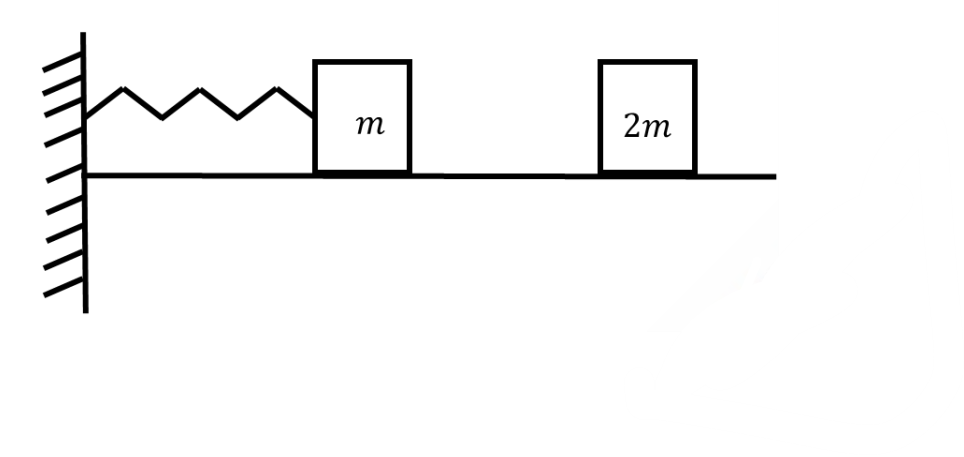
A mass \(m\) is connected to a massless spring of spring constant \(k\), which is fixed to a wall. Another mass \(2m\), having kinetic energy \(E\), collides collinearly with the mass m completely inelastically (see figure). The entire set up is placed on a frictionless floor. The maximum
compression of the spring is

(A)
\(\sqrt{\frac{4}{3}\frac{E}{k}}\)
(B)
\(\frac{E}{3k}\)
(C)
\(\frac{E}{5k}\)
(D)
\(\frac{E}{7k}\)
Check Answer
Option A
Q.No:59 JAM-2021
A thin circular disc lying in the xy-plane has a surface mass density \(\sigma\), given by
\[\sigma(r)=\left\{
\begin{array}{ll}
\sigma_0(1-\frac{r^2}{R^2}) & if\hspace{2mm} r\leq R \\
0 & if \hspace{2mm} r>R
\end{array}
\right.\]
where \(r\) is the distance from its center. Its moment of inertia about the z-axis, passing through its center is
(A)
\(\frac{\sigma_0 R^4}{4}\)
(B)
\(\frac{\pi \sigma_0 R^4}{6}\)
(C)
\(\sigma_0 R^4\)
(D)
\(2 \pi \sigma_0 R^4\)
Check Answer
Option B
Q.No:60 JAM-2021
The radial component of acceleration in plane polar coordinates is given by
(A)
\(\frac{d^2 r}{dt^2}\)
(B)
\(\frac{d^2 r}{dt^2}-r(\frac{d\theta}{dt})^2\)
(C)
\(\frac{d^2 r}{dt^2}+r(\frac{d\theta}{dt})^2\)
(D)
\(2\frac{dr}{dt}\frac{d\theta}{dt}+r\frac{d^2\theta}{dt^2}\)
Check Answer
Option B
Q.No:61 JAM-2021
A time independent conservative force \(\vec{F}\) has the form, \(\vec{F}=3y\hat{i} +f(x,y)\hat{j}\). Its magnitude at
\(x = y = 0\) is \(8\). The allowed form(s) of \(f(x,y)\) is(are)
(A)
\(3x+8\)
(B)
\(2x+8(y-1)^2\)
(C)
\(3x+8e^{-y^2}\)
(D)
\(2x+8 \hspace{1mm} cos \hspace{1mm} y\)
Check Answer
Option A,C
Q.No:62 JAM-2021
A particle with positive charge \(10^{-3}\) C and mass 0.2 kg is thrown upwards from the ground at an angle \(45^\circ\) with the horizontal with a speed of 5 m/s. The projectile moves through a horizontal electric field of 10 V/m, which is in the same direction as the horizontal
component of the initial velocity of the particle. The acceleration due to gravity is 10 \(\frac{m}{s^2}\). The range is ________________ m. (Round off to three decimal places).
Check Answer
Ans 2.510-2.515
Q.No:63 JAM-2021
A particle \(A\) of mass \(m\) is moving with a velocity \(v\hat{i}\), and collides elastically with a particle
\(B\), of mass \(2m\). \(B\) is initially at rest. After collision, \(A\) moves with a velocity \(v_A \hat{j}\). If \(v_B\) is the final speed of \(B\), then \(v_A ^2=kv_B ^2\). The value of \(k\) is _________________.
Check Answer
Ans 1
Q.No:64 JAM-2022
A particle of mass \(m\) and angular momentum \(L\) moves in space where its potential energy is
\(U(r)=kr^2\) (K>0)and \(r\) is the radial coordinate.
If the particle moves in a circular orbit, then the radius of the orbit is
(A)
\((\frac{L^2}{mk})^{\frac{1}{4}}\)
(B)
\((\frac{L^2}{2mk})^{\frac{1}{4}}\)
(C)
\((\frac{2L^2}{mk})^{\frac{1}{4}}\)
(D)
\((\frac{4L^2}{mk})^{\frac{1}{4}}\)
Check Answer
Option B
Q.No:65 JAM-2022
Consider a two-dimensional force field
\[\vec{F}(x,y)=(5x^2+ay^2+bxy)\hat{x}+(4x^2+4xy+y^2)\hat{y}.\]
If the force field is conservative, then the values of \(a\) and \(b\) are
(A)
\(a=2\) and \(b=4\)
(B)
\(a=2\) and \(b=8\)
(C)
\(a=4\) and \(b=2\)
(D)
\(a=8\) and \(b=2\)
Check Answer
Option B
Q.No:66 JAM-2022
Consider a particle of mass \(m\) moving in a plane with a constant radial speed \(\dot{r}\) and a constant angular speed \(\dot{\theta}\). The acceleration of the particle in \((r,\theta)\) coordinates is
(A)
\(2 r \dot{\theta}^2\hat{r}-\dot{r}\dot{\theta}\hat{\theta}\)
(B)
\(- r \dot{\theta}^2\hat{r}+2\dot{r}\dot{\theta}\hat{\theta}\)
(C)
\(\ddot{r}\hat{r}+r \ddot{\theta}\hat{\theta}\)
(D)
\(\dot{r} \theta \hat{r}r \dot{\theta}\hat{\theta}\)
Check Answer
Option B
Q.No:67 JAM-2022
A planet of mass \(m\) moves in an elliptical orbit. Its maximum and minimum distances from the Sun are \(R\) and \(r\), respectively. Let \(G\) denote the universal gravitational constant, and \(M\) the mass of the Sun. Assuming \(M\gg m\), the angular momentum of the planet with respect to the center of the Sun is
(A)
\(m\sqrt{\frac{2GMRr}{(R+r)}}\)
(B)
\(m\sqrt{\frac{GMRr}{2(R+r)}}\)
(C)
\(m\sqrt{\frac{GMRr}{(R+r)}}\)
(D)
\(2m\sqrt{\frac{2GMRr}{((R+r)}}\)
Check Answer
Option A
Q.No:68 JAM-2022
A square laminar sheet with side \(a\) and mass \(M\), has mass per unit area given by \(\sigma(x)=\sigma_0[1-\frac{x}{a}]\), (see figure). Moment of inertia of the sheet about y-axis is


(A)
\(\frac{Ma^2}{2}\)
(B)
\(\frac{Ma^2}{4}\)
(C)
\(\frac{Ma^2}{6}\)
(D)
\(\frac{Ma^2}{12}\)
Check Answer
Option C
Q.No:69 JAM-2022
A particle is subjected to two simple harmonic motions along the \(x\) and \(y\) axes, described by \(x(t)=a \hspace{1mm} sin \hspace{1mm} (2\omega t+ \pi)\) and \(y(t)=2a \hspace{1mm} sin \hspace{1mm} (\omega t)\). The resultant motion is given by
(A)
\(\frac{x^2}{a^2}+\frac{y^2}{4b^2}=1\)
(B)
\(x^2 + y^2 =1\)
(C)
\(y^2=x^2(1-\frac{x^2}{4a^2})\)
(D)
\(x^2=y^2(1-\frac{y^2}{4a^2})\)
Check Answer
Option D
Q.No:70 JAM-2022
A particle is executing simple harmonic motion with time period \(T\). Let \(x,v\) and \(a\) denote the displacement, velocity and acceleration of the particle, respectively, at time \(t\). Then,
(A)
\(\frac{aT}{x}\) does not change with time
(B)
\((aT + 2\pi v)\) does not change with time
(C)
\(x\) and \(v\) are related by an equation of a straight line
(D)
\(v\) and \(a\) are related by an equation of an ellipse
Check Answer
Option A,D
Q.No:71 JAM-2022
A string of length \(L\) is stretched between two points \(x=0\) and \(x=L\) and the endpoints are rigidly clamped. Which of the following can represent the displacement of the string from the equilibrium position?
(A)
\(x \hspace{1mm} cos(\frac{\pi x}{L})\)
(B)
\(x \hspace{1mm} sin(\frac{\pi x}{L})\)
(C)
\(x \hspace{1mm} (\frac{x}{L}-1)\)
(D)
\(x \hspace{1mm} (\frac{x}{L}-1)^2\)
Check Answer
Option B,C,D
Q.No:72 JAM-2022
A satellite is revolving around the Earth in a closed orbit. The height of the satellite above Earth’s surface at perigee and apogee are 2500 km and 4500 km, respectively. Consider the radius of the Earth to be 6500 km. The eccentricity of the satellite’s orbit is ___________________ (Round off to 1 decimal place).
Check Answer
Ans 0.1
Q.No:73 JAM-2022
Three masses \(m_1=1 , m_2=2\) and \(m_3=3\) are located on the x-axis such that their center of mass is at \(x=1\). Another mass \(m_4=4\) is placed at \(x_0\) and the new center of mass is at \(x=3\). The value of \(x_0\) is _________________.
Check Answer
Ans 6
Q.No:74 JAM-2022
A pipe of 1 m length is closed at one end. The air column in the pipe resonates at its fundamental frequency of 400 Hz. The number of nodes in the sound wave formed in the pipe is _____________________ .
[Speed of sound = 320 m/s]
Check Answer
Ans MTA
Q.No:75 JAM-2016
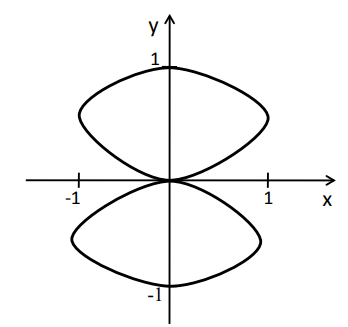
Two sinusoidal signals of frequencies \(\omega_x\) and \(\omega_y\) having same amplitude are applied to x- and y-channels of a cathode ray oscilloscope (CRO), respectively. The following stationary figure will be observed when

(A)
\(\omega_y=\omega_x\).
(B)
phase difference is 0.
(C)
\(\omega_y=2\omega_x\).
(D)
phase difference is \(\pi/2\).
Check Answer
Option B
Q.No:76 JAM-2017
In planar polar co-ordinates, an object’s position at time \(t\) is given as \((r,\theta)=(e^t m, \sqrt{8}t\)rad).The magnitude of its acceleration in \(m/s^2\) at \(t=0\) (to the nearest integer) is ________________________.
Check Answer
Ans 9
Q.No:77 JAM-2015
A uniform disk of mass m and radius R rolls, without slipping, down a fixed plane inclined at an
angle \(30^\circ\) to the horizontal. The linear acceleration of the disk (in m/\(sec^2\)) is ________________________.
Check Answer
Ans 3.25-3.35
Q.No:78 JAM-2017
To demonstrate Bernoulli’s principle, an instructor arranges two circular horizontal plates of radii b each with distance \(d(d\ll b)\) between them (see figure). The upper plate has
a hole of radius \(a\) in the middle. On blowing air at a speed \(v_0\) through the hole so that the flow rate of air is \(\pi a^2 v_0\). It is seen that the lower plate dos not fall. If the density of air is \(\rho\), the upward force on the lower plate is well approximated by the formula (assume that the region with \(r<a\) does not contribute to the upward force and the speed of air at the edges is negligible):


(A)
\(\frac{\pi \rho v_0^2 a^4}{4d^2}ln(\frac{b}{a})\)
(B)
\(\frac{\pi \rho v_0^2 a^2 b^2}{4d^2}ln(\frac{b}{a})\)
(C)
\(\frac{\pi \rho v_0^2 d^4}{2a b}ln(\frac{b}{a})\)
(D)
\(\frac{2\pi \rho v_0^2 a^4}{d^2}ln(\frac{b}{a})\)
Check Answer
Option A
Q.No:79 JAM-2015
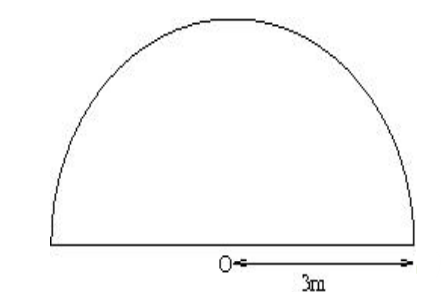
A homogeneous semi-circular plate of radius \(R = 3\) m is shown in the figure. The distance of the center of mass of the plate (in meter) from the point O is __________________________.