

Q.no: 1-JAM 2023
A wave travelling along the x-axis with y representing its displacement is described by (\(v\) is the speed of the wave)
A) \(\frac{dy}{dx}+\frac{1}{v} \frac{dy}{dt}=0\)
B) \(\frac{dy}{dx}-\frac{1}{v} \frac{dy}{dt}=0\)
C) \(\frac{d^2y}{dx^2}+\frac{1}{v^2} \frac{d^2y}{dt^2}=0\)
D) \(\frac{d^2y}{dx^2}-\frac{1}{v^2} \frac{d^2y}{dt^2}=0\)
Check Answer
Option A,B,D
Q.no: 2-JAM 2023
A rectangular pulse of width 0.5 cm is travelling to the right on a taut string (shown by full line in the figure) that has mass per unit length \(\mu_1\). The string is attached to another taut string (shown by dashed line) of mass per unit length \(\mu_2\). If the tension
in both the strings is the same, and the transmitted pulse has width 0.7 cm, the ratio \(\mu_1/\mu_2\) is _____________________ (rounded off to two decimal places).


Check Answer
Ans 1.94-1.98
Q.no: 3-JAM 2024
A tank, placed on the ground, is filled with water up to a height \( h \). A small hole is made at a height \( h_1 \) such that \( h_1 < h \). The water jet emerging

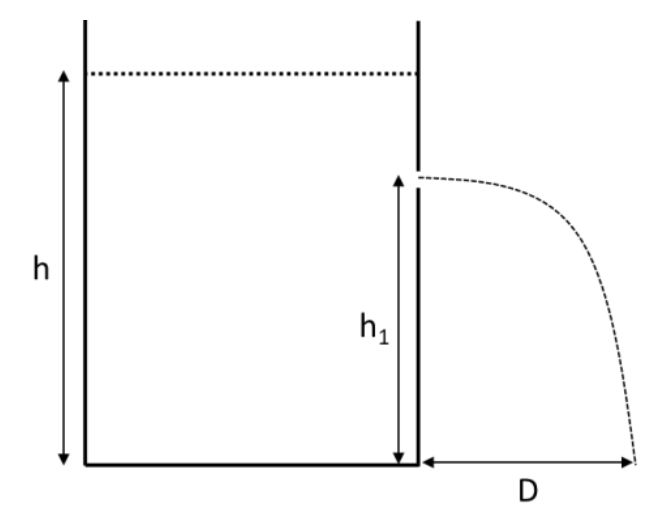
from the hole strikes the ground at a horizontal distance \( D \), as shown schematically in the figure. Which of the following statements is correct?
(\( g \) is the acceleration due to gravity)
A) Velocity at \( h_1 \) is \( \sqrt{2gh_1} \)
B) \( D = 2(h - h_1) \)
C) \( D \) will be maximum when \( h_1 = \frac{2}{3} h \)
D) The maximum value of \( D \) is \( h \)
Check Answer
Option D
Q.no: 4-JAM 2024
A whistle \( S \) of sound frequency \( f \) is oscillating with angular frequency \( \omega \) along the \( x \)-axis. Its instantaneous position and the velocity are given by \( x(t) = a \sin(\omega t) \) and \( v(t) = v_0 \cos (\omega t) \), respectively. An observer \( P \) is located on the \( y \)-axis at a distance \( L \) from the origin (see figure). Let \( v_{PS}(t) \) be the component of \( v(t) \) along the line joining the source and the observer. Choose the correct option(s):
(Here \( a \) and \( v_0 \) are constants)


A) \(v_{PS}(t) = \frac{1}{2} \frac{a v_0}{\sqrt{a^2 \sin^2 \omega t + L^2}} \sin (2\omega t)\)
B) The observed frequency will be \(f\) when the source is at \(x = 0\) and \(x = \pm a\)
C) The observed frequency will be \(f\) when the source is at position \(x = \pm \frac{a}{2}\)
D) \(v_{PS}(t) = \frac{1}{2} \frac{a v_0}{\sqrt{a^2 + L^2}} \sin (2\omega t)\)
Check Answer
Option A,B
Q.no: 5-JAM 2024
A particle of mass \( 1 \)kg, initially at rest, starts sliding down from the top of a frictionless inclined plane of angle \( \pi/6 \) (as schematically shown in the figure). The magnitude of the torque on the particle about the point \( O \) after a time \( 2 \) seconds is __________________ \( N\cdot m \). (Rounded off to nearest integer)


(Take \( g = 10 \) m/s\(^2\))
Check Answer
Ans 85-88
Q.no: 6-JAM 2024
The moment of inertia of a solid hemisphere (mass \( M \) and radius \( R \)) about the axis passing through the hemisphere and parallel to its flat surface is \( \frac{2}{5}MR^2 \). The distance of the axis from the center of mass of the hemisphere (in units of \( R \)) is _______________________. (Rounded off to two decimal places)
Check Answer
Ans 0.36-0.40
Q.no: 7-JAM 2023
Which of the following statements about the viscosity of a dilute ideal gas is correct?
A) It is independent of pressure at fixed temperature
B) It increases with increasing pressure at fixed temperature
C) It is independent of temperature
D) It decreases with increasing temperature
Check Answer
Option A
Q.no: 8-JAM 2023
A projectile of mass \(m\) is moving in the vertical x-y plane with the origin on the ground and y-axis pointing vertically up. Taking the gravitational potential energy to be zero on the ground, the total energy of the particle written in planar polar coordinates (\(r,\theta\)) is (here \(g\) is the acceleration due to gravity)
A) \(\frac{m}{2} \dot{r}^2+m \hspace{0.5mm} g \hspace{0.5mm} r \hspace{0.5mm} sin \hspace{0.5mm} \theta\)
B) \(\frac{m}{2} (\dot{r}^2 + r^2 \dot{\theta}^2)+m \hspace{0.5mm} g \hspace{0.5mm} r \hspace{0.5mm} cos \hspace{0.5mm} \theta\)
C) \(\frac{m}{2} (\dot{r}^2 + r^2 \dot{\theta}^2)+m \hspace{0.5mm} g \hspace{0.5mm} r \hspace{0.5mm} sin \hspace{0.5mm} \theta\)
D) \(\frac{m}{2} (\dot{r}^2 + r^2 \dot{\theta}^2)-m \hspace{0.5mm} g \hspace{0.5mm} r \hspace{0.5mm} cos \hspace{0.5mm} \theta\)
Check Answer
Option C
Q.no: 9-JAM 2023
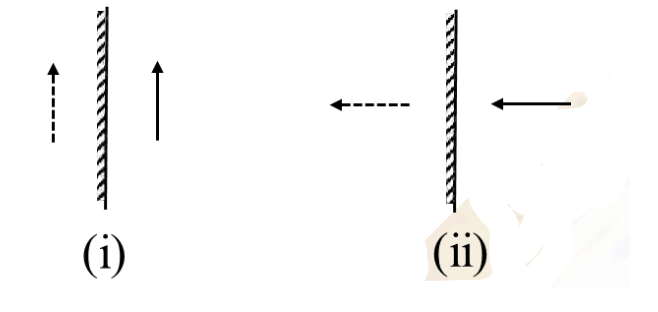
A rotating disc is held in front of a plane mirror in two different orientations which are (i) angular momentum parallel to the mirror and (ii) angular momentum perpendicular to the mirror. Which of the following schematic figures correctly describes the angular momentum (solid arrow) and its mirror image (shown by dashed arrows) in the two orientations?



Check Answer
Option B
Q.no: 10-JAM 2023
A uniform stick of length \(l\) and mass \(m\) pivoted at its top end is oscillating with an angular frequency \(\omega_r\). Assuming small oscillations, the ratio \(\omega_r/\omega_s\), where \(\omega_s\)
is the angular frequency of a simple pendulum of the same length, will be
A) \(\sqrt{3}\)
B) \(\sqrt{\frac{3}{2}}\)
C) \(\sqrt{2}\)
D) \(\frac{1}{\sqrt{3}}\)
Check Answer
Option B
Q.no: 11-JAM 2023
Water from a tank is flowing down through a hole at its bottom with velocity 5 m\(s^{-1}\). If this water falls on a flat surface kept below the hole at a distance of 0.1 m and spreads horizontally, the pressure (in kN\(m^{-2}\)) exerted on the flat surface is closest to
Given: acceleration due to gravity = 9.8 m\(s^{-2}\) and density of water = 1000 kg\(m^{-3}\)
A) 13.5
B) 27.0
C) 17.6
D) 6.8
Check Answer
Option B
Q.no: 12-JAM 2023
A rod of mass \(M\), length \(L\) and non-uniform mass per unit length \(\lambda(x)=\frac{3M x^2}{L^3}\), is held horizontally by a pivot, as shown in the figure, and is free to move in the plane of the figure. For this rod, which of the following statements are true?


A) Moment of inertia of the rod about an axis passing through the pivot is \(\frac{3}{5} M \hspace{0.5mm} L^2\)
B) Moment of inertia of the rod about an axis passing through the pivot is\(\frac{1}{3} M \hspace{0.5mm} L^2\)
C) Torque on the rod about the pivot is \(\frac{3}{4} M \hspace{0.5mm} g \hspace{0.5mm} L \)
D) If the rod is released, the point at a distance \(\frac{2 L}{3} \)
from the pivot will fall with acceleration \(g\)
Check Answer
Option A,C
Q.no: 13-JAM 2023
A particle \((p_1)\) of mass \(m\) moving with speed \(v\) collides with a stationary identical particle \((p_2)\). The particles bounce off each other elastically with \(p_1\) getting deflected by an angle \(\theta=30^\circ\) from its original direction. Then, which of the following statement(s) is/are true after the collision?
A) Speed of \(p_1\) is \(\frac{\sqrt{3}}{2} v\)
B) Kinetic energy of \(p_2\) is \(25\%\) of the total energy
C) Angle between the directions of motion of the two particles is \(90^\circ\)
D) The kinetic energy of the centre of mass of \(p_1\) and \(p_2\) decreases
Check Answer
Option A,B,C
Q.no: 14-JAM 2023
For a particle moving in a general central force field, which of the following statement(s) is/are true?
A) The angular momentum is a constant of motion
B) Kepler’s second law is valid
C) The motion is confined to a plane
D) Kepler’s third law is valid
Check Answer
Option A,B,C
Q.no: 15-JAM 2023
A single pendulum hanging vertically in an elevator has a time period \(T_0\) when the elevator is stationary. If the elevator moves upward with an acceleration of \(a=0.2 g\), the time period of oscillations is \(T_1\). Here \(g\) is the acceleration due to gravity. The ratio \(\frac{T_0}{T_1}\) is ________________________(rounded off to two decimal places).
Check Answer
Ans 1.09-1.11
Q.no: 16-JAM 2023
The sum of the x-components of unit vectors \(\dot{\hat{r}}\) and \(\dot{\hat{\theta}}\) for a particle moving with angular speed 2 rad \(s^{-1}\) at angle \(\theta=215 ^\circ\) is ___________________________(rounded off to two decimal places)
Check Answer
Ans 2.70-2.85
Q.no: 17-JAM 2023
Consider a spring mass system with mass 0.5 kg and spring constant \(k\) = 2 N\(m^{-1}\) in a viscous medium with drag coefficient \(b\) = 3 kg \(s^{-1}\). The additional mass required so that the motion becomes critically damped is __________________kg (rounded off to three decimal places).
Check Answer
Ans 0.620-0.630
Q.no: 18-JAM 2024
Which of the following types of motion may be represented by the trajectory,
\[ y(x) = ax^2 + bx + c ? \]
(Here \(a\), \(b\), and \(c\) are constants; \(x\), \(y\) are the position coordinates)
A) Projectile motion in a uniform gravitational field
B) Simple harmonic motion
C) Uniform circular motion
D) Motion on an inclined plane in a uniform gravitational field
Check Answer
Option A
Q.no: 19-JAM 2024
An incompressible fluid is flowing through a vertical pipe (height \( h \) and cross-sectional area \( A_0 \)). A thin mesh, having \( n \) circular holes of area \( A_h \), is fixed at the bottom end of the pipe. The speed of the fluid entering the top-end of the pipe is \( v_0 \). The volume flow rate from an individual hole of the mesh is given by:
(\( g \) is the acceleration due to gravity)
A) \( \frac{A_0}{n} \sqrt{v_0^2 + 2gh} \)
B) \( \frac{A_0}{n} \sqrt{v_0^2 + gh} \)
C) \( n(A_0 - A_h)\sqrt{v_0^2 + 2gh} \)
D) \( n(A_0 - A_h)\sqrt{v_0^2 + gh} \)
Check Answer
Option A
Q.no: 20-JAM 2024
A ball is dropped from a height \( h \) to the ground. If the coefficient of restitution is \( e \), the time required for the ball to stop bouncing is proportional to:
A) \( \frac{2 + e}{1 - e} \)
B) \( \frac{1 + e}{1 - e} \)
C) \( \frac{1 - e}{1 + e} \)
D) \( \frac{2 - e}{1 + e} \)
Check Answer
Option B
Q.no: 21-JAM 2024
If two traveling waves, given by
\( y_1 = A_0 \sin(kx - \omega t) \) and \( y_2 = A_0 \sin(\alpha kx - \beta \omega t) \)
are superposed, which of the following statements is correct?
A) For \( \alpha = \beta = 1 \), the resultant wave is a standing wave
B) For \( \alpha = \beta = -1 \), the resultant wave is a standing wave
C) For \( \alpha = \beta = 2 \), the carrier frequency of the resultant wave is \( \frac{3}{2} \omega \)
D) For \( \alpha = \beta = 2 \), the carrier frequency of the resultant wave is \( 3\omega \)
Check Answer
Option C
Q.no: 22-JAM 2024
A spring-mass system (spring constant 80N/m and damping coefficient 40N-s/m), initially at rest, is lying along the y-axis in the horizontal plane. One end of the spring is fixed and the mass (5kg) is attached at its other end. The mass is pulled along the y-axis by 0.5m from its equilibrium position and then released. Choose the correct statement(s).
(Ignore mass of the spring)
A) Motion will be under damped
B) Trajectory of the mass will be \( y(t) = \frac{1}{2} (1 + t)e^{-4t} \)
C) Motion will be critically damped
D) Trajectory of the mass will be \( y(t) = \frac{1}{2} (1 + 4t)e^{-4t} \)
Check Answer
Option C,D
Q.no: 23-JAM 2024
A particle of mass \( m \), having an energy \( E \) and angular momentum \( L \), is in a parabolic trajectory around a planet of mass \( M \). If the distance of the closest approach to the planet is \( r_m \), which of the following statement(s) is(are) true?
(\( G \) is the Gravitational constant)
A) \( E > 0 \)
B) \( E = 0 \)
C) \( L = \sqrt{2GMm^2r_m} \)
D) \( L = \sqrt{2GMm^2r_m} \)
Check Answer
Option B,C
Q.no: 24-JAM 2024
A satellite of mass \( 10kg \), in a circular orbit around a planet, is having a speed \( v=200m/s \). The total energy of the satellite is ____________________kJ. (Rounded off to nearest integer)
Check Answer
Ans 200
Q.no: 25-JAM 2025
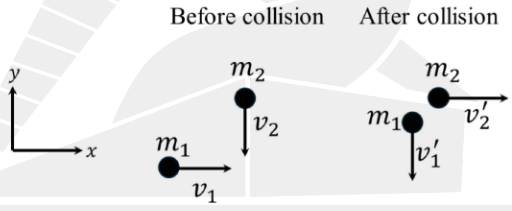
Two point particles having masses \(m_1\) and \(m_2\) approach each other in
perpendicular directions with speeds \(v_1\) and \(v_2\), respectively, as shown
in the figure.
After an elastic collision, they move away from each other in perpendicular
directions with speeds \(v_1'\) and \(v_2'\), respectively.
The ratio \(\frac{v_2'}{v_1'}\) is

A) \(\frac{m_1^{2} v_1}{m_2^{2} v_2}\)
B) \(\frac{m_1 v_1}{m_2 v_2}\)
C) \(\frac{m_1^{2} v_2}{m_2^{2} v_1}\)
D) \(\frac{m_1 v_2}{m_2 v_1}\)
Check Answer
Option A
Q.no: 26-JAM 2025
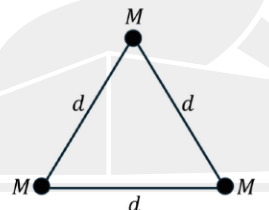
Three particles of equal mass \(M\), interacting via gravity, lie on the vertices of an
equilateral triangle of side \(d\), as shown in the figure.
The whole system is rotating with an angular velocity \(\omega\) about an axis
perpendicular to the plane of the system and passing through the center of mass.
The value of \(\omega\), for which the distance between the masses remains \(d\), is

A) \(\sqrt{\frac{2GM}{d^{3}}}\)
B) \(\sqrt{\frac{3GM}{d^{3}}}\)
C) \(\sqrt{\frac{GM}{3d^{3}}}\)
D) \(\sqrt{\frac{GM}{d^{3}}}\)
Check Answer
Option B
Q.no: 27-JAM 2025
Two masses, \(M_1\) and \(M_2\), are connected through a massless spring of spring
constant \(k\), as shown in the figure below. The mass \(M_1\) is at rest against
a rigid wall. Both \(M_1\) and \(M_2\) are on a frictionless surface.
The mass \(M_2\) is pushed towards \(M_1\) by a distance \(x\) from its equilibrium
position and then released.
After \(M_1\) leaves the wall, the speed of the center of mass of the composite
system is


A) \(\sqrt{\frac{k}{M_2}}\,x\)
B) \(\sqrt{\frac{k}{M_1 + M_2}}\,x\)
C) \(\frac{\sqrt{k M_2}}{M_1 + M_2}\,x\)
D) \(\frac{\sqrt{k M_1}}{M_1 + M_2}\,x\)
Check Answer
Option C
Q.no: 28-JAM 2025
One end of a long chain is lifted vertically from flat ground to a height \(H\) with
constant speed \(v\) by a force of magnitude \(F\).
Assume that the length of the chain is greater than \(H\) and that it has a uniform
mass per unit length \(\rho\).
The magnitude of the force \(F\) at height \(H\) is
(\(g\) is the acceleration due to gravity)
A) \(\rho\,(gH + v^{2})\)
B) \(\rho\,(gH + 2v^{2})\)
C) \(\rho\,(2gH + v^{2})\)
D) \(\frac{\rho}{2}\,(gH + v^{2})\)
Check Answer
Option A
Q.no: 29-JAM 2025
Consider the superposition of two orthogonal simple harmonic motions
\[
y_1 = a \cos(2\omega t), \qquad
y_2 = b \cos(\omega t + \phi).
\]
If \(\phi = \pi\), the resultant motion will represent
(\(a\), \(b\), and \(\omega\) are constants with appropriate dimensions)
A) a parabola
B) a hyperbola
C) an ellipse
D) a circle
Check Answer
Option A
Q.no: 30-JAM 2025
Two particles of masses \(m_1\) and \(m_2\), interacting via gravity, rotate in circular
orbits about their common center of mass with the same angular velocity \(\omega\).
For masses \(m_1\) and \(m_2\), respectively:
\(r_1\) and \(r_2\) are the constant distances from the center of mass,
\(L_1\) and \(L_2\) are the magnitudes of the angular momenta about the center of mass,
\(K_1\) and \(K_2\) are the kinetic energies.
Which of the following is(are) correct?
(\(G\) is the universal gravitational constant)
A) \( \frac{L_1}{L_2} = \frac{m_2}{m_1}\)
B) \( \frac{K_1}{K_2} = \frac{m_2}{m_1}\)
C) \( \omega = \sqrt{\frac{G(m_1 + m_2)}{(r_1 + r_2)^3}}\)
D) \( m_2 r_1 = m_1 r_2\)
Check Answer
Option A,B,C
Q.no: 31-JAM 2025
Two solid cylinders of the same density are found to have the same moment of inertia
about their respective principal axes.
The length of the second cylinder is 16 times that of the first cylinder.
If the radius of the first cylinder is 4 cm, the radius of the second cylinder is
_____ cm (in integer).
Check Answer
ANS 2
Q.no: 32-JAM 2025
A particle is moving with a constant angular velocity \(2~\text{rad s}^{-1}\) in an
orbit on a plane. The radial distance of the particle from the origin at time \(t\)
is given by
\[
r = r_0 e^{2\beta t},
\]
where \(r_0\) and \(\beta\) are positive constants.
The radial component of the acceleration vanishes for
\(\beta = \_\_\_\_~\text{rad s}^{-1}\) (in integer).
Check Answer
ANS 1
Q.no: 33-JAM 2025
A planet rotates in an elliptical orbit with a star situated at one of the foci.
The distance from the center of the ellipse to any focus is half of the semi-major axis.
The ratio of the speed of the planet when it is nearest (perihelion) to the star
to that at the farthest (aphelion) is _____ (in integer).