

CAUTION : Try solving the problem yourself for at least 5–10 minutes before clicking the AI Assistant. In the exam hall, you will be on your own.
Q.No:1 CSIR Dec-2014
In low density oxygen gas at low temperature, only the translational and rotational modes of the molecules are excited. The specific heat per molecule of the gas is
(1)
\(\frac{1}{2}k_B\)
(2)
\(k_B\)
(3)
\(\frac{3}{2}k_B\)
(4)
\(\frac{5}{2}k_B\)
Check Answer
Option 4
Q.No:2 CSIR Dec-2014
A collection \(N\) of non-interacting spins \(S_i\), \(i=1, 2, \cdots, N\), (\(S_i=\pm 1\)) is kept in an external magnetic field \(B\) at a temperature \(T\). The Hamiltonian of the system is \(H=-\mu B\sum_{i} S_i\). What should be the minimum value of \(\frac{\mu B}{k_B T}\) for which the mean value \(\langle S_i\rangle\geq \frac{1}{3}\)?
(1)
\(\frac{1}{2}N\ln{2}\)
(2)
\(2\ln{2}\)
(3)
\(\frac{1}{2}\ln{2}\)
(4)
\(N\ln{2}\)
Check Answer
Option 3
Q.No:3 CSIR June-2015
A system of N distinguishable particles,
each of which can be in one of the two energy levels 0 and \(\in\), has a total energy \(n\in\), where \(n\) is an integer. The entropy of the system is proportional to
(1)
\(N\) ln \(n\)
(2)
\(n\) ln \(N\)
(3)
ln \(\bigg(\frac{N!}{n!}\bigg)\)
(4)
\(ln \bigg(\frac{N!}{n!(N-n)!}\bigg)\)
Check Answer
Option 4
Q.No:4 CSIR June-2015
A system of \(N\) non-interacting classical
particles, each of mass \(m\) is in a two dimensional harmonic potential of the form \(V(r) = \alpha (x^2 + y^2)\) where \(\alpha\) is a positive constant. The canonical partition function of the system at temperature \(T\) is \(\bigg(\beta = \frac{1}{k_{B^{T}}}\bigg):\)
(1)
\(\left[ \bigg(\frac{\alpha}{2m}\bigg)^2 \frac{\pi}{\beta} \right]^{N}\)
(2)
\(\bigg(\frac{2m \alpha}{\alpha \beta}\bigg)^{2N}\)
(3)
\(\bigg(\frac{\alpha \pi}{2 m \beta}\bigg)^{N}\)
(4)
\(\bigg(\frac{2m \pi^{2}}{\alpha \beta^{2}}\bigg)^{N}\)
Check Answer
Option 4
Q.No:5 CSIR June-2015
Consider three Ising spins at the vertices of a triangle which interact with each other with a ferromagnetic Ising interaction of strength \(J\). The partition function of the system at temperature \(T\) is given by
\(\left(\beta=\frac{1}{k_{B} T}\right)\):
(1)
\(2 e^{3 \beta J}+6 e^{-\beta J}\)
(2)
\(2 e^{-3 \beta J}+6 e^{\beta J}\)
(3)
\(2 e^{3 \beta J}+6 e^{-3 \beta J}+3 e^{\beta J}+3 e^{-\beta \top}\)
(4)
\((2 \cosh \beta J)^{3}\)
Check Answer
Option 1
Q.No:6 CSIR Dec-2015
For a system of independent non-interacting one-dimensional oscillators, the value of the free energy per oscillator, in the limit \(T\to 0\), is
(1)
\(\frac{1}{2}\hbar \omega\)
(2)
\(\hbar \omega\)
(3)
\(\frac{3}{2}\hbar \omega\)
(4)
\(0\)
Check Answer
Option 1
Q.No:7 CSIR Dec-2015
The partition function of a system of \(N\) Ising spins is \(Z=\lambda_1^N+\lambda_2^N\), where \(\lambda_1\) and \(\lambda_2\) are functions of temperature, but are independent of \(N\). If \(\lambda_1>\lambda_2\), the free energy per spin in the limit \(N\to \infty\) is
(1)
\(-k_B T\ln{\left(\frac{\lambda_1}{\lambda_2}\right)}\)
(2)
\(-k_B T\ln{\lambda_2}\)
(3)
\(-k_B T\ln{(\lambda_1 \lambda_2)}\)
(4)
\(-k_B T\ln{\lambda_1}\)
Check Answer
Option 4
Q.No:8 CSIR Dec-2015
The Hamiltonian of a system of \(N\) non-interacting spin-1/2 particles is \(H=-\mu_0 B\sum_i S_i^Z\), where \(S_i^Z=\pm 1\) are the components of \(i^{\text{th}}\) spin along an external magnetic field \(B\). At a temperature \(T\) such that \(e^{\mu_0 B/k_B T}=2\), the specific heat per particle is
(1)
\(\frac{16}{25}k_B\)
(2)
\(\frac{8}{25}k_B \ln{2}\)
(3)
\(k_B(\ln{2})^2\)
(4)
\(\frac{16}{25}k_B(\ln{2})^2\)
Check Answer
Option 4
Q.No:9 CSIR Dec-2015
An ensemble of non-interacting spin-1/2 particles is in contact with a heat bath at temperature \(T\), and is subjected to an external magnetic field. Each particle can be in one of the two quantum states of energies \(\pm \epsilon_0\). If the mean energy per particle is \(-\epsilon_0/2\), then the free energy per particle is
(1)
\(-2\epsilon_0 \frac{\ln{(4/\sqrt{3})}}{\ln{3}}\)
(2)
\(-\epsilon_0 \ln{(3/2)}\)
(3)
\(-2\epsilon_0 \ln{2}\)
(4)
\(-\epsilon_0 \frac{\ln{2}}{\ln{3}}\)
Check Answer
Option 1
Q.No:10 CSIR June-2016
The specific heat per molecule of a gas of diatomic molecules at high temperatures is
(1)
\(8 k_B\)
(2)
\(3.5 k_B\)
(3)
\(4.5 k_B\)
(4)
\(3 k_B\)
Check Answer
Option 2
Q.No:11 CSIR June-2016
A gas of non-relativistic classical particles in one dimension is subjected to a potential \(V(x)=\alpha |x|\) (where \(\alpha\) is a constant). The partition function is (\(\beta=\frac{1}{k_B T}\))
(1)
\(\sqrt{\frac{4m\pi}{\beta^3 \alpha^2 h^2}}\)
(2)
\(\sqrt{\frac{2m\pi}{\beta^3 \alpha^2 h^2}}\)
(3)
\(\sqrt{\frac{8m\pi}{\beta^3 \alpha^2 h^2}}\)
(4)
\(\sqrt{\frac{3m\pi}{\beta^3 \alpha^2 h^2}}\)
Check Answer
Option 3
Q.No:12 CSIR June-2016
Consider a gas of \({C}s\) atoms at a number density of \(10^{12} atoms/cc\). When the typical inter-particle distance is equal to the thermal de Broglie wavelength of the particles, the temperature of the gas is nearest to (Take the mass of a Cs atom to be \(22.7\times 10^{-26} kg\).)
(1)
\(1\times 10^{-9} K\)
(2)
\(7\times 10^{-5} K\)
(3)
\(1\times 10^{-3} K\)
(4)
\(2\times 10^{-8} K\)
Check Answer
Option 3
Q.No:13 CSIR June-2016
The internal energy \(E(T)\) of a system at a fixed volume is found to depend on the temperature \(T\) as \(E(T)=aT^2+bT^4\). Then the entropy \(S(T)\), as a function of temperature, is
(1)
\(\frac{1}{2}aT^2+\frac{1}{4}bT^4\)
(2)
\(2aT^2+4bT^4\)
(3)
\(2aT+\frac{4}{3}bT^3\)
(4)
\(2aT+2bT^3\)
Check Answer
Option 3
Q.No:14 CSIR Dec-2016
Consider a gas of \(N\) classical particles in a two-dimensional square box of side \(L\). If the total energy of the gas is \(E\), the entropy (apart from an additive constant) is
(1)
\(Nk_B \ln{\left(\frac{L^2 E}{N}\right)}\)
(2)
\(Nk_B \ln{\left(\frac{LE}{N}\right)}\)
(3)
\(2Nk_B \ln{\left(\frac{L^2 \sqrt{E}}{N}\right)}\)
(4)
\(L^2 k_B \ln{\left(\frac{E}{N}\right)}\)
Check Answer
Option 3
Q.No:15 CSIR Dec-2016
The partition function of a two-level system governed by the Hamiltonian \(H=\begin{bmatrix}\gamma&-\delta\\-\delta&-\gamma\end{bmatrix}\) is
(1)
\(2\sinh{(\beta\sqrt{\gamma^2+\delta^2})}\)
(2)
\(2\cosh{(\beta\sqrt{\gamma^2+\delta^2})}\)
(3)
\(\frac{1}{2}\left[\cosh{(\beta\sqrt{\gamma^2+\delta^2})}+\sinh{(\beta\sqrt{\gamma^2+\delta^2})}\right]\)
(4)
\(\frac{1}{2}\left[\cosh{(\beta\sqrt{\gamma^2+\delta^2})}-\sinh{(\beta\sqrt{\gamma^2+\delta^2})}\right]\)
Check Answer
Option 2
Q.No:16 CSIR Dec-2016
An atom has a non-degenerate ground-state and a doubly-degenerate excited state. The energy difference between the two states is \(\varepsilon\). The specific heat at very low temperatures (\(\beta \varepsilon \gg 1\)) is given by
(1)
\(k_B(\beta \varepsilon)\)
(2)
\(k_B e^{-\beta \varepsilon}\)
(3)
\(2k_B(\beta \varepsilon)^2 e^{-\beta \varepsilon}\)
(4)
\(k_B\)
Check Answer
Option 3
Q.No:17 CSIR Dec-2016
The total spin of a hydrogen atom is due to the contribution of the spins of the electron and the proton. In the high temperature limit, the ratio of the number of atoms in the spin-1 state to the number in the spin-0 state is
(1)
\(2\)
(2)
\(3\)
(3)
\(1/2\)
(4)
\(1/3\)
Check Answer
Option 2
Q.No:18 CSIR June-2017
In a thermodynamic system in equilibrium, each molecule can exist in three possible states with probabilities \(1/2, 1/3\) and \(1/6\) respectively. The entropy per molecule is
(1)
\(k_B \ln{3}\)
(2)
\(\frac{1}{2}k_B \ln{2}+\frac{2}{3}k_B \ln{3}\)
(3)
\(\frac{2}{3}k_B \ln{2}+\frac{1}{2}k_B \ln{3}\)
(4)
\(\frac{1}{2}k_B \ln{2}+\frac{1}{6}k_B \ln{3}\)
Check Answer
Option 3
Q.No:19 CSIR June-2017
The Hamiltonian for three Ising spins \(S_0, S_1\) and \(S_2\), taking values \(\pm 1\), is
\[
H=-JS_0(S_1+S_2).
\]
If the system is in equilibrium at temperature \(T\), the average energy of the system, in terms of \(\beta=(k_B T)^{-1}\), is
(1)
\(-\frac{1+\cosh{(2\beta J)}}{2\beta \sinh{(2\beta J)}}\)
(2)
\(-2J[1+\cosh{(2\beta J)}]\)
(3)
\(-2/\beta\)
(4)
\(-2J\frac{\sinh{(2\beta J)}}{1+\cosh{(2\beta J)}}\)
Check Answer
Option 4
Q.No:20 CSIR Dec-2017
A closed system having three non-degenerate energy levels with energies \(E=0, \pm \epsilon\), is at temperature \(T\). For \(\epsilon=2k_B T\), the probability of finding the system in the state with energy \(E=0\), is
(1)
\(1/(1+2\cosh{2})\)
(2)
\(1/(2\cosh{2})\)
(3)
\(\frac{1}{2}\cosh{2}\)
(4)
\(1/\cosh{2}\)
Check Answer
Option 1
Q.No:21 CSIR Dec-2017
Two non-degenerate energy levels with energies \(0\) and \(\epsilon\) are occupied by \(N\) non-interacting particles at a temperature \(T\). Using classical statistics, the average internal energy of the system is
(1)
\(N\epsilon/(1+e^{\epsilon/k_B T})\)
(2)
\(N\epsilon/(1-e^{\epsilon/k_B T})\)
(3)
\(N\epsilon e^{-\epsilon/k_B T}\)
(4)
\(\frac{3}{2}Nk_B T\)
Check Answer
Option 1
Q.No:22 CSIR June-2018
In a system of \(N\) distinguishable particles, each particle can be in one of two states with energies \(0\) and \(-E\), respectively. The mean energy of the system at temperature \(T\) is
(1)
\(-\frac{1}{2}N(1+e^{E/k_B T})\)
(2)
\(-NE/(1+e^{E/k_B T})\)
(3)
\(-\frac{1}{2}NE\)
(4)
\(-NE/(1+e^{-E/k_B T})\)
Check Answer
Option 4
Q.No:23 CSIR Dec-2018
The rotational energy levels of a molecule are \(E_{\ell}=\frac{\hbar^2}{2\mathbf{I}_0}\ell(\ell+1)\), where \(\ell=0, 1, 2, \cdots\) and \(\mathbf{I}_0\) is its moment of inertia. The contribution of the rotational motion to the Helmholz free energy per molecule, at low temperatures in a dilute gas of these molecules, is approximately
(1)
\(-k_B T\left(1+\frac{\hbar^2}{\mathbf{I}_0 k_B T}\right)\)
(2)
\(-k_B T e^{-\frac{\hbar^2}{\mathbf{I}_0 k_B T}}\)
(3)
\(-k_B T\)
(4)
\(-3k_B T e^{-\frac{\hbar^2}{\mathbf{I}_0 k_B T}}\)
Check Answer
Option 4
Q.No:24 CSIR Dec-2018
The vibrational motion of a diatomic molecule may be considered to be that of a simple harmonic oscillator with angular frequency \(\omega\). If a gas of these molecules is at a temperature \(T\), what is the probability that a randomly picked molecule will be found in its lowest vibrational state?
(1)
\(1-e^{-\frac{\hbar \omega}{k_B T}}\)
(2)
\(e^{-\frac{\hbar \omega}{2k_B T}}\)
(3)
\(\tanh{\left(\frac{\hbar \omega}{k_B T}\right)}\)
(4)
\(\frac{1}{2}\text{cosech}{\left(\frac{\hbar \omega}{2k_B T}\right)}\)
Check Answer
Option 1
Q.No:25 CSIR Dec-2018
The Hamiltonian of a one-dimensional Ising model of \(N\) spins (\(N\) large) is
\[
H=-J\sum_{i=1}^{N} \sigma_i \sigma_{i+1}
\]
where the spin \(\sigma_i=\pm 1\) and \(J\) is a positive constant. At inverse temperature \(\beta=1/k_B T\), the correlation function between the nearest neighbour spins \(\langle \sigma_i \sigma_{i+1}\rangle\) is
(1)
\(e^{-\beta J}/(e^{\beta J}+e^{-\beta J})\)
(2)
\(e^{-2\beta J}\)
(3)
\(\tanh{(\beta J)}\)
(4)
\(\coth{(\beta J)}\)
Check Answer
Option 3
Q.No:26 CSIR Dec-2018
The energy levels accessible to a molecule have energies \(E_1=0, E_2=\Delta\) and \(E_3=2\Delta\) (where \(\Delta\) is a constant). A gas of these molecules is in thermal equilibrium at temperature \(T\). The specific heat at constant volume in the high temperature limit (\(k_B T\gg \Delta\)) varies with temperature as
(1)
\(1/T^{3/2}\)
(2)
\(1/T^3\)
(3)
\(1/T\)
(4)
\(1/T^2\)
Check Answer
Option 4
Q.No:27 CSIR June-2019
In a system comprising of approximately \(10^{23}\) distinguishable particles, each particle may occupy any of \(20\) distinct states. The maximum value of the entropy per particle is nearest to
(1)
\(20k_B\)
(2)
\(3k_B\)
(3)
\(10(\ln{2})k_B\)
(4)
\(20(\ln{2})k_B\)
Check Answer
Option 2
Q.No:28 CSIR June-2019
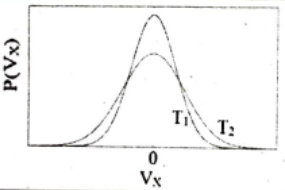
Consider a classical gas in thermal equilibrium at temperatures \(T_1\) and \(T_2\), where \(T_1< T_2\). Which of the following graphs correctly represents the qualitative behaviour of the probability density function of the \(x\)-component of the velocity?




Check Answer
Option 3
Q.No:29 CSIR June-2019
The Hamiltonian of a classical nonlinear one dimensional oscillator is \(H=\frac{1}{2m}p^2+\lambda x^4\), where \(\lambda>0\) is a constant. The specific heat of a collection of \(N\) independent such oscillators is
(1)
\(3Nk_B/2\)
(2)
\(3Nk_B/4\)
(3)
\(Nk_B\)
(4)
\(Nk_B/2\)
Check Answer
Option 2
Q.No:30 CSIR June-2019
The Hamiltonian of three Ising spins \(S_1, S_2\) and \(S_3\), each taking values \(\pm 1\), is \(H=-J(S_1 S_2+S_2 S_3)-hS_1\), where \(J\) and \(h\) are positive constants. The mean value of \(S_3\) in equilibirium at a temperature \(T=1/(k_B \beta)\), is
(1)
\(\tanh^3{(\beta J)}\)
(2)
\(\tanh{(\beta h)} \tanh^2{(\beta J)}\)
(3)
\(\sinh{(\beta h)}\sinh^2{(\beta J)}\)
(4)
\(0\)
Check Answer
Option 2
Q.No:31 CSIR Dec-2019
The energies available to a three-state system are \(0, E\) and \(2E\), where \(E>0\). Which of the following graphs best represents the temperature dependence of the specific heat?


Check Answer
Option 4
Q.No:32 CSIR Dec-2019
The angular frequency of oscillation of a quantum harmonic oscillator in two dimensions is \(\omega\). If it is in contact with an external heat bath at temperature \(T\), its partition function is (in the following \(\beta=\frac{1}{k_B T}\))
(1)
\(\frac{e^{2\beta h\omega}}{(e^{2\beta h\omega}-1)^2}\)
(2)
\(\frac{e^{\beta h\omega}}{(e^{\beta h\omega}-1)^2}\)
(3)
\(\frac{e^{\beta h\omega}}{e^{\beta h\omega}-1}\)
(4)
\(\frac{e^{2\beta h\omega}}{e^{2\beta h\omega}-1}\)
Check Answer
Option 2
Q.No:33 CSIR Dec-2019
The Hamiltonian of two particles, each of mass \(m\), is \(H(q_1, p_1; q_2, p_2)=\frac{p_1^2}{2m}+\frac{p_2^2}{2m}+k\left(q_1^2+q_2^2+\frac{1}{4}q_1 q_2\right)\), where \(k>0\) is a constant. The value of the partition function \(Z(\beta)=\int_{-\infty}^{\infty} dq_1 \int_{-\infty}^{\infty} dp_1 \int_{-\infty}^{\infty} dq_2 \int_{-\infty}^{\infty} dp_2 e^{-\beta H(q_1, p_1; q_2, p_2)}\) is
(1)
\(\frac{2m\pi^2}{k\beta^2}\sqrt{\frac{16}{15}}\)
(2)
\(\frac{2m\pi^2}{k\beta^2}\sqrt{\frac{15}{16}}\)
(3)
\(\frac{2m\pi^2}{k\beta^2}\sqrt{\frac{63}{64}}\)
(4)
\(\frac{2m\pi^2}{k\beta^2}\sqrt{\frac{64}{63}}\)
Check Answer
Option 4
Q.No:34 Assam CSIR Dec-2019
The total internal energy of a system of \(N\) distinguishable particles (where \(N\) is large) is \(U\). Each particle may be in the ground state of energy \(0\), or in an excited state of energy \(\epsilon\). The entropy of the system is
(1)
\(k_B\left[N\ln{N}+\left(N-\frac{U}{\epsilon}\right)\ln{\left(N-\frac{U}{\epsilon}\right)}+\frac{U}{\epsilon}\ln{\frac{U}{\epsilon}}\right]\)
(2)
\(k_B\left[N\ln{N}-\left(N-\frac{U}{\epsilon}\right)\ln{\left(N-\frac{U}{\epsilon}\right)}+\frac{U}{\epsilon}\ln{\frac{U}{\epsilon}}\right]\)
(3)
\(k_B\left[N\ln{N}-\left(N-\frac{U}{\epsilon}\right)\ln{\left(N-\frac{U}{\epsilon}\right)}-\frac{U}{\epsilon}\ln{\frac{U}{\epsilon}}\right]\)
(4)
\(k_B N\ln{N}\)
Check Answer
Option 3
Q.No:35 Assam CSIR Dec-2019
The Hamiltonian of a system of three Ising spins is \(H=-J(S_1 S_2+S_2 S_3)\), where each spin \(S_i=\pm 1\), and \(J>0\). Then at thermal equilibrium at temperature \(T\), the correlation function \(\langle S_1S_2\rangle\) is
(1)
\(0\)
(2)
\(\text{sech}{\frac{J}{k_B T}}\)
(3)
\(\tanh{\frac{J}{k_B T}}\)
(4)
\(\left(\tanh{\frac{J}{k_B T}}\right)^2\)
Check Answer
Option 3
Q.No:36 CSIR June-2020
An idealised atom has a non-degenerate ground state at zero energy and a \(g\)-fold degenerate excited state of energy \(E\). In a non-interacting system of \(N\) such atoms, the population of the excited state may exceed that of the ground state above a temperature \(T>\frac{E}{2k_B \ln{2}}\). The minimum value of \(g\) for which this is possible is
(a)
\(8\)
(b)
\(4\)
(c)
\(2\)
(d)
\(1\)
Check Answer
Option b
Q.No:37 CSIR June-2020
The Hamiltonian of a system of \(N\) non-interacting particles, each of mass \(m\), in one dimension is
\[
H=\sum_{i=1}^{N} \left(\frac{p_i^2}{2m}+\frac{\lambda}{4}x_i^4\right)
\]
where \(\lambda>0\) is a constant and \(p_i\) and \(x_i\) are the momentum and position respectively of the \(i\)-th particle. The average internal energy of the system is
(a)
\(\frac{4}{3}k_B T\)
(b)
\(\frac{3}{4}k_B T\)
(c)
\(\frac{3}{2}k_B T\)
(d)
\(\frac{1}{3}k_B T\)
Check Answer
Option b
Q.No:38 CSIR June-2020
For an ideal gas consisting of \(N\) distinguishable particles in a volume \(V\), the probability of finding exactly \(2\) particles in a volume \(\delta V\ll V\), in the limit \(N, V\to \infty\), is
(a)
\(2N\delta V/V\)
(b)
\((N\delta V/V)^2\)
(c)
\(\frac{(N\delta V)^2}{2V^2} e^{-N\delta V/V}\)
(d)
\(\left(\frac{\delta V}{V}\right)^2 e^{-N\delta V/V}\)
Check Answer
Option c
Q.No:39 CSIR June-2020
The Hamiltonian of a system of \(3\) spins is \(H=J(S_1 S_2+S_2 S_3)\), where \(S_i=\pm 1\) for \(i=1, 2, 3\). Its canonical partition function, at temperature \(T\), is
(a)
\(2\left(2\sinh{\frac{J}{k_B T}}\right)^2\)
(b)
\(2\left(2\cosh{\frac{J}{k_B T}}\right)^2\)
(c)
\(2\left(2\cosh{\frac{J}{k_B T}}\right)\)
(d)
\(2\left(2\cosh{\frac{J}{k_B T}}\right)^3\)
Check Answer
Option b
Q.No:40 CSIR Feb-2022
The energy levels of a non-degenerate quantum system are \(\epsilon_n=nE_0\) , where \(E_0\) is a
constant and \(n=1,2,3,... .\) At a temperature \(T\) , the free energy \(F\) can be expressed in terms of
the average energy \(E\) by
(1)
\(E_0+k_BTln\frac{E}{E_0}\)
(2)
\(E_0+2k_BTln\frac{E}{E_0}\)
(3)
\(E_0-k_BTln\frac{E}{E_0}\)
(4)
\(E_0-2k_BTln\frac{E}{E_0}\)
Check Answer
Option 3
Q.No:41 CSIR Feb-2022
A polymer, made up of \(N\) monomers, is in thermal equilibrium at temperature \(T\) . Each
monomer could be of length \(a\) or \(2a\) . The first contributes zero energy, while the second one
contributes \(\epsilon\). The average length (in units of Na ) of the polymer at temperature \(T=\epsilon/k_B\) is
(1)
\(\frac{5+e}{4+e}\)
(2)
\(\frac{4+e}{3+e}\)
(3)
\(\frac{3+e}{2+e}\)
(4)
\(\frac{2+e}{1+e}\)
Check Answer
Option 4
Q.No:42 CSIR Feb-2022
Balls of ten different colours labeled by
\(a=1,2,......,10\) are to be distributed among different
coloured boxes. A ball can only go in a box of the same colour, and each box can contain at most
one ball. Let \(n_a\) and \(N_a\) denote respectively, the numbers of balls and boxes of colour \(a\) .
Assuming that \(N_a\gg n_a\gg 1\) , the total entropy (in units of the Boltzmann constant) can be best
approximated by
(1)
\(\sum_a(N_a ln N_a+n_a ln n_a-(N_a-n_a)ln(N_a-n_a))\)
(2)
\(\sum_a(N_a ln N_a-n_a ln n_a-(N_a-n_a)ln(N_a-n_a))\)
(3)
\(\sum_a(N_a ln N_a-n_a ln n_a+(N_a-n_a)ln(N_a-n_a))\)
(4)
\(\sum_a(N_a ln N_a+n_a ln n_a+(N_a-n_a)ln(N_a-n_a))\)
Check Answer
Option 2
Q.No:43 CSIR Sep-2022
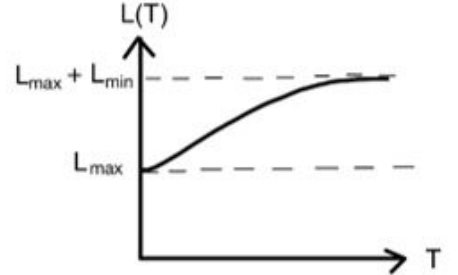
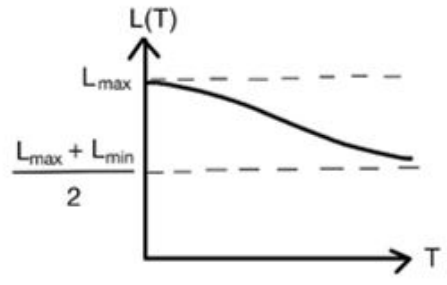
An elastic rod has a low energy state of length \(L_{max}\) and high energy state of length \(L_{min}\). The best schematic
representation of the temperature \((T)\) dependence of the mean equilibrium length \(L(T)\) of the rod, is




Check Answer
Option 4
Q.No:44 CSIR Sep-2022
If the average energy \(\langle E \rangle_T\) of a quantum harmonic oscillator at a temperature \(T\) is such that \(\langle E \rangle_T =2\langle E \rangle_{T\rightarrow 0}\), then \(T\) satisfies
(1)
\(coth \left( \frac{\hbar \omega}{k_B T} \right)=2\)
(2)
\(coth \left( \frac{\hbar \omega}{2k_B T} \right) =2\)
(3)
\(coth \left( \frac{\hbar \omega}{k_B T} \right) =4\)
(4)
\(coth\left( \frac{\hbar \omega}{2k_B T} \right) =4\)
Check Answer
Option 2
Q.No:45 CSIR Sep-2022
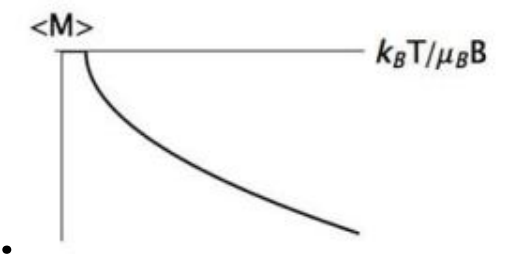
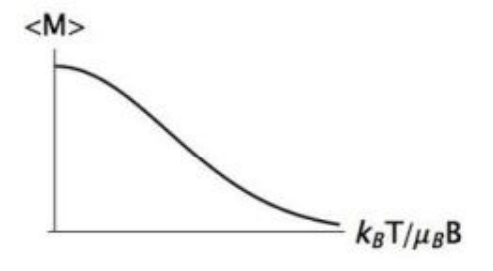
A paramagnetic salt with magnetic moment per ion \(\mu_\pm=\pm \mu_B\) (where \(\mu_B\) is the Bohr magneton) is in thermal equilibrium at temperature \(T\) in a constant magnetic field \(B\). The average magnetic moment \(\langle M \rangle\), as a function of \(k_BT/\mu_BB\) is best represented by





Check Answer
Option 3
Q.No:46 CSIR Sep-2022
The energies of two level system are \(\pm E\). Consider an ensemble of such non interacting systems at temperature \(T\). At low temperatures, the leading term in the specific heat depend on T as
(1)
\(\frac{1}{T^2} e^{-E/k_BT}\)
(2)
\(\frac{1}{T^2} e^{-2E/k_BT}\)
(3)
\(T^2 e^{-E/k_BT}\)
(4)
\(T^2 e^{-2E/k_BT}\)
Check Answer
Option 2
Q.No:47 CSIR Sep-2022
A system of N non-interacting particles in one-dimension, each of which is in a potential \(V(x)=gx^6\) where \(g>0\) is a constant and \(x\) denotes the displacement of the particle from its equilibrium position. In thermal equilibrium, the heat capacity at constant volume is
(1)
\(\frac{7}{6}Nk_B\)
(2)
\(\frac{4}{3}Nk_B\)
(3)
\(\frac{3}{2}Nk_B\)
(4)
\(\frac{2}{3}Nk_B\)
Check Answer
Option 4
Q.No:48 CSIR- Dec-2023
A quantum system is described by the Hamiltonian
\[
{H} = J {S}_z + \lambda {S}_x,
\]
where \( {S}_i = \frac{\hbar}{2} {\sigma}_i \) and \( {\sigma}_i (i = x,y,z) \) are the Pauli matrices. If \( 0 < \lambda \ll J \), then the leading correction in \( \lambda \) to the partition function of the system at temperature \( T \) is
1) \( \frac{\hbar\lambda^2}{2Jk_B T} \coth \left( \frac{J\hbar}{2k_B T} \right) \)
2) \( \frac{\hbar\lambda^2}{2Jk_B T} \tanh \left( \frac{J\hbar}{2k_B T} \right) \)
3) \( \frac{\hbar\lambda^2}{2Jk_B T} \cosh \left( \frac{J\hbar}{2k_B T} \right) \)
4) \( \frac{\hbar\lambda^2}{2Jk_B T} \sinh \left( \frac{J\hbar}{2k_B T} \right) \)
Check Answer
Option 4
Q.No:49 CSIR- Dec-2023
A system of \( N \) non-interacting classical spins, where each spin can take values \( \sigma = -1,0,1 \), is placed in a magnetic field \( h \). The single spin Hamiltonian is given by
\[
H = -\mu_B h \sigma + \Delta(1 - \sigma^2),
\]
where \( \mu_B \), \( \Delta \) are positive constants with appropriate dimensions.
If \( M \) is the magnetization, the zero-field magnetic susceptibility per spin \( \frac{1}{N} \left. \frac{\partial M}{\partial h} \right|_{h \to 0} \), at a temperature \( T = \frac{1}{\beta k_B} \) is given by
1) \( \beta \mu_B^2 \)
2) \( \frac{2\beta \mu_B^2}{2+e^{-\beta \Delta}} \)
3) \( \beta \mu_B^2 e^{-\beta \Delta} \)
4) \( \frac{\beta \mu_B^2}{1+e^{-\beta \Delta}} \)
Check Answer
Option 2
Q.No: 50 CSIR- June-2023
Two energy levels 0 (non-degenerate) and \(\epsilon\) (doubly degenerate), are available to \(N\) non-interacting distinguishable particles. If \(U\) is the total energy of the system, for large values of \(N\) the entropy of the system is \(k_B[NlnN-(N-\frac{U}{\epsilon})ln(N-\frac{U}{\epsilon})+X]\). In this expression, \(X\) is
1) \(-\frac{U}{\epsilon}ln\frac{U}{2\epsilon}\)
2) \(-\frac{U}{\epsilon}ln\frac{2U}{\epsilon}\)
3) \(-\frac{2U}{\epsilon}ln\frac{2U}{\epsilon}\)
4) \(-\frac{U}{\epsilon}ln\frac{U}{\epsilon}\)
Check Answer
Option 1
Q.No: 51 CSIR- June-2023
In a one-dimensional system of \(N\) spins, the allowed values of each spin are \(\sigma_i={1,2,3,...,q},\) where \(q\ge 2\) is an integer. The energy of the system is
\[-J\sum_{i=1}^N \delta_{\sigma_i,\sigma_{i+1}}\]\\
where \(J>0\) is a constant. If periodic boundary conditions are imposed, the number of ground states of the system is
1) \(q\)
2) \(Nq\)
3) \(q^N\)
4) \(1\)
Check Answer
Option 1
Q.No: 51 CSIR- June-2024
A single particle can exist in two states with energies \( 0 \) and \( E \) respectively. At high temperatures \( \left( k_B T \gg E \right) \), the specific heat of the system \( C_V \) will be approximately:
1) proportional to \( \frac{1}{T} \)
2) proportional to \( \frac{1}{T^2} \)
3) proportional to \( \frac{E}{e^{k_B T}} \)
4) constant
Check Answer
Option 2
Q.No: 52 CSIR- June-2024
Quantum particles of unit mass, in a potential
\[
V(x) = \left\{
\begin{array}{ll}
\frac{1}{2} \omega^2 x^2 & \text{for } x > 0 \\
\infty & \text{for } x \leq 0
\end{array}
\right.
\]
are in equilibrium at a temperature \(T\). Let \(n_2\) and \(n_3\) denote the numbers of the particles in the second and third excited states respectively. The ratio \(n_2/n_3\) is given by:
1) \(\exp\left(\frac{2\hbar\omega}{k_B T}\right)\)
2) \(\exp\left(\frac{\hbar\omega}{k_B T}\right)\)
3) \(\exp\left(\frac{3\hbar\omega}{k_B T}\right)\)
4) \(\exp\left(\frac{4\hbar\omega}{k_B T}\right)\)
Check Answer
Option 1
Q.No: 53 CSIR- June-2024
Rotational energy of a molecule in the angular momentum state \( j \) is given by
\[
E_j = \frac{\hbar^2}{2I} j(j + 1),
\]
where \( I \) is the moment of inertia of the molecule. The probability that the molecule will be in its ground state at temperature \( T \) (such that \( k_B T \gg \frac{\hbar^2}{2I} \)) is:
1) \( \frac{3\hbar^2}{2I k_B T} \)
2) \( \frac{2\hbar^2}{3I k_B T} \)
3) \( \frac{1\hbar^2}{2I k_B T} \)
4) \( \frac{\hbar^2}{I k_B T} \)
Check Answer
Option 2
Q.No: 54 CSIR- June-2024
Five classical spins are placed at the vertices of a regular pentagon. The Hamiltonian of the system is \(H = J \sum S_i S_j\), where \(J > 0\), \(S_i = \pm 1\) and the sum is over all possible nearest neighbour pairs. The degeneracy of the ground state is
1) \(8\)
2) \(5\)
3) \(4\)
4) \(10\)
Check Answer
Option 4
Q.No: 55 CSIR- Dec-2024
An isolated box of volume \(V\) contains 5 identical, but distinguishable and non-interacting particles. The particles can either be in the ground state of zero energy or in an excited state of energy \(\varepsilon\). The ground state is non-degenerate while the excited state is doubly degenerate. There is no restriction on the number of particles that can be put in a given state. The number of accessible microstates corresponding to the macrostate of the system with total energy \(E = 2\varepsilon\) are
1) 10
2) 20
3) 40
4) 30
Check Answer
Option 3
Q.No: 56 CSIR- Dec-2024
A system comprises \(N\) distinguishable atoms \((N \gg 1)\). Each atom has two energy levels \(\omega\) and \(3\omega\) (\(\omega > 0\)). Let \(\varepsilon_{\text{eq}}\) denote the average energy per particle when the system is in thermal equilibrium. The upper limit of \(\varepsilon_{\text{eq}}\) is
1) \(\frac{3\omega}{2}\)
2) \(3\omega\)
3) \(\frac{5\omega}{2}\)
4) \(2\omega\)
Check Answer
Option 4
Q.No: 57 CSIR- Dec-2024
Energy of two Ising spins \((s = \pm \frac{1}{2})\) is given by
\(E = s_{1}s_{2} + s_{1} + s_{2}\).
At temperature \(T\), the probability that both spins take the value \(-\frac{1}{2}\) is 16 times the probability that both take the value \(+\frac{1}{2}\).
At the same temperature, what is the probability that the spins take opposite values?
1) \(\frac{16}{25}\)
2) \(\frac{8}{25}\)
3) \(\frac{8}{33}\)
4) \(\frac{16}{33}\)
Check Answer
Option 4
Q.No: 57 CSIR- Dec-2024
Eigenstates of a system are specified by two non-negative integers \(n_{1}\) and \(n_{2}\). The energy of the system is given by
\[
E_{n} = \left(n_{1} + \frac{1}{2}\right)\hbar\omega + \left(n_{2} + \frac{1}{2}\right)2\hbar\omega.
\]
If \(\alpha \equiv \exp\!\left(-\frac{\hbar\omega}{k_{B}T}\right)\), what is the probability that at temperature \(T\) the energy of the system will be less than \(4\hbar\omega\)?
1) \((1 - \alpha^{2})(1 - \alpha)(2 + \alpha + 2\alpha^{2})\)
2) \((1 - \alpha)^{2}(1 - \alpha)(2 + \alpha + \alpha^{2})\)
3) \((1 - \alpha^{2})(1 + \alpha)(1 + \alpha + 2\alpha^{2})\)
4) \((1 - \alpha)^{2}(1 + \alpha)(1 + \alpha + 2\alpha^{2})\)
Check Answer
Option 4
Q.No: 58 CSIR- June-2025
Consider one mole of an ideal diatomic gas molecule at temperature \(T\) such that
\(k_{B}T \gg h\nu\), where \(\nu\) is the frequency of its vibrational mode.
If \(C_{p}\) and \(C_{v}\) are the specific heats of this gas at constant pressure and volume respectively,
then the ratio \(\gamma = \frac{C_{p}}{C_{v}}\) is
1) 2
2) \(\frac{7}{5}\)
3) \(\frac{5}{3}\)
4) \(\frac{9}{7}\)
Check Answer
Option 4
Q.No: 59 CSIR- June-2025
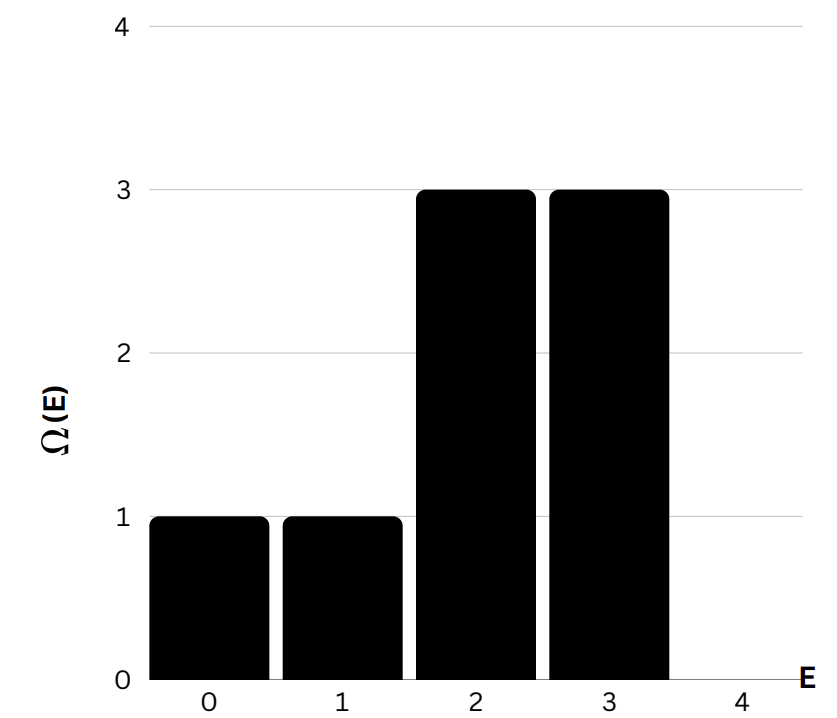
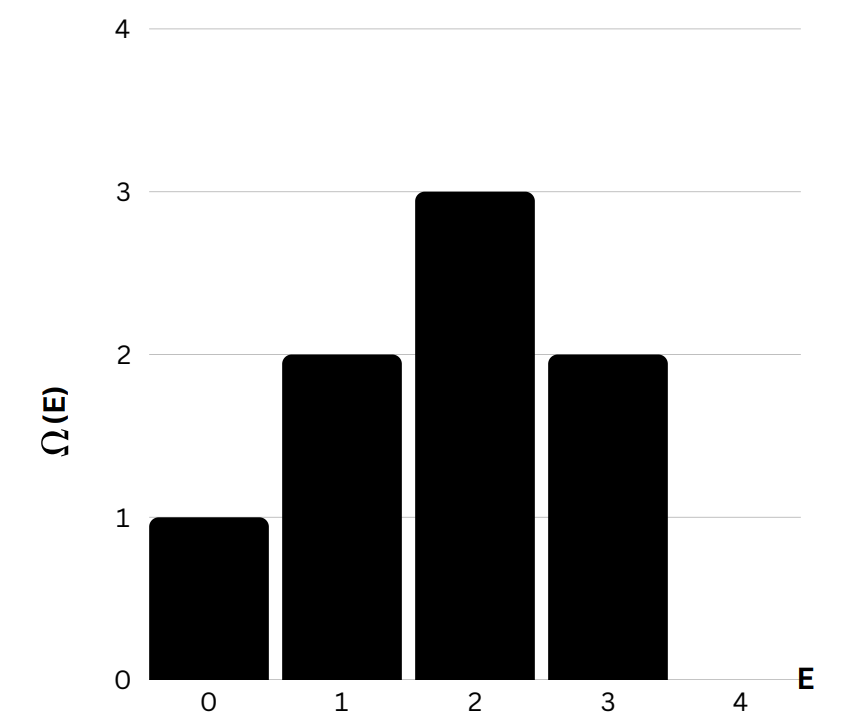
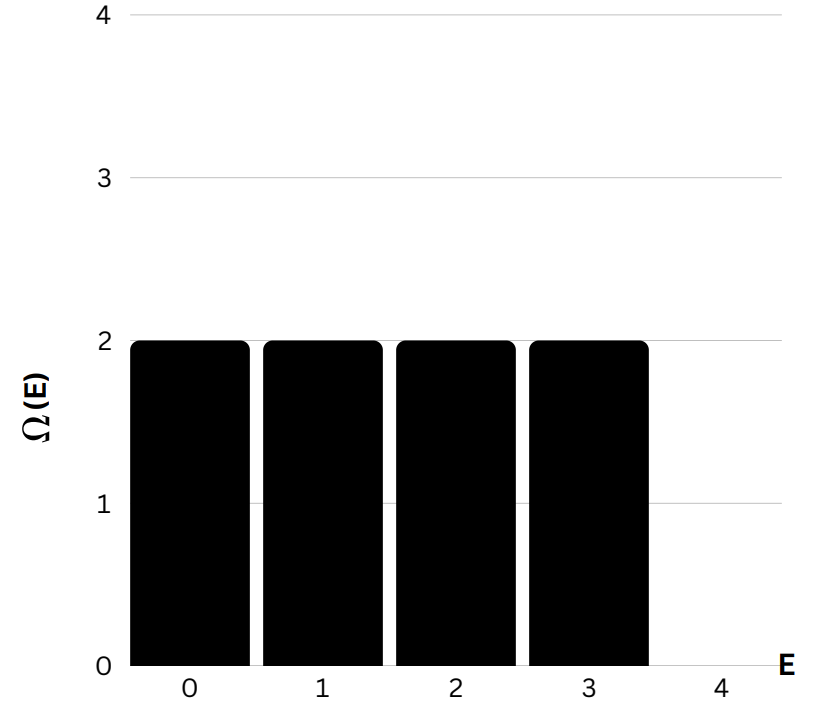
There are two boxes, one at the ground level, and the other at a fixed height \(h\).
There are three balls of different colours, each having mass \(m\) and radius \(r \ll h\).
There is no restriction on the number of balls that can be simultaneously put in a given box.
For a given value of the total energy \(E\) (in units of \(mgh\), \(g\) being the acceleration due to gravity),
the number of accessible microstates is \(\Omega(E)\).
The plot of \(\Omega(E)\) vs \(E\) is:




Check Answer
Option 3
Q.No: 60 CSIR- June-2025
Consider \(2N\) Ising spins, \(s_i\) (\(s_i = \pm 1\)), in a one-dimensional lattice with periodic boundary conditions.
The Hamiltonian is given by
\[
H = -J \sum_{i=1}^{2N} s_i s_{i+1}
\]
where \(J\) denotes the strength of the nearest-neighbour interactions with \(J > 0\).
Let \(F\) be the fully ferromagnetic state and let \(A\) be the lowest-energy state with zero magnetization.
The energy difference between these two states is
1) \(\frac{3J}{2}\)
2) \(4J\)
3) \(\frac{J}{2}\)
4) \(2J\)
Check Answer
Option 2
Q.No: 61 CSIR- June-2025
A rigid molecule can have two possible rotational states: \(j = 0\) or \(j = 1\).
Its rotational energies are given by
\(\epsilon_j = \frac{\hbar^{2}}{2I} j(j+1)\), where \(I\) is its moment of inertia.
For an ensemble of such molecules in thermal equilibrium at temperature \(T\),
the ratio of the number of molecules in the \(j = 1\) state (\(N_{1}\)) to those in the \(j = 0\) state (\(N_{0}\)) is
\(\frac{N_{1}}{N_{0}} = 0.003\).
The temperature \(T\) (in units of \(\frac{\hbar^{2}}{2 I k_{B}}\)) is closest to
1) 0.29
2) 0.21
3) 0.15
4) 0.34