

CAUTION : Try solving the problem yourself for at least 5–10 minutes before clicking the AI Assistant. In the exam hall, you will be on your own.
Q.No:1 GATE-2012
Two infinitely extended homogeneous isotropic dielectric media (medium-1 and medium-2 with dielectric constants \(\frac{\varepsilon_1}{\varepsilon_0}=2\) and \(\frac{\varepsilon_2}{\varepsilon_0}=5\), respectively) meet at the \(z=0\) plane as shown in the figure. A uniform electric field exists everywhere. For \(z\geq 0\), the electric field is given by \(\vec{E}_1=2\hat{i}-3\hat{j}+5k\). The interface separating the two media is charge free.
The electric displacement vector in the medium-2 is given by


(A)
\(\vec{D}_2=\varepsilon_0[10\hat{i}+15j+10k]\)
(B)
\(\vec{D}_2=\varepsilon_0[10\hat{i}-15j+10k]\)
(C)
\(\vec{D}_2=\varepsilon_0[4\hat{i}-6j+10k]\)
(D)
\(\vec{D}_2=\varepsilon_0[4\hat{i}+6j+10k]\)
Check Answer
Option B
Q.No:2 GATE-2012
In a hydrogen atom, consider that the electronic charge is uniformly distributed in a spherical volume of radius \(a\) (\(=0.5\times 10^{-10} m\)) around the proton. The atom is placed in a uniform electric field \(E=30\times 10^5 V/m\). Assume that the spherical distribution of the negative charge remains undistorted under the electric field.
In the equilibrium condition, the separation between the positive and the negative charge centers is
(A)
\(8.66\times 10^{-16} m\)
(B)
\(2.60\times 10^{-15} m\)
(C)
\(2.60\times 10^{-16} m\)
(D)
\(8.66\times 10^{-15} m\)
Check Answer
Option C
Q.No:3 GATE-2012
In a hydrogen atom, consider that the electronic charge is uniformly distributed in a spherical volume of radius \(a\) (\(=0.5\times 10^{-10} m\)) around the proton. The atom is placed in a uniform electric field \(E=30\times 10^5 V/m\). Assume that the spherical distribution of the negative charge remains undistorted under the electric field.
The polarizability of the hydrogen atom in unit of \((C^2 m/N)\) is
(A)
\(2.0\times 10^{-40}\)
(B)
\(1.4\times 10^{-41}\)
(C)
\(1.4\times 10^{-40}\)
(D)
\(2.0\times 10^{-39}\)
Check Answer
Option B
Q.No:4 GATE-2013
A charge distribution has the charge density given by \(\rho=Q\{\delta(x-x_0)-\delta(x+x_0)\}\). For this charge distribution the electric field at \((2x_0, 0, 0)\)
(A)
\(\frac{2Q\hat{x}}{9\pi \epsilon_0 x_0^2}\)
(B)
\(\frac{Q\hat{x}}{4\pi \epsilon_0 x_0^3}\)
(C)
\(\frac{Q\hat{x}}{4\pi \epsilon_0 x_0^2}\)
(D)
\(\frac{Q\hat{x}}{16\pi \epsilon_0 x_0^2}\)
Check Answer
Option A
Q.No:5 GATE-2014
A ray of light inside Region 1 in the \(xy\)-plane is incident at the semicircular boundary that carries no free charges. The electric field at the point \(P(r_0, \pi/4)\) in plane polar coordinates is \(\vec{E}_1=7\hat{e}_r-3\hat{e}_{\varphi}\), where \(\hat{e}_r\) and \(\hat{e}_{\varphi}\) are the unit vectors. The emerging ray in Region 2 has the electric field \(\vec{E}_2\) parallel to \(x\)-axis. If \(\varepsilon_1\) and \(\varepsilon_2\) are the dielectric constants of Region 1 and Region 2 respectively, then \(\frac{\varepsilon_2}{\varepsilon_1}\) is _____________


Check Answer
Ans 2.3-2.4
Q.No:6 GATE-2015
A point charge is placed between two semi-infinite conducting plates which are inclined at an angle of \(30^{\circ}\) with respect to each other. The number of image charges is ________________
Check Answer
Ans 11
Q.No:7 GATE-2015
The space between two plates of a capacitor carrying charges \(+Q\) and \(-Q\) is filled with two different dielectric materials, as shown in the figure. Across the interface of the two dielectric materials, which one of the following statements is correct?


(A)
\(\vec{E}\) and \(\vec{D}\) are continuous
(B)
\(\vec{E}\) is continuous and \(\vec{D}\) is discontinuous
(C)
\(\vec{D}\) is continuous and \(\vec{E}\) is discontinuous
(D)
\(\vec{E}\) and \(\vec{D}\) are discontinuous
Check Answer
Option C
Q.No:8 GATE-2015
A charge \(-q\) is distributed uniformly over a sphere, with a positive charge \(q\) at its center in (i). Also in (ii), a charge \(-q\) is distributed uniformly over an ellipsoid with a positive charge \(q\) at its center. With respect to the origin of the coordinate system, which one of the following statements is correct?


(A)
The dipole moment is zero in both (i) and (ii)
(B)
The dipole moment is non-zero in (i) but zero in (ii)
(C)
The dipole moment is zero in (i) but non-zero in (ii)
(D)
The dipole moment is non-zero in both (i) and (ii)
Check Answer
Option A
Q.No:9 GATE-2016
An infinite, conducting slab kept in a horizontal plane carries a uniform charge density \(\sigma\). Another infinite slab of thickness \(t\), made of a linear dielectric material of dielectric constant \(k\), is kept above the conducting slab. The bound charge density on the upper surface of the dielectric slab is
(A)
\(\frac{\sigma}{2k}\)
(B)
\(\frac{\sigma(k-2)}{2k}\)
(C)
\(\frac{\sigma}{k}\)
(D)
\(\frac{\sigma(k-1)}{k}\)
Check Answer
Option D
Q.No:10 GATE-2017
Identical charges \(q\) are placed at five vertices of a regular hexagon of side \(a\). The magnitude of the electric field and the electrostatic potential at the centre of the hexagon are respectively
(A)
\(0, 0\)
(B)
\(\frac{q}{4\pi \varepsilon_0 a^2}, \frac{q}{4\pi \varepsilon_0 a}\)
(C)
\(\frac{q}{4\pi \varepsilon_0 a^2}, \frac{5q}{4\pi \varepsilon_0 a}\)
(D)
\(\frac{\sqrt{5}q}{4\pi \varepsilon_0 a^2}, \frac{\sqrt{5}q}{4\pi \varepsilon_0 a}\)
Check Answer
Option C
Q.No:11 GATE-2017
A parallel plate capacitor with square plates of side \(1 m\) separated by \(1\) micro meter is filled with a medium of dielectric constant of \(10\). If the charges on the two plates are \(1 C\) and \(-1 C\), the voltage across the capacitor is _________ kV. (up to two decimal places). (\(\varepsilon_0=8.854\times 10^{-12} F/m\))
Check Answer
Ans 11.25-11.34
Q.No:12 GATE-2017
Three charges \((2 C, -1 C, -1 C)\) are placed at the vertices of an equilateral triangle of side \(1 m\) as shown in the figure. The component of the electric dipole moment about the marked origin along the \(\hat{y}\) direction is ___________________C m.


Check Answer
Ans 1.72-1.75
Q.No:13 GATE-2019
An infinitely long thin cylindrical shell has its axis coinciding with the \(z\)-axis. It carries a surface charge density \(\sigma_0 \cos{\phi}\), where \(\phi\) is the polar angle and \(\sigma_0\) is a constant. The magnitude of the electric field inside the cylinder is
(A)
\(0\)
(B)
\(\frac{\sigma_0}{2\epsilon_0}\)
(C)
\(\frac{\sigma_0}{3\epsilon_0}\)
(D)
\(\frac{\sigma_0}{4\epsilon_0}\)
Check Answer
Option B
Q.No:14 GATE-2019
Consider a system of three charges as shown in the figure below:


For \(r=10 m; \theta=60 degrees; q=10^{-6} Coulomb\), and \(d=10^{-3} m\), the electric dipole potential in volts (rounded off to three decimal places) at a point \((r, \theta)\) is _____________ [Use: \(\frac{1}{4\pi\epsilon_0}=9\times 10^9 \frac{Nm^2}{C^2}\)]
Check Answer
Ans 0.044-0.046
Q.No:15 GATE-2020
Which one of the following relations determines the manner in which the electric field lines are refracted across the interface between two dielectric media having dielectric constants \(\varepsilon_1\) and \(\varepsilon_2\) (see figure)?

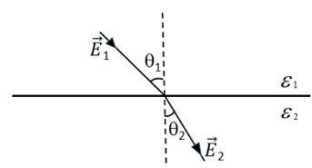
(A)
\(\varepsilon_1 \sin{\theta_1}=\varepsilon_2 \sin{\theta_2}\)
(B)
\(\varepsilon_1 \cos{\theta_1}=\varepsilon_2 \cos{\theta_2}\)
(C)
\(\varepsilon_1 \tan{\theta_1}=\varepsilon_2 \tan{\theta_2}\)
(D)
\(\varepsilon_1 \cot{\theta_1}=\varepsilon_2 \cot{\theta_2}\)
Check Answer
Option B
Q.No:16 GATE-2020
A conducting sphere of radius \(1 m\) is placed in air. The maximum number of electrons that can be put on the sphere to avoid electrical breakdown is about \(7\times 10^n\), where \(n\) is an integer. The value of \(n\) is _______________.
Assume:
Breakdown electric field strength in air is \(|\vec{E}|=3\times 10^6 V/m\)
Permittivity of free space \(\varepsilon_0=8.85\times 10^{-12} F/m\)
Electron charge \(e=1.60\times 10^{-19} C\)
Check Answer
Ans 14-15
Q.No:17 GATE-2020
A charge \(q\) moving with uniform speed enters a cylindrical region in free space at \(t=0\) and exits the region at \(t=\tau\) (see figure). Which one of the following options best describes the time dependence of the total electric flux \(\varphi(t)\), through the entire surface of the cylinder?


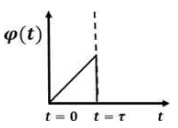

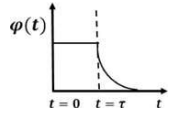


Check Answer
Option D
Q.No:18 GATE-2021
Consider two concentric conducting spherical shells as shown in the figure. The inner shell has a radius \(a\) and carries a charge \(+Q\). The outer shell has a radius \(b\) and carries a charge \(-Q\). The empty space between them is half-filled by a hemispherical shell of a dielectric having permittivity \(\varepsilon_1\). The remaining space between the shells is filled with air having the permittivity \(\varepsilon_0\).


The electric field at a radial distance \(r\) from the center and between the shells (\(a<r<b\)) is
(A)
\(\frac{Q}{2\pi(\varepsilon_0+\varepsilon_1)} \frac{\hat{r}}{r^2}\) everywhere
(B)
\(\frac{Q}{4\pi \varepsilon_0} \frac{\hat{r}}{r^2}\) on the air side and \(\frac{Q}{4\pi \varepsilon_1} \frac{\hat{r}}{r^2}\) on the dielectric side
(C)
\(\frac{Q}{2\pi \varepsilon_0} \frac{\hat{r}}{r^2}\) on the air side and \(\frac{Q}{2\pi \varepsilon_1} \frac{\hat{r}}{r^2}\) on the dielectric side
(D)
\(\frac{Q}{4\pi(\varepsilon_0+\varepsilon_1)} \frac{\hat{r}}{r^2}\) everywhere
Check Answer
Option A
Q.No:19 GATE-2022
On the surface of a spherical shell enclosing a charge free region, the electrostatic potential values are as follows: One quarter of the area has potential \(\phi_0\), another quarter has potential \(2\phi_0\) and the rest has potential \(4\phi_0\). The potential at the centre of the shell is
(a)
\(\frac{11}{4}\phi_0\)
(b)
\(\frac{11}{2}\phi_0\)
(c)
\(\frac{7}{3}\phi_0\)
(d)
\(\frac{7}{4}\phi_0\)
Check Answer
Option a
Q.No:20 GATE-2022
Electric field is measured along the axis of a uniformly charged disc of radius \(25\hspace{1mm}\text{cm}\). At a distance \(d\) from the centre, the field differs by \(10\%\) from that of an infinite plane having the same charge density. The value of \(d\) is -------------- \(\text{cm}\). (Round off to one decimal place)
(Round off to one decimal place)
Check Answer
Ans 2.4-2.6
Q.No:21 GATE-2022
A parallel plate capacitor with spacing \(d\) and area of cross-section \(A\) is connected to a source of voltage \(V\). If the plates are pulled apart quasistatically to a spacing of \(2d\), then which of the following statements are correct?
(a)
The force between the plates at spacing \(2d\) is \(\frac{1}{8}\left(\frac{\epsilon_0 AV^2}{d^2}\right)\)
(b)
The work done in moving the plates is \(\frac{1}{8}\left(\frac{\epsilon_0 AV^2}{d}\right)\)
(c)
The energy transferred to the voltage source is \(\frac{1}{2}\left(\frac{\epsilon_0 AV^2}{d}\right)\)
(d)
The energy of the capacitor reduces by \(\frac{1}{4}\left(\frac{\epsilon_0 AV^2}{d}\right)\)
Check Answer
Option a,c,d
Q.No:22 GATE-2017
Three charges \((2 C, -1 C, -1 C)\) are placed at the vertices of an equilateral triangle of side \(1 m\) as shown in the figure. The component of the electric dipole moment about the marked origin along the \(\hat{y}\) direction is _____________ C m.


Check Answer
Ans 1.72-1.75
Q.No:23 GATE-2023
An electric field as a function of radial coordinate \(r\) has the form
\(\vec{E}=\alpha \frac{e^{-r^2}}{r}\hat{r}\) where \(\alpha\) is a constant. Assume that dimensions are appropriately taken care of. The electric flux through a sphere of radius \(\sqrt{2}\), centered at the origin, is \(\Phi\). What is the value of \(\frac{\Phi}{2\pi \alpha}\) (rounded off to two decimal places)?
Check Answer
Ans 0.36-0.40
Q.No:24 GATE-2023
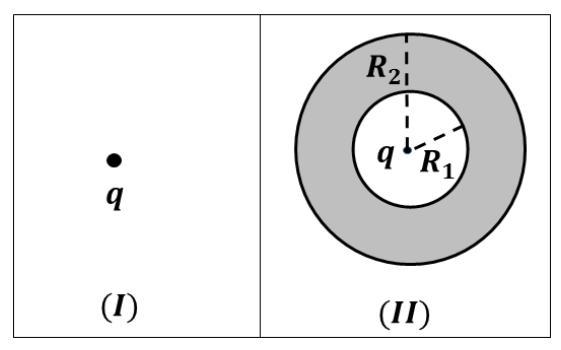
Two independent electrostatic configurations are shown in the figure.
Configuration (\(I\)) consists of an isolated point charge \(q = 1 \hspace{0.5mm} C\), and configuration (\(II\)) consists of another identical charge surrounded by a thick conducting shell of inner radius \(R_1=1 \hspace{0.5mm}m\) and outer radius \(R_2=2\hspace{0.5mm} m\), with the charge being at the center of the shell. \(W_I=\frac{\epsilon_0}{2}\int E_I ^2 dV\) and \(W_{II}=\frac{\epsilon_0}{2}\int E_{II} ^2 dV\) ,
where \(E_I\) and \(E_{II}\) are the magnitudes of the electric fields for configurations (\(I\)) and (\(II\)) respectively, \(\epsilon_0\) is the permittivity of vacuum, and the volume integration's are carried out over all space. If \(\frac{8\pi}{\epsilon_0}|W_I -W_{II}|=\frac{1}{n}\), what is the value of the integer \(n\)?

Check Answer
Ans 2
Q.No:25 GATE-2024
The electric field in a region depends only on \( x \) and \( y \) coordinates as
\[
\vec{E} = k \left( \frac{x \hat{x} + y \hat{y}}{x^2 + y^2} \right)
\]
where \( k \) is a constant. The flux of \( \vec{E} \) through the surface of a sphere of radius \( R \) with its center at the origin is \( n\pi k R \), where the value of \( n \) is _____ (in integer).
Check Answer
Ans 4
Q.No:26 GATE-2024
Two point charges of charge \(+q\) each are placed a distance \(2d\) apart. A grounded solid conducting sphere of radius \(a\) is placed midway between them. Assume \(a^2 \ll d^2\). Which of the following statement is/are true?
(A) If \(a > \frac{d}{8}\), the net force acting on the charges is directed towards each other
(B) The potential at the surface of the sphere is zero
(C) Total induced charge on the sphere is \((-2aq/d)\)
(D) The potential at the center of the sphere is non-zero
Check Answer
option A,B,C
Q.No:27 GATE-2024
In a parallel plate capacitor, the plate at \(x = 0\) is grounded and the plate at \(x = d\) is maintained at a potential \(V_0\). The space between the two plates is filled with a linear dielectric of permittivity \(\varepsilon = \varepsilon_0 (1 + \frac{x}{d})\), where \(\varepsilon_0\) is the permittivity of free space. Neglecting the edge effects, the electric field (\(\vec{E}\)) inside the capacitor is
(A) \(-\frac{V_0}{(d + x)\ln 2} \hat{x}\)
(B) \(-\frac{V_0}{d} \hat{x}\)
(C) \(-\frac{V_0}{(d + x)} \hat{x}\)
(D) \(-\frac{V_0 d}{(d + x)x} \hat{x}\)
Check Answer
option A
Q.No:28 GATE-2025
A linear dielectric sphere of radius \(R\) has a uniform frozen-in polarization along the \(z\)-axis. The center of the sphere initially coincides with the origin, about which the electric dipole moment is \(\vec{p}_1\). When the sphere is shifted to the point \((2R,0,0)\), the corresponding dipole moment with respect to the origin is \(\vec{p}_2\). The value of \(\frac{|\vec{p}_1|}{|\vec{p}_2|}\) (an integer) is _____
Check Answer
Ans 1
Q.No:29 GATE-2025
A thin circular ring of radius \(R\) lies in the \(xy\)-plane with its centre at the origin. The ring carries a uniform line charge density \(\lambda\). The quadrupole contribution to the electrostatic potential at the point \((0,0,d)\), where \(d \gg R\), is
A) \(-\frac{\lambda R^{3}}{4\epsilon_{0}d^{3}}\)
B) \(0\)
C) \(\frac{\lambda R^{3}}{4\epsilon_{0}d^{3}}\)
D) \(-\frac{\lambda R^{3}}{2\epsilon_{0}d^{3}}\)
Check Answer
Option A
Q.No:30 GATE-2025
A point charge \(q\) is placed at a distance \(d\) above an infinite, grounded conducting plate placed on the \(xy\)-plane at \(z=0\). The electrostatic potential in the \(z>0\) region is given by
\(\phi=\phi_{1}+\phi_{2}\),
where
\[
\phi_{1}=\frac{1}{4\pi\epsilon_{0}}\frac{q}{\sqrt{x^{2}+y^{2}+(z-d)^{2}}}
\qquad\text{and}\qquad
\phi_{2}=-\frac{1}{4\pi\epsilon_{0}}\frac{q}{\sqrt{x^{2}+y^{2}+(z+d)^{2}}}.
\]
Which of the following option(s) is/are correct?
A) The magnitude of the force experienced by the point charge q is \(\frac{1}{16\pi\epsilon_{0}}\frac{q}{d^{2}}\).
B) The electrostatic energy of the system is \(\frac{1}{8\pi\epsilon_{0}}\frac{q^{2}}{d}\).
C) The induced surface charge density on the plate is proportional to \(\frac{1}{\sqrt{x^{2}+y^{2}+d^{2}}}\).
D) The electrostatic potential \(\phi_{1}\) satisfies Poisson's equation for \(z>0\).
Check Answer
Option D
Q.No:31 GATE-2025
A neutral conducting sphere of radius \(R\) is placed in a uniform electric field of magnitude \(E_{0}\), that points along the \(z\)-axis. The electrostatic potential at any point \(\vec{r}\) outside the sphere is given by
\[
V(r,\theta)=V_{0}-E_{0}r\Bigl(1-\frac{R^{3}}{r^{3}}\Bigr)\cos\theta,
\]
where \(V_{0}\) is the constant potential of the sphere. Which of the following option(s) is/are correct?
A) The induced surface charge density on the sphere is proportional to \(\sin\theta\).
B) As \(r\to\infty,\ \vec{E}=E_{0}\cos\theta\,\hat{r}\).
C) The electric field at any point is curl free for \(r>R\).
D) The electric field at any point is divergence free for \(r>R\).
Check Answer
Option C,D
Q.No:32 GATE-2025
A point charge \(q\) is placed at the origin, inside a linear dielectric medium of infinite extent, having relative permittivity \(\varepsilon_{r}\). Which of the following option(s) is/are correct?
A) The magnitude of the polarization varies as \(\frac{1}{r^{2}}\).
B) The magnitude of the polarization varies as \(\frac{1}{r^{3}}\).
C) The magnitude of the screened charge due to the dielectric medium is less than the magnitude of the point charge \(q\) for \(\varepsilon_{r}>1\).
D) The magnitude of the screened charge due to the dielectric medium is more than the magnitude of the point charge \(q\) for \(\varepsilon_{r}=1\).
Check Answer
Option A,C
Q.No:33 GATE-2026
An infinitely large non-conducting thin sheet in the \(xy\)-plane \((z=0)\) carries a uniform surface charge density
\(
\sigma = 17.70 \times 10^{-12}\ \text{C.m}^{-2}.
\)
The electric field in the region \(z \lt 0\) is
\(
\vec{E}_2 = \hat{x} + 2\hat{y} + 3\hat{z}.
\)
Then, the electric field \(\vec{E}_1\) in the region \(z \gt 0\) will be \(\_\_\_\_\)
\(
\left( \epsilon_0 = 8.85 \times 10^{-12}\ \text{C}^2\text{.N}^{-1}\text{.m}^{-2} \right)
\)
A) \(\vec{E}_1 = \hat{x} + 2\hat{y} + 5\hat{z}\)
B) \(\vec{E}_1 = \hat{x} + 2\hat{y} + 4\hat{z}\)
C) \(\vec{E}_1 = \hat{x} + 2\hat{y} + 3\hat{z}\)
D) \(\vec{E}_1 = \hat{x} + 4\hat{y} + \hat{z}\)
Check Answer
Option A
Q.No:34 GATE-2026
A dielectric sphere carries a uniform polarization
\(P = 26\,\mu\text{C.cm}^{-2}.
\) The magnitude of the electric field at the center of the sphere is
\(
E \times 10^9\ \text{N.C}^{-1}.
\)
The value of \(E\) (rounded off to one decimal place) is \(\_\_\_\_\_\).
\(\left(\epsilon_0 = 8.85 \times 10^{-12}\ \text{C}^2\text{.N}^{-1}\text{.m}^{-2}\right)
\)
Check Answer
Ans 9-10
Q.No:35 GATE-2026
A positive point charge is fixed at the origin. At some distance from it on the \(x\)-axis, a point dipole is kept pointing in the \(+y\) direction. The force on the dipole is
A) \(0\)
B) in the \(+y\) direction
C) in the \(-y\) direction
D) in the \(+x\) direction