

CAUTION : Try solving the problem yourself for at least 5–10 minutes before clicking the AI Assistant. In the exam hall, you will be on your own.
Q.No:1 CSIR Dec-2014
The equation of motion of a system described by the time-dependent Lagrangian \(L=e^{\gamma t}\left[\frac{1}{2}m\dot{x}^2-V(x)\right]\) is
(1)
\(m\ddot{x}+\gamma m\dot{x}+\frac{dV}{dx}=0\)
(2)
\(m\ddot{x}+\gamma m\dot{x}-\frac{dV}{dx}=0\)
(3)
\(m\ddot{x}-\gamma m\dot{x}+\frac{dV}{dx}=0\)
(4)
\(m\ddot{x}+\frac{dV}{dx}=0\)
Check Answer
Option 1
Q.No:2 CSIR June-2015
A particle of unit mass moves in the xy-plane in such a way that \(\dot{x}(t) = y(t)\) and \(\dot{y}(t) = -x(t)\). We can conclude that it is in a conservative force-field which can be derived from the potential
(1)
\(\frac{1}{2}(x^2 +y^2)\)
(2)
\(\frac{1}{2}(x^2 - y^2)\)
(3)
\(x + y \)
(4)
\(x - y\)
Check Answer
Option 1
Q.No:3 CSIR Dec-2015
The Lagrangian of a particle moving in a plane is given in Cartesian coordinates as
\[
L=\dot{x} \dot{y}-x^2-y^2
\]
In polar coordinates the expression for the canonical momentum \(p_r\) (conjugate to the radial coordinate \(r\)) is
(1)
\(\dot{r} \sin{\theta}+r\dot{\theta} \cos{\theta}\)
(2)
\(\dot{r} \cos{\theta}+r\dot{\theta} \sin{\theta}\)
(3)
\(2\dot{r} \cos{2\theta}-r\dot{\theta} \sin{2\theta}\)
(4)
\(\dot{r} \sin{2\theta}+r\dot{\theta} \cos{2\theta}\)
Check Answer
Option 4
Q.No:4 CSIR Dec-2016
The dynamics of a particle governed by the Lagrangian \(L=\frac{1}{2}m\dot{x}^2-\frac{1}{2}kx^2-kx\dot{x}t\) describes
(1)
an undamped simple harmonic oscillator
(2)
a damped harmonic oscillator with a time varying damping factor
(3)
an undamped harmonic oscillator with a time dependent frequency
(4)
a free particle
Check Answer
Option 4
Q.No:5 CSIR Dec-2016
The parabolic coordinates \((\xi, \eta)\) are related to the Cartesian coordinates \((x, y)\) by \(x=\xi \eta\) and \(y=\frac{1}{2}(\xi^2-\eta^2)\). The Lagrangian of a two-dimensional simple harmonic oscillator of mass \(m\) and angular frequency \(\omega\) is
(1)
\(\frac{1}{2}m[\dot{\xi}^2+\dot{\eta}^2-\omega^2(\xi^2+\eta^2)]\)
(2)
\(\frac{1}{2}m(\xi^2+\eta^2)\left[(\dot{\xi}^2+\dot{\eta}^2)-\frac{1}{4}\omega^2(\xi^2+\eta^2)\right]\)
(3)
\(\frac{1}{2}m(\xi^2+\eta^2)\left(\dot{\xi}^2+\dot{\eta}^2-\frac{1}{2}\omega^2 \xi\eta\right)\)
(4)
\(\frac{1}{2}m(\xi^2+\eta^2)\left(\dot{\xi}^2+\dot{\eta}^2-\frac{1}{4}\omega^2\right)\)
Check Answer
Option 2
Q.No:6 CSIR June-2017
The Lagrangian of a free relativistic particle (in one dimension) of mass \(m\) is given by \(L=-m\sqrt{1-\dot{x}^2}\) where \(\dot{x}=dx/dt\). If such a particle is acted upon by a constant force in the direction of its motion, the phase space trajectories obtained from the corresponding Hamiltonian are
(1)
ellipses
(2)
cycloids
(3)
hyperbolas
(4)
parabolas
Check Answer
Option 3
Q.No:7 CSIR Dec-2018
The motion of a particle in one dimension is described by the Lagrangian \(L=\frac{1}{2}\left(\left(\frac{dx}{dt}\right)^2-x^2\right)\) in suitable units. The value of the action along the classical path from \(x=0\) at \(t=0\) to \(x=x_0\) at \(t=t_0\), is
(1)
\(\frac{x_0^2}{2\sin^2{t_0}}\)
(2)
\(\frac{1}{2}x_0^2 \tan{t_0}\)
(3)
\(\frac{1}{2}x_0^2 \cot{t_0}\)
(4)
\(\frac{x_0^2}{2\cos^2{t_0}}\)
Check Answer
Option 3
Q.No:8 CSIR Dec-2019
Which of the following terms, when added to the Lagrangian \(L(x, y, \dot{x}, \dot{y})\) of a system with two degrees of freedom, will not change the equations of motion?
(1)
\(x\ddot{x}-y\ddot{y}\)
(2)
\(x\ddot{y}-y\ddot{x}\)
(3)
\(x\dot{y}-y\dot{x}\)
(4)
\(y\dot{x}^2-x\dot{y}^2\)
Check Answer
Option 2
Q.No:9 Assam CSIR Dec-2019
The action \(S=\int dt \left[\frac{1}{2}m\dot{x}^2-gx^k\right]\) (where \(g\) is a constant) describes the motion of a particle of mass \(m\) in a one-dimensional potential. The action remains invariant under the scale transformation \(t\to \lambda^{\alpha} t\) and \(x\to \lambda^{\beta} x\), if
(1)
\(k=-2, \alpha=1\) and \(\beta=2\)
(2)
\(k=-2, \alpha=2\) and \(\beta=1\)
(3)
\(k=1, \alpha=2\) and \(\beta=1\)
(4)
\(k=1, \alpha=1\) and \(\beta=2\)
Check Answer
Option 2
Q.No:10 CSIR June-2020
A point mass \(m\), is constrained to move on the inner surface of a paraboloid of revolution \(x^2+y^2=az\) (where \(a>0\) is a constant). When it spirals down the surface, under the influence of gravity (along \(-z\) direction), the angular speed about the \(z\)-axis is proportional to
(a)
\(1\) (independent of \(z\))
(b)
\(z\)
(c)
\(z^{-1}\)
(d)
\(z^{-2}\)
Check Answer
Option c
Q.No:11 CSIR June-2023
A one-dimensional rigid rod is constrained to move inside a sphere such that its two ends are always in contact with the surface. The number of constraints on the Cartesian coordinates of the endpoints of the rod is
1) 3
2) 5
3) 2
4) 4
Check Answer
Option 1
Q.No:12 CSIR June-2023
The trajectory of a particle moving in a plane is expressed in polar coordinates \((r,\theta)\) by the equations \(r=r_0e^{\beta t}\) and \(\frac{d\theta}{dt}=\omega\), where the parameters \(r_0\),\(\beta\) and \(\omega\) are positive. Let \(v_r\) and \(a_r\) denote the velocity and acceleration, respectively, in the radial direction. For this trajectory
1) \(a_r<0\) at all times irrespective of the values of the parameters
2) \(a_r>0\) at all times irrespective of the values of the parameters
3) \(\frac{dv_r}{dt}>0\) and \(a_r>0\) for all choices of parameters
4) \(\frac{dv_r}{dt}>0\), however, \(a_r=0\) for some choices of parameters
Check Answer
Option 4
Q.No:13 CSIR Dec-2023
A Lagrangian is given by
\[
L = \frac{1}{2}m(\dot{x}^2 + \dot{y}\dot{z} + \dot{z}^2) - \alpha(2x + 3y + z).
\]
The conserved momentum is
1) \( m[2\dot{x} + \dot{z}] \)
2) \( m[2\dot{x} + \dot{y} + \dot{z}] \)
3) \( m\left[\dot{x} + \frac{3}{2}\dot{y} + \frac{1}{2}\dot{z}\right] \)
4) \( m[2\dot{x} + 3\dot{z}] \)
Check Answer
Option 4
Q.No:14 CSIR Dec-2024
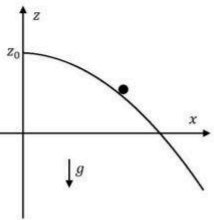
A frictionless track is defined by
\( z = z_{0} - \frac{x^{2}}{4z_{0}} \), as shown in the figure.
A particle is constrained to slide down the track under the action of gravity.
The tangential acceleration at position \((x, z)\) would be

1) \(\frac{2 g x}{\sqrt{x^{2} + 4 z_{0}^{2}}}\)
2) \(\frac{g x}{\sqrt{x^{2} + 4 z_{0}^{2}}}\)
3) \(\frac{g x}{2 z_{0}}\)
4) \(g \sqrt{\frac{x(x + z_{0})}{x^{2} + 4 z_{0}^{2}}}\)
Check Answer
Option 2
Q.No:15 CSIR Dec-2024
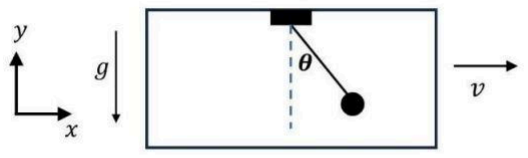
The point of support of a simple pendulum, of mass \(m\) and length \(l\),
is attached to the roof of a taxi as shown in the figure.
The taxi is moving with uniform velocity \(v\).
The Lagrangian for the pendulum is

1) \(L = \frac{1}{2} m l^{2} \dot{\theta}^{2}
+ \frac{1}{2} m v^{2}
+ m l v \cos\theta \, \dot{\theta}
- m g l \cos\theta\)
2) \(L = \frac{1}{2} m l^{2} \dot{\theta}^{2}
+ \frac{1}{2} m v^{2}
+ m l v \cos\theta \, \dot{\theta}
+ m g l \cos\theta\)
3) \(L = \frac{1}{2} m l^{2} \dot{\theta}^{2}
+ \frac{1}{2} m v^{2}
+ m l v \sin\theta \, \dot{\theta}
+ m g l \cos\theta\)
4) \(L = \frac{1}{2} m l^{2} \dot{\theta}^{2}
+ \frac{1}{2} m v^{2}
+ m l v \sin\theta \, \dot{\theta}
- m g l \cos\theta\)
Check Answer
Option 2
Q.No:16 CSIR Dec-2024
A non-relativistic particle of mass \(m\) and charge \(q\) is moving in a magnetic field
\(\vec{B}(x,y,z)\). If \(\vec{v}\) denotes its velocity and \(\{\cdot,\cdot\}_{\text{P.B.}}\)
denotes the Poisson bracket, then
\(\epsilon_{ijk}\{v_i, v_j\}_{\text{P.B.}}\)
is equal to
1) \(-\frac{q}{m^{2}} B_k\)
2) \(0\)
3) \(\frac{2q}{m^{2}} B_k\)
4) \(\frac{q}{m^{2}} B_k\)
Check Answer
Option 3
Q.No:17 CSIR Dec-2024
The Lagrangian of a system is
\[
L = \frac{15}{2} m \dot{x}^{2} + 6m \dot{x}\dot{y} + 3m \dot{y}^{2} - mg(x + 2y).
\]
Which one of the following quantities is conserved?
1) \(12\dot{x} + 3\dot{y}\)
2) \(12\dot{x} - 3\dot{y}\)
3) \(3\dot{x} - 12\dot{y}\)
4) \(3\dot{x} + 3\dot{y}\)
Check Answer
Option 1
Q.No:18 CSIR June-2025
A particle of mass \(m\) is subjected to a potential
\[
V(x) = V_0 \,\theta(x) - kx,
\]
where \(V_0\) and \(k\) are positive constants and \(V_0\) is much larger than the energy
of the particle. The function \(\theta(x) = 1\) for \(x \ge 0\) and equals 0 otherwise.
The particle starts from rest at \(t = 0\) and \(x = -5\).
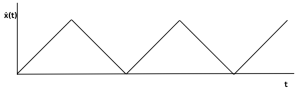
In the limit \(V_0 \to \infty\), the graph for \(\dot{x}(t)\) is best represented by




Check Answer
Option 2
Q.No:19 CSIR June-2025
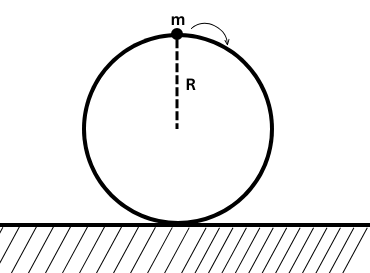
A sphere of radius \(R\) is held fixed on the horizontal ground.
A point particle of mass \(m\) slides without friction from the top
under the action of earth’s gravity, as shown in the figure.
The speed of the particle when it leaves the surface of the sphere is

1) \(\sqrt{\frac{2}{3} g R}\)
2) \(\sqrt{\frac{3}{4} g R}\)
3) \(\sqrt{2 g R}\)
4) \(\sqrt{g R}\)
Check Answer
Option 1
Q.No:20 CSIR June-2025
A massless rod of length \(l\) is hinged at the extreme end of a vertical spring whose
other end is fixed to the ground. A point mass \(m\) is fixed at the end of the rod,
as shown in the figure.
Assume harmonic motion of the spring given by
\[
h(t) = h_0(2 + \cos \omega t),
\]
where \(h_0 >l\).
The equation of motion of the mass (confined to the plane of the figure) is given by


1) \(l\ddot{\theta} + \omega^{2} h_0 \sin\theta \sin\omega t - g \sin\theta = 0\)
2) \(l\ddot{\theta} + \omega^{2} h_0 \sin\theta \cos\omega t - g \sin\theta = 0\)
3) \(l\ddot{\theta} + \omega^{2} h_0 \sin\theta \cos\omega t + g \sin\theta = 0\)
4) \(l\ddot{\theta} - \omega^{2} h_0 \sin\theta \sin\omega t + g \sin\theta = 0\)
Check Answer
Option 2
Q.No:1 GATE-2012
A particle of mass \(m\) slides under the gravity without friction along the parabolic path \(y=ax^2\) as shown in the figure. Here \(a\) is a constant.


The Lagrangian for this particle is given by,
(A)
\(L=\frac{1}{2}m\dot{x}^2-mgax^2\)
(B)
\(L=\frac{1}{2}m(1+4a^2 x^2)\dot{x}^2-mgax^2\)
(C)
\(L=\frac{1}{2}m\dot{x}^2+mgax^2\)
(D)
\(L=\frac{1}{2}m(1+4a^2 x^2)\dot{x}^2+mgax^2\)
Check Answer
Option B
Q.No:2 GATE-2012
A particle of mass \(m\) slides under the gravity without friction along the parabolic path \(y=ax^2\) as shown in the figure. Here \(a\) is a constant.
The Lagrange's equation of motion of the particle is
(A)
\(\ddot{x}=2gax\)
(B)
\(m(1+4a^2 x^2)\ddot{x}=-2mgax-4ma^2 x\dot{x}^2\)
(C)
\(m(1+4a^2 x^2)\ddot{x}=2mgax+4ma^2 x\dot{x}^2\)
(D)
\(\ddot{x}=-2gax\)
Check Answer
Option B
Q.No:3 GATE-2012
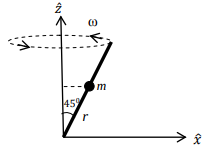
A bead of mass \(m\) can slide without friction along a massless rod kept at \(45^{\circ}\) with the vertical as shown in the figure. The rod is rotating about the vertical axis with a constant angular speed \(\omega\). At any instant, \(r\) is the distance of the bead from the origin. The momentum conjugate to \(r\) is

(A)
\(m\dot{r}\)
(B)
\(\frac{1}{\sqrt{2}}m\dot{r}\)
(C)
\(\frac{1}{2}m\dot{r}\)
(D)
\(\sqrt{2}m\dot{r}\)
Check Answer
Option A
Q.No:4 GATE-2016
A particle of mass \(m=0.1 kg\) is initially at rest at origin. It starts moving with a uniform acceleration \(\vec{a}=10\hat{i} ms^{-2}\) at \(t=0\). The action \(S\) of the particle, in units of \(J\)-\(s\), at \(t=2 s\) is ____________. (Give your answer upto two decimal places)
Check Answer
Ans 26.65-26.68
Q.No:5 GATE-2016
The Lagrangian of a system is given by \(L=\frac{1}{2}ml^2[\dot{\theta}^2+\sin^2{\theta}\dot{\varphi}^2]-mgl\cos{\theta}\), where \(m, l\) and \(g\) are constants. Which of the following is conserved?
(A)
\(\dot{\varphi}\sin^2{\theta}\)
(B)
\(\dot{\varphi}\sin{\theta}\)
(C)
\(\frac{\dot{\varphi}}{\sin{\theta}}\)
(D)
\(\frac{\dot{\varphi}}{\sin^2{\theta}}\)
Check Answer
Option A
Q.No:6 GATE-2017
If the Lagrangian \(L_0=\frac{1}{2}m\left(\frac{dq}{dt}\right)^2-\frac{1}{2}m\omega^2 q^2\) is modified to \(L=L_0+\alpha q\left(\frac{dq}{dt}\right)\), which one of the following is TRUE?
(A)
Both the canonical momentum and equation of motion do not change
(B)
Canonical momentum changes, equation of motion does not change
(C)
Canonical momentum does not change, equation of motion changes
(D)
Both the canonical momentum and equation of motion change
Check Answer
Option B
Q.No:7 GATE-2019
A projectile of mass \(1 kg\) is launched at an angle of \(30^{\circ}\) from the horizontal direction at \(t=0\) and takes time \(T\) before hitting the ground. If its initial speed is \(10 ms^{-1}\), the value of the action integral for the entire flight in the units of kg m^2 s^{-1} (rounded off to one decimal place) is __________
[Take \(g=10 ms^{-2}\)]
Check Answer
Ans 33.2-33.4
Q.No:8 GATE-2020
If a particle is moving along a sinusoidal curve, the number of degrees of freedom of the particle is ______________________.
Check Answer
Ans 1
Q.No:9 GATE-2021
A hoop of mass \(M\) and radius \(R\) rolls without slipping along a straight line on a horizontal surface as shown in the figure. A point mass \(m\) slides without friction along the inner surface of the hoop, performing small oscillations about the mean position. The number of degrees of freedom of the system (in integer) is ___________.


Check Answer
Ans 2
Q.No:10 GATE-2021
A uniform block of mass \(M\) slides on a smooth horizontal bar. Another mass \(m\) is connected to it by an inextensible string of length \(l\) of negligible mass, and is contrained to oscillate in the \(X\)-\(Y\) plane only. Neglect the sizes of the masses. The number of degrees of freedom of the system is two and the generalized coordinates are chosen as \(x\) and \(\theta\), as shown in the figure.

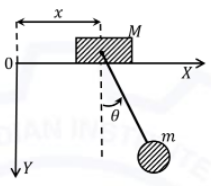
If \(p_x\) and \(p_{\theta}\) are the generalized momenta corresponding to \(x\) and \(\theta\), respectively, then the correct option(s) is(are)
(A)
\(p_x=(m+M)\dot{x}+ml\cos{\theta}\dot{\theta}\)
(B)
\(p_{\theta}=ml^2\dot{\theta}-ml\cos{\theta}\dot{x}\)
(C)
\(p_x\) is conserved
(D)
\(p_{\theta}\) is conserved
Check Answer
Option A_C
Q.No:11 GATE-2022
A particle of mass \(1 \hspace{1mm}\text{kg}\) is released from a height of \(1 \hspace{1mm}\text{m}\) above the ground. When it reaches the ground, what is the value of Hamilton's action for this motion in \(\text{J} s\)? (\(g\) is the acceleration due to gravity; take gravitation potential to be zero on the ground)
(a)
\(-\frac{2}{3}\sqrt{2g}\)
(b)
\(\frac{5}{3}\sqrt{2g}\)
(c)
\(3\sqrt{2g}\)
(d)
\(-\frac{1}{3}\sqrt{2g}\)
Check Answer
Option d
Q.No:12 GATE-2026
A projectile of mass \(m\) is launched from the ground with the initial speed \(v_0\) at an angle \(30^\circ\) from the horizontal. Take the ground to be horizontal. Ignoring the drag, the magnitude of Hamilton’s action
\(
\int L\,dt
\)
for the particle from the beginning till it hits the ground is
\(
f \times \left(\frac{mv_0^3}{g}\right).
\)
The value of \(f\) (rounded off to two decimal places) is \(\_\_\_\_\_\).
Check Answer
Ans 0.32-0.34
Q.No:13 GATE-2026
The Lagrangian
\[
L_0=
\frac{1}{2}m\dot{q}^{\,2}
-
\frac{1}{2}m\omega^2q^2
\]
with the generalized coordinate \(q\) is transformed to
\[
L=L_0+\alpha\frac{df(q)}{dt}.
\]
Consider the following statements:
\( \text{(i) Expression for the canonical momentum does not change.}\)
\(\text{(ii) The equation of motion does not change.}\)
Which of the following options is correct for the above statements?
Which of the following options is correct for the above statements?
A) Both (i) and (ii) are correct.
B) Both (i) and (ii) are not correct.
C) (i) is correct and (ii) is not correct.
D) (i) is not correct and (ii) is correct.
Check Answer
Option D
Q.No:14 GATE-2026
A symmetric rigid body has moment of inertia \(I_1\), \(I_2\), \(I_3\) about its principal axes \(1\), \(2\), and \(3\), respectively, with \(I_1 = I_3 = I_{\perp}\) and \(I_2 \neq I_{\perp}\). It is rotating in space with no torque on it so that its angular momentum \(\vec{L}\) is constant. Let \(\omega_1\), \(\omega_2\), \(\omega_3\) be the components of its angular velocity along the principal axes \(1\), \(2\), and \(3\), respectively. Which of the following quantities is/are constant during the motion of this rigid body?
A) \(\omega_1 + \omega_3\)
B) \(\omega_1^2 + \omega_3^2\)
C) Angle between axis \(2\) and \(\vec{L}\)
D) \(\omega_2\)
Check Answer
Option B,C,D
Q.No:15 GATE-2026
A \(15\ \text{cm}\) long scale is held horizontally with one of its ends on the edge of a \(1\ \text{m}\) high table and the other end resting on one’s index finger. As the finger is removed (see figure below), the scale starts rotating about its end on the table.
After \(0.1\ \text{s}\), during which it has rotated by a negligibly small angle but has gained a rotational speed as it leaves the table and falls vertically towards the ground. When its centre of mass has fallen by \(0.5\ \text{m}\), it has rotated by an angle \(\theta\).


The value of \(\theta\) in degrees (rounded off to one decimal place) is \(\_\_\_\_\_\).
\((g=9.8\ \text{m.s}^{-2}) \)
\((g=9.8\ \text{m.s}^{-2}) \)