

CAUTION : Try solving the problem yourself for at least 5–10 minutes before clicking the AI Assistant. In the exam hall, you will be on your own.
Q.No:1 JEST-2012
A magnetic field \(\vec{B}=B_0(\hat{i}+2\hat{j}-4\hat{k})\) exists at a point. If a test charge moving with a velocity, \(\vec{v}=v_0(3\hat{i}-\hat{j}+2\hat{k})\) experiences no force at a certain point, the electric field at that point in SI units is
(a)
\(\vec{E}=-v_0 B_0(3\hat{i}-2\hat{j}-4\hat{k})\)
(b)
\(\vec{E}=-v_0 B_0(\hat{i}+\hat{j}+7\hat{k})\)
(c)
\(\vec{E}=v_0 B_0(14\hat{j}+7\hat{k})\)
(d)
\(\vec{E}=-v_0 B_0(14\hat{j}+7\hat{k})\)
Check Answer
Option d
Q.No:2 JEST-2013
A thin uniform ring carrying charge \(Q\) and mass \(M\) rotates about its axis. What is the gyromagnetic ratio (defined as ratio of magnetic dipole moment to the angular momentum) of this ring?
(a)
\(Q/(2\pi M)\)
(b)
\(Q/M\)
(c)
\(Q/(2M)\)
(d)
\(Q/(\pi M)\)
Check Answer
Option c
Q.No:3 JEST-2014
A system of two circular co-axial coils carrying equal currents \(I\) along same direction having equal radius \(R\) and separated by a distance \(R\) (as shown in the figure below). The magnitude of magnetic field at the midpoint \(P\) is given by


(a)
\(\frac{\mu_0 I}{2\sqrt{2}R}\)
(b)
\(\frac{4\mu_0 I}{5\sqrt{5}R}\)
(c)
\(\frac{8\mu_0 I}{5\sqrt{5}R}\)
(d)
\(0\)
Check Answer
Option c
Q.No:4 JEST-2015
A charged particle is released at time \(t=0\), from the origin in the presence of uniform static electric and magnetic fields given by \(E=E_0 \hat{y}\) and \(B=B_0 \hat{z}\) respectively. Which of the following statements is true for \(t>0\)?
(a)
The particle moves along the \(x\)-axis.
(b)
The particle moves in a circular orbit.
(c)
The particle moves in the \((x, y)\) plane.
(d)
particle moves in the \((y, z)\) plane
Check Answer
Option
Q.No:5 JEST-2016
The strength of magnetic field at the center of a regular hexagon with sides of length \(a\) carrying a steady current \(I\) is:
(A)
\(\frac{\mu_0 I}{\sqrt{3}\pi a}\)
(B)
\(\frac{\sqrt{6}\mu_0 I}{\pi a}\)
(C)
\(\frac{3\mu_0 I}{\pi a}\)
(D)
\(\frac{\sqrt{3}\mu_0 I}{\pi a}\)
Check Answer
Option D
Q.No:6 JEST-2016
A spherical shell of radius \(R\) carries a constant surface charge density \(\sigma\) and is rotating about one of its diameters with an angular velocity \(\omega\). The magnitude of the magnetic moment of the shell is:
(A)
\(4\pi \sigma \omega R^4\)
(B)
\(4\pi \sigma \omega R^4/3\)
(C)
\(4\pi \sigma \omega R^4/15\)
(D)
\(4\pi \sigma \omega R^4/9\)
Check Answer
Option B
Q.No:7 JEST-2018
An apparatus is made from two concentric conducting cylinders of radii \(a\) and \(b\) respectively, where \(a<b\). The inner cylinder is grounded and the outer cylinder is at a positive potential \(V\). The space between the cylinders has a uniform magnetic field \(H\) directed along the axis of the cylinders. Electrons leave the inner cylinder with zero speed and travel towards the outer cylinder. What is the threshold value of \(V\) below which the electrons cannot reach the outer cylinder?
(A)
\(\frac{eH^2(b^2-a^2)}{8mc^2}\)
(B)
\(\frac{eH^2(b^2-a^2)^2}{8mc^2 b^2}\)
(C)
\(\frac{eH^2(b^2-a^2)^2}{8mc^2 a^2}\)
(D)
\(\frac{eH^2 b\sqrt{(b^2-a^2)}}{8mc^2}\)
Check Answer
Option B
Q.No:8 JEST-2019
A wire with uniform line charge density \(\lambda\) per unit length carries a current \(I\) as shown in the figure. Take the permittivity and permeability of the medium to be \(\varepsilon_0=\mu_0=1\). A particle of charge \(q\) is at a distance \(r\) and is traveling along a trajectory parallel to the wire. What is the speed of the charge?


(A)
\(\frac{\lambda}{I}\)
(B)
\(\frac{\lambda}{2I}\)
(C)
\(\frac{\lambda}{3I}\)
(D)
\(\frac{4\lambda}{I}\)
Check Answer
Option A
Q.No:9 JEST-2020
Consider three infinitely long, straight, and coplanar wires which are placed parallel to each other. The distance between the adjacent wires is \(d\). Each wire carries a current \(I\) in the same direction. Consider points on either side of the middle wire where the magnetic field vanishes. What is the distance of these points from the middle wire?
(A)
\(\frac{2d}{3}\)
(B)
\(\frac{2d}{\sqrt{3}}\)
(C)
\(\frac{d}{3}\)
(D)
\(\frac{d}{\sqrt{3}}\)
Check Answer
Option D
Q.No:10 JEST-2021
A circular ring of radius \(R\) with total charge \(Q_{\text{ring}}\) has uniform linear charge density. It rotates about an axis passing through its centre and perpendicular to its plane with a constant angular speed \(\omega\). The magnetic field at the centre is found to be \(\mathbf{B}_0\). Another thin circular disk of the same radius \(R\) has a constant surface charge density with a total charge \(Q_{\text{disk}}\). This disk too rotates about the same axis as the ring with the same constant angular speed \(\omega\). The magnetic field at the centre in this case is found to be \(10^{-3}\mathbf{B}_0\). What is the value of \(Q_{\text{ring}}/Q_{\text{disk}}\)?
Check Answer
Ans 2000
Q.No:11 JEST-2022
An electron of kinetic energy \(100 MeV\) moving in a region of uniform magnetic field penetrates a layer of lead. In the process it looses half of its kinetic energy. The radius of curvature of the path has changed by a factor
Check Answer
Ans 0.50
Q.No:12 JEST-2023
Two identical magnetic dipoles of length \(\ell\), which are free to rotate, are kept fixed at a distance \(d (d \gg \ell)\). In their minimum energy configuration, they will orient themselves
1) anti-parallel to each other and perpendicular to the line joining them
2) parallel to each other and aligned to the line joining them
3) anti-parallel to each other and aligned to the line joining them
4) parallel to each other and perpendicular to the line joining them
Check Answer
option b
Q.No:13 JEST-2023
Two semi-infinite wires are placed on the x- axis, one from \(-\infty\) to the \(-d\), and the the other from \(d\) to \(\infty\). Both wires carry a steady current \(I\) in the same direction. The magnitude of the magnetic field at a distance \(d\) away from the center of this gap in the y-z plane (ignore the charge accumulation) is:
(a) \(\frac{\mu_0 I }{\pi d} \sqrt{2}\)
(b) \(\frac{\mu_0 I }{2 \pi d} (1-\frac{1}{\sqrt{2}})\)
(c) \(\frac{\mu_0 I }{\pi d} \frac{I}{\sqrt{2}}\)
(d) \(\frac{\mu_0 I }{\pi d} \frac{1}{2}\)
Check Answer
option b
Q.No:14 JEST-2024
A magnetic vector potential is given as \( \vec{A} = 6\hat{i} + yz^2\hat{j} + (3y + z)\hat{k} \). Find the corresponding outgoing magnetic flux through the five faces (excluding the shaded one) of a unit cube with one corner at the origin, as shown in the figure.


Check Answer
Ans 0
Q.No:15 JEST-2025
A circular loop of radius \(a\), carrying a current \(I\) in an anticlockwise direction (when seen downwards from the positive \(Z\)-axis), is placed on the \(XY\)-plane centered at the origin. What is the magnetic field on the \(XY\)-plane at \(r \gg a\)?
a)\(\frac{\mu_{0} I a^{2}}{4 r^{3}}\,\hat{r}\)
b)\(0\)
c) \(\frac{\mu_{0} I a^{2}}{4\pi r^{3}}\) in the positive \(Z\)-direction
d) \(\frac{\mu_{0} I a^{2}}{4 r^{3}}\) in the negative \(Z\)-direction
Check Answer
Option d
Q.No:16 JEST-2026
The vector \(\vec{B}\) is defined as
\[
\vec{B}=B_1f(x)[\sin(ay)\,\hat{i}+\cos(ay)\,\hat{j}]
+2B_0a^2xy\hat{k},
\]
where \(\omega\), \(B_1\) and \(B_2\) are constants with appropriate dimensions. For which of the following forms of the function \(f(x)\) will \(\vec{B}\) be a valid magnetic field?
a) \(e^{ax}\)
b) \(\ln(ax)\)
c) \(\sin(ax)\)
d) \(ax\)
Check Answer
Option a
Q.No:1 TIFR-2012
Consider three identical infinite straight wires A, B and C arranged in parallel on a plane as shown in the figure.

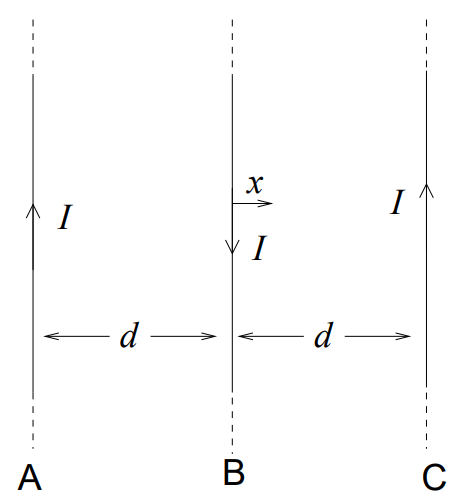
The wires carry equal currents \(I\) with directions as shown in the figure and have mass per unit length \(m\). If the wires A and C are held fixed and the wire B is displaced by a small distance \(x\) from its position, then it (B) will execute simple harmonic motion with a time period
(a)
\(2\pi \sqrt{\frac{m}{\pi \mu_0}}\left(\frac{d}{I}\right)\)
(b)
\(2\pi \sqrt{\frac{2\pi m}{\mu_0}}\left(\frac{d}{I}\right)\)
(c)
\(2\pi \sqrt{\frac{m}{2\pi \mu_0}}\left(\frac{d}{I}\right)\)
(d)
\(2\pi \sqrt{\frac{m}{\mu_0}}\left(\frac{d}{I}\right)\)
Check Answer
Option c
Q.No:2 TIFR-2014
A short solenoid with \(n\) turns per unit length has diameter \(D\) and length \(L=8D/15\), as shown in the figure, and it carries a constant current \(I\).


The magnetic field \(B\) at a point \(P\) on the axis of the solenoid at a distance \(H=2D/3\) from its near end (see figure) is
[use \(\int dx (1+x^2)^{-3/2}=x(1+x^2)^{-1/2}\)]
(a)
\(\frac{4}{65}\mu_0 nI\)
(b)
\(\frac{4}{13}\mu_0 nI\)
(c)
\(\frac{24}{15}\mu_0 nI\)
(d)
\(\frac{112}{65}\mu_0 nI\)
Check Answer
Option a
Q.No:3 TIFR-2015
Two semi-infinite solenoids placed next to each other are separated by a small gap of width \(W\) as shown in the figure.

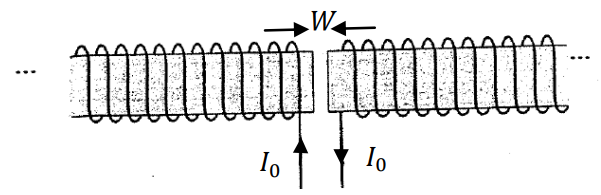
The current \(I_0\) in the solenoids flows in the direction as shown. If the solenoids have a circuit cross-section of radius \(R\) and are filled with a magnetic material of permeablity \(\mu\) (\(\mu>\mu_0\)), then the magnetic energy densities \(u_i\) inside the solenoid and \(u_g\) in the gap are best related by
(a)
\(u_g>u_i\)
(b)
\(u_g<u_i\)
(c)
\(u_g=cu_i\)
(d)
\(u_g>cu_i\)
Check Answer
Option a
Q.No:4 TIFR-2016
A circular loop of fine wire of radius \(R\) carrying a current \(I\) is placed in a uniform magnetic field \(B\) perpendicular to the plane of the loop. If the breaking tension of the wire is \(T_b\), the wire will break when the magnetic field exceeds
(a)
\(T_b/IR\)
(b)
\(T_b/2\pi IR\)
(c)
\(\mu_0 T_b/2\pi IR\)
(d)
\(\mu_0 T_b/4\pi IR\)
Check Answer
Option a
Q.No:5 TIFR-2016
In an ionization experiment conducted in the laboratory, different singly-charged positive ions are produced and accelerated simultaneously using a uniform electric field along the \(x\)-axis. If we need to determine the masses of various ions produced, which of the following methods will \(\underline{NOT}\) work
(a)
Detect them at a fixed distance from the interaction point along \(x\)-axis and measure their time of arrival.
(b)
Apply a uniform magnetic field along \(y\)-axis and measure the deviation.
(c)
Apply a uniform electric field along \(y\)-axis and measure the deviation.
(d)
Apply a uniform electric field along \(y\)-axis and a (variable) uniform magnetic field along \(z\)-axis simultaneously and note the zero deviation.
Check Answer
Option c
Q.No:6 TIFR-2019
Consider three straight, coplanar, parallel wires of infinite length where the distance between adjacent wires is \(d\). Each wire carries a current \(I\) in the same direction. The perpendicular distance from the middle wire (on either side) where the magnetic field vanishes is
(a)
\(d/\sqrt{3}\)
(b)
\(2d/3\)
(c)
\(d/3\)
(d)
\(2d/\sqrt{3}\)
Check Answer
Option a
Q.No:7 TIFR-2020
Four students were asked to write down possible forms for the magnetic vector potential \(\vec{A}(\vec{x})\) corresponding to a uniform magnetic field of magnitude \(B\) along the positive \(z\) direction. Three returned correct answers and one returned an incorrect answers. Their answers are reproduced below. Which was the incorrect answer?
(a)
\(Bx\hat{j}\)
(b)
\(-By\hat{i}\)
(c)
\(\frac{1}{2}(Bx\hat{i}-By\hat{j})\)
(d)
\(\frac{1}{2}(-By\hat{i}+Bx\hat{j})\)
Check Answer
Option a
Q.No:8 TIFR-2020
The magnetic vector potential \(\vec{A}=A_x \hat{i}+A_y \hat{j}+A_z\hat{k}\) is defined in a region \(R\) of space by
\[
A_x=5\cos{\pi y}
A_y=2+\sin{\pi x}
A_z=0
\]
in an appropriate unit.
If \(L\) be a square loop of wire in the \(x\)-\(y\) plane, with its ends at
\[
(0, 0)
(0, 0.25)
(0.25, 0.25)
\]
in an appropriate unit and it lies entirely in the region \(R\), the numerical value of the flux of the above magnetic field (in the same units) passing through \(L\) is
(a)
\(0.543\)
(b)
\(3.31\)
(c)
\(-0.75\)
(d)
zero
Check Answer
Option a
Q.No:9 TIFR-2022
An electromagnet is made by winding \(N\) turns of wire around a wooden cylinder of diameter \(d\) and passing a current \(I\) through it. When the current flows, a magnetic field of magnitude \(B\) is produced at a perpendicular distance \(z_0\) from the axis of the cylinder, where \(z_0 \gg d\).
If the number of turns \(N\), the diameter of the wooden cylinder \(d\) and the current \(I\) are all doubled, then the magnitude of the magnetic field will be \(B/2\) at a distance \(z\)=
(a)
3.2 \(z_0\)
(b)
0.5 \(z_0\)
(c)
4.8 \(z_0\)
(d)
2.4 \(z_0\)
Check Answer
Option a
Q.No:10 TIFR-2022
Two co-axial solenoids A and B, one placed completely inside the other, have the following parameters:


The mutual inductance between the solenoids is
(a)
1.58 mH
(b)
125.7 mH
(c)
395.0 mH
(d)
12.57 mH
Check Answer
Option a
Q.No:11 TIFR-2024
A mass spectrometer consists of a parallel plate capacitor with plates A and B that accelerates ions through an electric potential \( V \), which is followed by a box carrying a uniform magnetic field \( B \) of magnitude 0.2 Tesla (coming out of the page as shown).

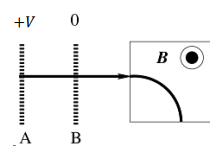
This setup is used to separate two isotopes of Uranium:
1) \( ^{235}U \) (mass = \( 3.93 \times 10^{-25} \) kg)
2) \( ^{238}U \) (mass = \( 3.98 \times 10^{-25} \) kg)
Singly charged ions (charge \( +e \)) of the two isotopes are created at the plate A and pass without energy loss through plate B into the box. In order to separate the isotopes, their radii of curvature in the box must differ by 2 mm. What is the approximate \( V \) through which the ions must be accelerated in order to achieve this?
(a) 800 Volts
(b) 8000 Volts
(c) 80 Volts
(d) 8 Volts
Check Answer
Option a
Q.No:12 TIFR-2025
An experimental set–up needs to be kept in an environment with zero magnetic field
by minimizing the Earth’s magnetic field. This can be achieved by:
a) Keeping the setup in a place completely covered with a sheet of metal of very
high magnetic permeability
b) Keeping the setup in a place completely covered with a sheet of metal of very
high permittivity
c) Keeping the setup at the centre of the interior of a long solenoid
d) Keeping the setup in a place completely covered with a sheet of an insulating
material
Check Answer
Option a
Q.No:13 TIFR-2025
A negative electric charge \(-q\) moves in a (classical) circular orbit at a non-relativistic
speed \(v\) around a positive charge. The magnetic field at the centre of the circular
orbit due to the negative charge is found to be \(B_{1}\). Now, consider another situation
where a negative charge \(-2q\) moves in a circular orbit at the same speed \(v\) around
the same positive charge. The magnetic field at the centre of the circular orbit in this
case is \(B_{2}\). What is the ratio \(B_{2}/B_{1}\)?
a) 1/2
b) 1
c) 2
d) 4
Check Answer
NO OPTIONS ARE CORRECT
Q.No:14 TIFR-2025
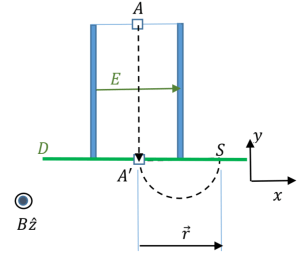
There is a uniform electric field \(E\hat{x}\) between two parallel plates of a capacitor
(parallel to the \(xz\)-plane). The plates are placed in a uniform magnetic field
\(B\hat{z}\) which fills the entire region (inside and outside the capacitor). Charged
particles enter the capacitor through a small aperture \(A\). They exit from a small
aperture \(A'\) at the other end, if they do not deviate from a straight line path.
There is a detector plate \(D\) in the \(xz\)-plane passing through \(A'\). \(D\) detects
where the particles impinge. What is the displacement vector \(\vec{r}\) between the
impact point \(S\) and the aperture \(A'\) for a particle with mass \(m\) and charge
\(q\)? (This device is a simple version of a mass spectrometer.)

a) \(-\frac{2mE}{qB^{2}}\hat{x}\)
b) \(-\frac{mE}{qB^{2}}\hat{x}\)
c) \(-\frac{mE}{2qB^{2}}\hat{x}\)
d) \(\frac{mE}{qB^{2}}\hat{x}\)