

CAUTION : Try solving the problem yourself for at least 5–10 minutes before clicking the AI Assistant. In the exam hall, you will be on your own.
Q.No:1 GATE-2013
Interference fringes are seen at an observation plane \(z=0\), by the superposition of two plane waves \(A_1 \exp{[i(\vec{k}_1.\vec{r}-\omega t)]}\) and \(A_2 \exp{[i(\vec{k}_2.\vec{r}-\omega t)]}\), where \(A_1\) and \(A_2\) are real amplitudes. The condition for interference maximum is
(A)
\((\vec{k}_1-\vec{k}_2).\vec{r}=(2m+1)\pi\)
(B)
\((\vec{k}_1-\vec{k}_2).\vec{r}=2m\pi\)
(C)
\((\vec{k}_1+\vec{k}_2).\vec{r}=(2m+1)\pi\)
(D)
\((\vec{k}_1+\vec{k}_2).\vec{r}=2m\pi\)
Check Answer
Option B
Q.No:2 GATE-2014
In an interference pattern formed by two coherent sources, the maximum and the minimum of the intensities are \(9I_0\) and \(I_0\), respectively. The intensities of the individual waves are
(A)
\(3I_0\) and \(I_0\)
(B)
\(4I_0\) and \(I_0\)
(C)
\(5I_0\) and \(4I_0\)
(D)
\(9I_0\) and \(I_0\)
Check Answer
Option B
Q.No:3 GATE-2015
A plane wave \((\hat{x}+i\hat{y})E_0\exp{[i(kz-\omega t)]}\) after passing through an optical element emerges as \((\hat{x}-i\hat{y})E_0\exp{[i(kz-\omega t)]}\), where \(k\) and \(\omega\) are the wavevector and the angular frequency, respectively. The optical element is a
(A)
quarter wave plate
(B)
half wave plate
(C)
polarizer
(D)
Faraday rotator
Check Answer
Option B
Q.No:4 GATE-2015
A monochromatic plane wave (\(\text{wavelength}=600 nm\)) \(E_0\exp{[i(kz-\omega t)]}\) is incident normally on a diffraction grating giving rise to a plane wave \(E_1 \exp{[i(\vec{k}_1\cdot \vec{r}-\omega t)]}\) in the first order of diffraction. Here \(E_1<E_0\) and \(\vec{k}_1=|\vec{k}_1| \left[\frac{1}{2}\hat{x}+\frac{\sqrt{3}}{2}\hat{z}\right]\). The period (in \(\mu m\)) of the diffraction grating is __________ (upto one decimal place)
Check Answer
Ans 1.2
Q.No:5 GATE-2016
In a Young's double slit experiment using light, the apparatus has two slits of unequal widths. When only slit-\(1\) is open, the maximum observed intensity on the screen is \(4I_0\). When only slit-\(2\) is open, the maximum observed intensity is \(I_0\). When both the slits are open, an interference pattern appears on the screen. The ratio of the intensity of the principal maximum to that of the nearest minimum is ________________.
Check Answer
Ans 9
Q.No:6 GATE-2017
Light is incident from a medium of refractive index \(n=1.5\) onto vacuum. The smallest angle of incidence for which the light is not transmitted into vacuum is __________ degrees. (up to two decimal places).
Check Answer
Ans 41.60-42.00
Q.No:7 GATE-2018
A quarter wave plate introduces a path difference of \(\lambda/4\) between the two components of polarization parallel and perpendicular to the optic axis. An electromagnetic wave with \(\vec{E}=(\hat{x}+\hat{y})E_0 e^{i(kz-\omega t)}\) is incident normally on a quarter wave plate which has its optic axis making an angle \(135^{\circ}\) with the \(x\)-axis as shown


The emergent electromagnetic wave would be
(A)
elliptically polarized
(B)
circularly polarized
(C)
linearly polarized with polarization as that of incident wave
(D)
linearly polarized but with polarization at \(90^{\circ}\) to that of the incident wave
Check Answer
Option C
Q.No:8 GATE-2019
The electric field of an electromagnetic wave is given by \(\vec{E}=3\sin{(kz-\omega t)}\hat{x}+4\cos{(kz-\omega t)}\hat{y}\). The wave is
(A)
linearly polarized at an angle \(\tan^{-1}{\left(\frac{4}{3}\right)}\) from the \(x\)-axis
(B)
linearly polarized at an angle \(\tan^{-1}{\left(\frac{3}{4}\right)}\) from the \(x\)-axis
(C)
elliptically polarized in clockwise direction when seen travelling towards the observer
(D)
elliptically polarized in counter-clockwise direction when seen travelling towards the observer
Check Answer
Option D
Q.No:9 GATE-2019
In a set of \(N\) successive polarizers, the \(m^{\text{th}}\) polarizer makes an angle \(\left(\frac{m\pi}{2N}\right)\) with the vertical. A vertically polarized light beam of intensity \(I_0\) is incident on two such sets with \(N=N_1\) and \(N=N_2\), where \(N_2>N_1\). Let the intensity of light beams coming out be \(I(N_1)\) and \(I(N_2)\), respectively. Which of the following statements is correct about the two outgoing beams?
(A)
\(I(N_2)>I(N_1)\); the polarization in each case is vertical
(B)
\(I(N_2)<I(N_1)\); the polarization in each case is vertical
(C)
\(I(N_2)>I(N_1)\); the polarization in each case is horizontal
(D)
\(I(N_2)<I(N_1)\); the polarization in each case is horizontal
Check Answer
Option C
Q.No:10 GATE-2022
A student sets up Young's double slit experiment with electrons of momentum \(p\) incident normally on the slits of width \(w\) separated by distance \(d\). In order to observe interference fringes on a screen at a distance \(D\) from the slits, which of the following conditions should be satisfied?
(a)
\(\frac{\hbar}{p}>\frac{Dw}{d}\)
(b)
\(\frac{\hbar}{p}>\frac{dw}{D}\)
(c)
\(\frac{\hbar}{p}>\frac{d^2}{D}\)
(d)
\(\frac{\hbar}{p}>\frac{d^2}{\sqrt{Dw}}\)
Check Answer
Option b
Q.No:11 GATE-2023
Young’s double slit experiment is performed using a beam of \(C_{60}\) (fullerene) molecules, each molecule being made up of 60 carbon atoms. When the slit separation is 50 nm, fringes are formed on a screen kept at a distance of 1 m from the slits. Now, the experiment is repeated with \(C_{70}\) molecules with a slit separation of 92.5 nm. The kinetic energies of both the beams are the same. The position of the \(4^{th}\) bright fringe for \(C_{60}\) will correspond to the \(n^{th}\) bright fringe for \(C_{70}\). What is the value of \(n\) (rounded off to the nearest integer) ?
(A)
5
(B)
6
(C)
7
(D)
8
Check Answer
Option D
Q.No:12 GATE-2023
Different spectral lines of the Balmer series (transitions\(n \to 2\), with \(n\) being the principal quantum number) fall one at a time on a Young’s double slit apparatus. The separation between the slits is \(d\) and the screen is placed at a constant distance from the slits. What factor should \(d\) be multiplied by to maintain a constant fringe
width for various lines, as \(n\) takes different allowed values?
(A)
\(\frac{n^2-4}{4n^2}\)
(B)
\(\frac{n^2+4}{4n^2}\)
(C)
\(\frac{4n^2}{n^2-4}\)
(D)
\(\frac{4n^2}{n^2+4}\)
Check Answer
Option C
Q.No:13 GATE-2026
For the electric field of an electromagnetic wave given below, which of the following statements is correct?
\[
\vec{E} = \hat{x} E_0 \cos(\omega t)
+ \hat{y}\, 2E_0 \cos\left(\omega t + \frac{\pi}{2}\right)
\]
A) The electric field is linearly polarised with slope 2.
B) The electric field is circularly polarised with radius \(E_0\).
C) The electric field is elliptically polarised with a ratio of major to minor axis being 2.
D) The electric field is unpolarised with the two components being phase shifted by \(\pi/2\).
Check Answer
Option C
Q.No:1 CSIR Dec-2014
A parallel beam of light of wavelength \(\lambda\) is incident normally on a thin polymer film with air on both sides. If the film has refractive index \(n>1\), then second-order bright fringes can be observed in reflection when the thickness of the film is
(1)
\(\lambda/4n\)
(2)
\(\lambda/2n\)
(3)
\(3\lambda/4n\)
(4)
\(\lambda/n\)
Check Answer
Option 3
Q.No:2 CSIR Dec-2014
When laser light of wavelength \(\lambda\) falls on a metal scale with \(1 mm\) engravings at a grazing angle of incidence, it is diffracted to form a vertical chain of diffraction spots on a screen kept perpendicular to the scale. If the wavelength of the laser is increased by \(200 nm\), the angle of the first-order diffraction spot changes from \(5^{\circ}\) to
(1)
\(6.60^{\circ}\)
(2)
\(5.14^{\circ}\)
(3)
\(5.018^{\circ}\)
(4)
\(5.21^{\circ}\)
Check Answer
Option 2
Q.No:3 CSIR Dec-2016
A screen has two slits, each of width \(w\), with their centres at a distance \(2w\) apart. It is illuminated by a monochromatic plane wave travelling along the \(x\)-axis.


The intensity of the interference pattern, measured on a distant screen, at an angle \(\theta=n\lambda/w\) to the \(x\)-axis is
(1)
zero for \(n=1, 2, 3 ...\)
(2)
maximum for \(n=1, 2, 3 ...\)
(3)
maximum for \(n=\frac{1}{2}, \frac{3}{2}, \frac{5}{2} ...\)
(4)
zero for \(n=0\) only
Check Answer
Option 1
Q.No:4 CSIR Dec-2016
The electric field of an electromagnetic wave is \(\vec{E}(z, t)=E_0 \cos{(kz+\omega t)}\hat{i}+2E_0\sin{(kz+\omega t)}\hat{j}\), where \(\omega\) and \(k\) are positive constants. This represents
(1)
a linearly polarised wave travelling in the positive \(z\)-direction
(2)
a circularly polarised wave travelling in the negative \(z\)-direction
(3)
an elliptically polarised wave travelling in the negative \(z\)-direction
(4)
an unpolarised wave travelling in the positive \(z\)-direction
Check Answer
Option 3
Q.No:5 CSIR Dec-2016
A pair of parallel glass plates separated by a distance \(d\) is illuminated by white light as shown in the figure below. Also shown is the graph of the intensity of the reflected light \(I\) as a function of the wavelength \(\lambda\) recorded by a spectrometer.

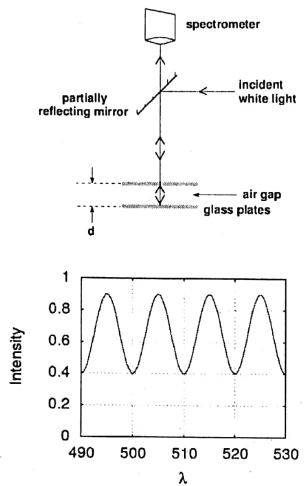
Assuming that the interference takes place only between light reflected by the bottom surface of the top plate and the top surface of bottom plate, the distance \(d\) is closest to
(4)
\(12 \mu m\)
(4)
\(24 \mu m\)
(4)
\(60 \mu m\)
(4)
\(120 \mu m\)
Check Answer
Option 1
Q.No:6 CSIR June-2016
The figure below describes the arrangement of slits and screens in a Young's double slit experiment. The width of the slit in \(S_1\) is \(a\) and the slits in \(S_2\) are of negligible width.


If the wavelength of the light is \(\lambda\), the value of \(d\) for which the screen would be dark is
(1)
\(b\sqrt{\left(\frac{a}{\lambda}\right)^2-1}\)
(2)
\(\frac{b}{2}\sqrt{\left(\frac{a}{\lambda}\right)^2-1}\)
(3)
\(\frac{a}{2}\left(\frac{b}{\lambda}\right)^2\)
(4)
\(\frac{ab}{\lambda}\)
Check Answer
Option 2
Q.No:7 CSIR June-2018
The following configuration of three identical narrow slits are illuminated by monochromatic light of wavelength \(\lambda\) (as shown in the figure below). The intensity is measured at an angle \(\theta\) (where \(\theta\) is the angle with the incident beam) at a large distance from the slits. If \(\delta=\frac{2\pi d}{\lambda}\sin{\theta}\), the intensity is proportional to


(1)
\(2\cos{\delta}+2\cos{2\delta}\)
(2)
\(3+\frac{1}{\delta^2}\sin^2{3\delta}\)
(3)
\(3+2\cos{\delta}+2\cos{2\delta}+2\cos{3\delta}\)
(4)
\(2+\frac{1}{\delta^2}\sin^2{3\delta}\)
Check Answer
Option 3
Q.No:8 CSIR Dec-2018
A monochromatic and linearly polarised light is used in a Young's double slit experiment. A linear polarizer, whose pass axis is at an angle \(45^{\circ}\) to the polarization of the incident wave, is placed in front of one of the slits. If \(I_{max}\) and \(I_{min}\), respectively, denote the maximum and minimum intensities of the interference pattern on the screen, the visibility, defined as the ratio \(\frac{I_{max}-I_{min}}{I_{max}+I_{min}}\), is
(1)
\(\frac{\sqrt{2}}{3}\)
(2)
\(\frac{2}{3}\)
(3)
\(\frac{2\sqrt{2}}{3}\)
(4)
\(\sqrt{\frac{2}{3}}\)
Check Answer
Option 2
Q.No:9 CSIR June-2019
Two coherent plane electromagnetic waves of wavelength \(0.5 \mu m\) (both have the same amplitude and are linearly polarized along the \(z\)-direction) fall on the \(y=0\) plane. Their wave vectors \(\mathbf{k}_1\) and \(\mathbf{k}_2\) are as shown in the figure.


If the angle \(\theta\) is \(30^{\circ}\), the fringe spacing of the interference pattern produced on the plane is
(1)
\(1.0 \mu m\)
(2)
\(0.29 \mu m\)
(3)
\(0.58 \mu m\)
(4)
\(0.5 \mu m\)
Check Answer
Option 4
Q.No:10 CSIR Dec-2019
The phase difference between two small oscillating electric dipoles, separated by a distance \(d\), is \(\pi\). If the wavelength of the radiation is \(\lambda\), the condition for constructive interference between the two dipolar radiations at a point \(P\) when \(r\gg d\) (symbols are as shown in the figure, and \(n\) is an integer) is


(1)
\(d\sin{\theta}=\left(n+\frac{1}{2}\right)\lambda\)
(2)
\(d\sin{\theta}=n\lambda\)
(3)
\(d\cos{\theta}=n\lambda\)
(4)
\(d\cos{\theta}=\left(n+\frac{1}{2}\right)\lambda\)
Check Answer
Option 1
Q.No:11 Assam CSIR Dec-2019
A swimmer stands at the edge of a swimming pool of uniform depth filled with water. Let \(d(x)\) denote the depth, as it appears to her, at a distance \(x\) measured along the bottom of the pool. Which of the following plots best represents \(d(x)\)?


Check Answer
Option 2
Q.No:12 Assam CSIR Dec-2019
Which of the following represents the electric field of a circularly polarized electromagnetic wave?
(1)
\(E\cos{(\omega t-kz)}\hat{i}+E\cos{(\omega t-kz)}\hat{j}\)
(2)
\(E\cos{(\omega t-kz)}\hat{i}+E\sin{(\omega t-kz)}\hat{j}\)
(3)
\(E\cos{(\omega t-kz)}\hat{i}+E\sin{(\omega t-kz)}\hat{k}\)
(4)
\(E\cos{(\omega t-kz)}\hat{j}+E\cos{(\omega t-kz)}\hat{k}\)
Check Answer
Option 2
Q.No:13 CSIR June-2020
The following figure shows the intensity of the interference pattern in the Young's double-slit experiment with two slits of equal width is observed on a distant screen


If the separation between the slits is doubled and the width of each of the slits is halved, then the new interference pattern is best represented by


Check Answer
Option b
Q.No:14 CSIR June-2024
A finite sized light source is used in a double slit experiment. The observed intensity pattern changes from figure (a) to figure (b), as shown below.


The observed change can occur due to:
1) narrowing of the slits.
2) a reduction in the distance between the slits.
3) a decrease in the coherence length of the light source.
4) a reduction in the size of the light source.
Check Answer
Option 3
Q.No:15 CSIR Dec-2024
A narrow horizontal slit is illuminated by an extended sodium lamp. A thin Fresnel biprism with its edge aligned perpendicular to the slit is positioned, as shown in the figure.
Given that the length of the slit is larger than the base of the biprism, the pattern of illumination on the screen is best described by

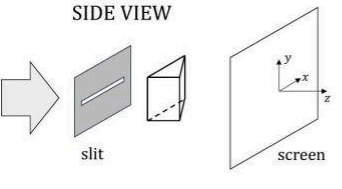

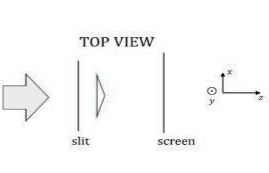
1) Fringes in both \(x\) and \(y\) direction.
2) Almost uniform illumination.
3) Horizontal fringes periodic only along the \(x\)-axis.
4) Horizontal fringes periodic only along the \(y\)-axis.
Check Answer
Option 2
Q.No:16 CSIR Dec-2024
A grating spectrometer in vacuum, illuminated by \(500\,\text{nm}\) light, gives first–order spectrum at an angle of \(20^\circ\). When the vacuum chamber is filled with Argon gas at pressure \(P\), this angle
1) increases, due to increase in the refractive index of the medium
2) decreases, due to increase in the refractive index of the medium
3) decreases, due to decrease in the frequency of light in argon gas
4) increases, due to decrease in the frequency of light in argon gas
Check Answer
Option 2
Q.No:17 CSIR Dec-2024
When a photographic film is exposed to light, the electric field of light causes the film to turn dark after chemical processing. A photographic film of thickness \(50\,\text{nm}\) is kept inclined to a shiny metal surface at an angle of \(\theta = 0.01\,\text{radian}\), as shown in the figure.
After exposing this film to a linearly polarized beam of light of wavelength \(500\,\text{nm}\) incident normally to the metal surface, it developed periodic bright bands. We can explain this observation as the proof of

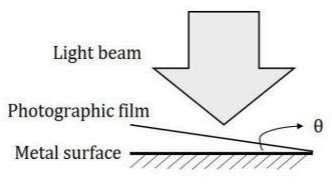
1) Interference between the incident wave and the wave reflected from the surface of the metal.
2) Diffraction pattern produced by the photographic film.
3) Interference of light due to the presence of photographic film.
4) Polarization of light due to photographic film.
Check Answer
Option 1
Q.No:18 CSIR June-2025
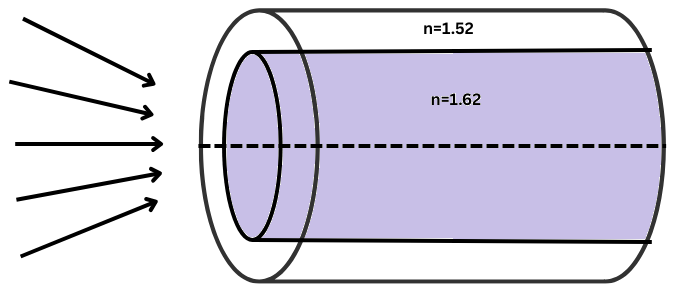
A 1 km long optical fiber of core and clad refractive indices 1.62 and 1.52, respectively, is laid in a straight line. Several identical light pulses are launched simultaneously from air on the entrance of this fiber from different angles about its axis, as shown below. The diameter of the fiber is small compared to its length. The maximum time difference between the pulses emerging at the other end of the fiber would be closest to

1) \(355\ \text{ns}\)
2) \(317\ \text{ns}\)
3) \(5.40\ \mu\text{s}\)
4) \(5.75\ \mu\text{s}\)
Check Answer
Option 1
Q.No:19 CSIR June-2025
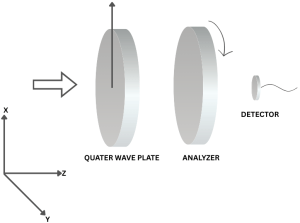
A beam of light along the \(z\)–axis passes through a quarter wave plate and an analyzer as shown in the figure.
The fast axis of the quarter wave plate is aligned with the \(x\)–axis. The light intensity is measured by a detector placed after the analyzer.
Consider two scenarios where the incident light beam is (a) circularly polarized and (b) linearly polarized along the \(x\)–axis. If the polarization axis of the analyzer is rotated by one full cycle about the \(z\)–axis, the number of times the detector measures the maximum intensity in each case would be

1) (a) 4 and (b) 0
2) (a) 2 and (b) 0
3) (a) 4 and (b) 4
4) (a) 2 and (b) 2
Check Answer
Option 4
Q.No:20 CSIR June-2025
A highly collimated laser beam with a diameter of \(1\,\text{cm}\) and wavelength \(500\,\text{nm}\) is directed from the earth’s surface towards the moon (\(\sim 384{,}000\,\text{km}\) away from the earth). Assuming ideal diffraction-limited propagation in vacuum, which of the following best estimates the diameter of the beam upon returning to the earth after reflection from an ideal reflector installed on the moon.
1) \(200\,\text{m}\)
2) \(20\,\text{m}\)
3) \(20\,\text{km}\)
4) \(200\,\text{km}\)