

CAUTION : Try solving the problem yourself for at least 5–10 minutes before clicking the AI Assistant. In the exam hall, you will be on your own.
Q.No:1 JEST-2012
When unpolarised light is incident on a glass plate at a particular angle, it is observed that the reflected beam is linearly polarised. What is the angle of the refracted beam with respect to the surface normal? Refractive index of glass is \(1.52\)
(a)
\(56.7^{\circ}\)
(b)
\(33.4^{\circ}\)
(c)
\(23.3^{\circ}\)
(d)
The light is completely reflected and there is no refracted beam.
Check Answer
Option b
Q.No:2 JEST-2014
For an optical fiber with core and cladding index of \(n_1=1.45\) and \(n_2=1.44\), respectively, what is the approximate cut-off angle of incidence? Cut-off angle of incidence is defined as the incidence angle below which light will be guided.
(a)
\(7^{\circ}\)
(b)
\(22^{\circ}\)
(c)
\(5^{\circ}\)
(d)
\(0^{\circ}\)
Check Answer
Option
Q.No:3 JEST-2014
A spherical air bubble is embedded in a glass slab. It will behave like a
(a)
Cylindrical lens
(b)
Achromatic lens
(c)
Converging lens
(d)
Diverging lens
Check Answer
Option d
Q.No:4 JEST-2014
The resolving power of a grating spectrograph can be improved by
(a)
recording the spectrum in the lowest order
(b)
using a grating with longer grating period
(c)
masking a part of the grating surface
(d)
illuminating the grating to the maximum possible extent
Check Answer
Option d
Q.No:5 JEST-2014
Three sinusoidal waves have the same frequency with amplitude \(A, A/2\) and \(A/3\) while their phase angles are \(0, \pi/2\) and \(\pi\) respectively. The amplitude of the resultant wave is
(a)
\(\frac{11A}{6}\)
(b)
\(\frac{2A}{3}\)
(c)
\(\frac{5A}{6}\)
(d)
\(\frac{7A}{6}\)
Check Answer
Option c
Q.No:6 JEST-2015
The wavelength of red helium-neon laser in air is \(6328\) Angstroms. What happens to its frequency in glass that has a refractive index of \(1.50\)?
(a)
Increases by a factor of \(3\)
(b)
Decreases by a factor of \(1.5\)
(c)
Remains the same
(d)
Decreases by a factor of \(0.5\)
Check Answer
Option c
Q.No:7 JEST-2015
Let \(\lambda\) be the wavelength of incident light. The diffraction pattern of a circular aperture of dimension \(r_0\) will transform from Fresnel to Fraunhofer regime if the screen distance \(z\) is,
(a)
\(z\gg \frac{r_0^2}{\lambda}\)
(b)
\(z\gg \frac{\lambda^2}{r_0}\)
(c)
\(z\ll \frac{\lambda^2}{r_0}\)
(d)
\(z\gg \frac{r_0^2}{\lambda}\)
Check Answer
Option a
Q.No:8 JEST-2016
The electric field \(\vec{E}=E_0\sin{(\omega t-kz)}\hat{x}+2E_0\sin{(\omega t-kz+\pi/2)}\hat{y}\) represents:
(A)
a linearly polarized wave
(B)
a right-hand circularly polarized wave
(C)
a left-hand circularly polarized wave
(D)
an elliptically polarized wave
Check Answer
Option D
Q.No:9 JEST-2016
Circular fringes are obtained with a Michelson interferometer using \(600 nm\) laser light. What minimum displacement of one mirror will make the central fringe from bright to dark?
(A)
\(600 nm\)
(B)
\(300 nm\)
(C)
\(150 nm\)
(D)
\(120\) Angstroms
Check Answer
Option C
Q.No:10 JEST-2017
A thin air film of thickness \(d\) is formed in a glass medium. For normal incidence, the condition for constructive interference in the reflected beam is (in terms of wavelength \(\lambda\) and integer \(m=0, 1, 2...\))
(A)
\(2d=(m-1/2)\lambda\).
(B)
\(2d=m\lambda\).
(C)
\(2d=(m-1)\lambda\).
(D)
\(2\lambda=(m-1/2)d\).
Check Answer
Option A
Q.No:11 JEST-2019
The refractive index (\(n\)) of the entire environment around a double slit interference setup is changed from \(n=1\) to \(n=2\). Which one of the following statements is correct about the change in the interference pattern?
(A)
The fringe pattern disappears
(B)
The central bright maximum turns dark, i.e. becomes a minimum
(C)
Fringe width of the pattern increases by a factor \(2\)
(D)
Fringe width of the pattern decreases by a factor \(2\)
Check Answer
Option D
Q.No:12 JEST-2019
A collimated white light source illuminates the slits of a double slit interference setup and forms the interference pattern on a screen. If one slit is covered with a blue filter, which one of the following statements is correct?
(A)
No interference pattern is observed after the slit is covered with the blue filter
(B)
Interference pattern remains unchanged with and without the blue filter
(C)
A blue interference pattern is observed
(D)
The central maximum is blue with coloured higher order maxima
Check Answer
Option C
Q.No:13 JEST-2019
White light of intensity \(I_0\) is incident normally on a filter plate of thickness \(d\). The plate has a wavelength (\(\lambda\)) dependent absorption coefficient \(\alpha(\lambda)=\alpha_0\left(1-\frac{\lambda}{\lambda_0}\right)^2\) per unit length. The band pass edge of the filter is defined as the wavelength at which the intensity, after passing through the filter, is \(I=\frac{I_0}{\rho}\). \(\alpha_0, \lambda_0\) and \(\rho\) are constants. The reflection coefficient of the plate may be assumed to be independent of \(\lambda\). Which one of the following statements is true about the bandwidth of the filter?
(A)
The bandwidth is linearly dependent on \(\lambda_0\)
(B)
The bandwidth is independent of the plate thickness \(d\)
(C)
The bandwidth is linearly dependent on \(\alpha_0\)
(D)
The bandwidth is dependent on the ratio \(\alpha_0/d\)
Check Answer
Option A
Q.No:14 JEST-2019
In the Young's double slit experiment (screen distance \(D=50 cm\) and slit separation \(d=0.1 cm\)), a thin mica sheet of refractive index \(n=1.5\) is introduced in the path of one of the beams. If the central fringe gets shifted by \(0.2 cm\), what is the thickness (in micrometer) of the mica sheet?
Check Answer
Ans 8
Q.No:15 JEST-2020
Three polarizers are stacked, normal to a central axis, along which is incident a beam of unpolarized light of intensity \(I_0\). The first and the third polarizers are perpendicular to each other and the middle polarizer is rotated at an angular frequency \(\omega\) about the central axis (light beam). The time dependent intensity of light emerging after the third polarizer will be given by
(A)
\(I(t)=(I_0/16)\{1-\cos{(4\omega t)}\}\)
(B)
\(I(t)=(I_0/8)\{1-\cos{(2\omega t)}\}\)
(C)
\(I(t)=(I_0/4)\{1-2\cos{\omega t}\}\)
(D)
\(I(t)=(I_0/2)\cos^2{\omega t}\)
Check Answer
Option A
Q.No:16 JEST-2020
A thin film of water having refractive index \(n=1.333\) floats on the surface of a beaker of silicone oil having refractive index \(n_s=1.40\). The arrangement is illuminated by \(600 nm\) light incident normally from top and a large region of the film appears bright red. What is the minimum possible thickness of the film (in nm)?
Check Answer
Ans 225
Q.No:17 JEST-2021
A monochromatic linearly polarized light with electromagnetic field \(\vec{E}=E_0\sin{(\omega t-kz)}(\hat{\mathbf{x}}+\hat{\mathbf{y}})\) is incident normally on a birefringent calcite crystal. The wavelength of the wave is \(590 \text{nm}\) and the refractive indices of the crystal along the \(x\)- and \(y\)-directions are \(1.66\) and \(1.49\), respectively. If the thickness of the crystal is \(434 \text{nm}\), what will be the polarization of the light that emerges from the crystal?
(A)
Linearly polarized along the same axis as the incident light
(B)
Linearly polarized but along a different axis than the incident light
(C)
Circularly polarized
(D)
Neither linearly nor circularly polarized but elliptically polarized
Check Answer
Option D
Q.No:18 JEST-2021
A glass sphere of radius \(R\) and refractive index \(n\) acts like a lens with focal length
(A)
\(-\frac{nR}{2(n-1)}\)
(B)
\(+\frac{nR}{2(n-1)}\)
(C)
\(-\frac{nR}{2(n-1)^2}\)
(D)
\(+\frac{nR}{2(n-1)^2}\)
Check Answer
Option B
Q.No:19 JEST-2021
A flat soap film has a uniform thickness of \(510 \text{nm}\). White light (having wavelengths in the range of about \(390\)--\(700 \text{nm}\)) is incident normally on the film. If the refractive index of the soap is \(1.33\), what will be the dominant colour of the reflected light?
(A)
Violet
(B)
Green
(C)
Red
(D)
White
Check Answer
Option B
Q.No:20 JEST-2021
An ideal polariser is placed in between two crossed polarisers in a coaxial geometry as shown. The middle polariser is rotated at the angular speed of \(\omega\) about the common axis. If unpolarised light of intensity \(I_0\) is incident on this system, the emergent intensity of the light would be


(A)
\(\frac{I_0}{8}[1-\cos{4\omega t}]\)
(B)
\(\frac{I_0}{16}[1-\cos{4\omega t}]\)
(C)
\(\frac{I_0}{16}[1-\cos{\omega t}]\)
(D)
\(\frac{I_0}{16}[1-\frac{1}{2}\cos{\omega t}]\)
Check Answer
Option B
Q.No:21 JEST-2022
A pair of crossed ideal linear polarizers allow no light to pass through. To produce some output one can insert optical elements between the crossed polarizers. For given light beam of input intensity \(I_0\), Nirmalya inserts a quarter-wave plate between the crossed polarizers and records an output intensity \(\alpha I_0\). On the other hand, Ayan inserts two linear polarizers having orientations \(30^{\circ}\) and \(60^{\circ}\) w.r.t. the first polarizer of the crossed pair, and records an output intensity of \(\beta I_0\). What is the ratio \(\frac{\alpha}{\beta}\)?
Check Answer
Ans 1.19
Q.No:22 JEST-2023
Two linear polarizers are placed coaxially with the transmission axis of the first polarizer in the vertical orientation and the second polarizer in the horizontal orientation. A half waveplate placed coaxially between these crossed polarizers is rotating about its axis at an angular frequency \(\omega\). At \(t = 0\), the fast axis of the half waveplate was oriented vertically. A beam of unpolarized light of intensity \(I_0\) is incident along the axis of this optical system. The output intensity measured by a detector after the beam passes through this optical system is
(a) \(\frac{I_0}{4} [1+ cos\hspace{0.5mm} (\omega t)]\)
(b) \(\frac{I_0}{4} [1- cos\hspace{0.5mm} (2\omega t)]\)
(c) \(\frac{I_0}{4} [1- cos\hspace{0.5mm} (4 \omega t)]\)
(d) \(\frac{I_0}{2} [1- cos\hspace{0.5mm} (\omega t)]\)
Check Answer
Option c
Q.No:23 JEST-2023
If linearly polarized light is sent through two polarizers, the first at \(45^\circ\) to the original axis of polarization and the second at \(90^\circ\) to the original axis of polarization, what fraction of the
original intensity passes through the last polarizer?
(a) \(\frac{1}{2}\)
(b) \(\frac{1}{4}\)
(c) \(0\)
(d) \(\frac{1}{8}\)
Check Answer
Option b
Q.No:24 JEST-2023
A right-angled prism is placed in air (the refractive index of air is 1) and a light beam is incident perpendicular to the base of the prism as shown in the figure. In order to get the light beam totally reflected, the minimum value of the refractive index of the prism should be


(a) \(1\)
(b) \(\frac{\sqrt{3}}{2}\)
(c) \(\frac{\pi}{2}\)
(d) \(\sqrt{2}\)
Check Answer
Option d
Q.No:25 JEST-2024
A step index optical fiber has refractive indices \( n_1 = 1.474 \) for core region and \( n_2 = 1.470 \) for the cladding region. A ray of light is incident from air into the core through the cross section of the fiber at an angle \( \theta \) with the normal. What is the limiting value of \( \theta \) below which the light ray will be totally internally reflected? Refractive index of air is taken as 1.


(a) \( 6.229^\circ \)
(b) \( 58.194^\circ \)
(c) \( 2.862^\circ \)
(d)\( 4.222^\circ \)
Check Answer
Option a
Q.No:26 JEST-2024
What is the right sequence of optical components to convert unpolarized light into circularly polarized light?
(a) Light source \(\rightarrow\) linear polarizer \(\rightarrow\) quarter wave plate
(b) Light source \(\rightarrow\) quarter wave plate \(\rightarrow\) half wave plate
(c) Light source \(\rightarrow\) linear polarizer \(\rightarrow\) half wave plate
(d) Light source \(\rightarrow\) half wave plate \(\rightarrow\) quarter wave plate
Check Answer
Option a
Q.No:27 JEST-2024
An object of height \( 10 \, \text{mm} \) is located \( 150 \, \text{mm} \) to the left of a thin lens of focal length \( +50 \, \text{mm} \). A second thin lens of focal length \( -100 \, \text{mm} \) is to be placed to the right of the first lens such that the real image of the object is located \( 100 \, \text{mm} \) to the right of the second lens. What should be the separation in mm between the two lenses?
Check Answer
Ans 25
Q.No:28 JEST-2025
A wire of length \(0.01\,\text{mm}\) is placed perpendicular to the axis of a thin convex lens, \(30\,\text{cm}\) from its center. If the focal length of the lens is \(20\,\text{cm}\), what is the length of the image of the wire?
a) \(0.02\,\text{mm}\)
b) \(0.03\,\text{mm}\)
c) \(0.01\,\text{mm}\)
d) \(1\,\text{mm}\)
Check Answer
Option a
Q.No:29 JEST-2025
The Fraunhofer diffraction pattern formed by an elliptical aperture will be
a) elliptical with the semi–major axis parallel to that of the aperture.
b) circular.
c) elliptical with the semi–major axis perpendicular to that of the aperture.
d) hyperbolic.
Check Answer
Option c
Q.No:30 JEST-2025
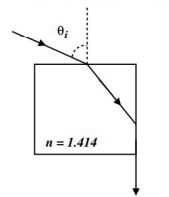
A ray of light is incident on a glass cube of refractive index \(1.414\) as shown in the figure.
Find the angle of incidence \(\theta_{i}\), such that the ray grazes down the side of the glass cube.

a) \(\pi/4\)
b) \(\pi/3\)
c) \(0\)
d) \(\pi/2\)
Check Answer
Option d
Q.No:31 JEST-2025
The Fraunhofer diffraction intensity pattern for light of wavelength \(\lambda\) by a single slit of width \(a\) is given by
\[
I = A_{0}^{2}\left(\frac{\sin{\beta}}{\beta}\right)^{2}
\]
where \(A_{0}\) is the intensity of the central maximum and
\[
\beta = \frac{\pi a \sin\theta}{\lambda},
\]
\(\theta\) being the angle with the incident beam. What is the angular separation, in milli–radians, between the two first minima on two sides of the central beam, if \(a = 1\,\text{mm}\) and \(\lambda = 5000\,\text{Å}\)?
Check Answer
ANS 1
Q.No:32 JEST-2026
In Young's double slit set-up, the screen is placed at a distance \(D=150\ \text{cm}\) from the slits. At a point \(P\) on the screen, the second maximum is being observed. What is the minimum amount by which \(D\) should be increased so that \(P\) becomes a minimum?
a) \(80\ \text{cm}\)
b) \(20\ \text{cm}\)
c) \(50\ \text{cm}\)
d) \(30\ \text{cm}\)
Check Answer
Option d
Q.No:33 JEST-2026
Consider a Newton’s rings experiment with a biconvex lens of diameter \(20\ \text{cm}\) and maximum thickness \(60\ \mu\text{m}\) placed on a flat reflecting surface, illuminated by normal incident light of wavelength \(600\ \text{nm}\). When we change the medium of the experiment from air to a liquid medium, the fringe separation reduces by \(20\%\). What is the refractive index of the liquid medium?
Check Answer
ANS 1.5-1.6
Q.No:1 TIFR-2012
Unpolarised light of intensity \(I_0\) passes successively through two identical linear polarisers A and B, placed such that their polarisation axes are at an angle of \(45^{\circ}\) (see figure) with respect to one another.


Assuming A and B to be perfect polarisers (i.e. no absorption losses), the intensity of the transmitted light will be \(I_T=\)
(a)
\(I_0/4\)
(b)
\(I_0/2\sqrt{2}\)
(c)
\(I_0/2\)
(d)
\(I_0/\sqrt{2}\)
Check Answer
Option a
Q.No:2 TIFR-2013
A ray of light is incident on the surface of a thin prism at a small angle \(\theta_1\) with the normal, as shown in the figure on the right. The material of the prism has refractive index \(n\) and you may assume the outside refractive index to be unity. If the (small) apex angle of the prism is \(\alpha\), the deviation angle \(\delta\) (angle between the incident and exited ray; see figure) is given by


(a)
\(\alpha\)
(b)
\(\alpha n\)
(c)
\(\alpha(n+1)\)
(d)
\(\alpha(n-1)\)
Check Answer
Option d
Q.No:3 TIFR-2013
A parallel beam of light of wavelength \(\lambda\) is incident on a transmission grating with groove spacing \(d\), at an angle \(\theta_i\), as shown in the figure on the left. The plane of incidence is normal to the grooves. After diffraction, the transmitted beam is seen to be at an angle \(\alpha\) relative to the normal. Which of the following conditions must be satisfied for this to happen?


(a)
\(d(\sin{\theta_i}-\sin{\alpha})=n\lambda\)
(b)
\(d(\sin{\theta_i}+\sin{\alpha})=n\lambda\)
(c)
\(2d\sin{(\theta_i-\alpha)}=n\lambda\)
(d)
\(2d\sin{(\alpha+\theta_i)}=n\lambda\)
Check Answer
Option b
Q.No:4 TIFR-2013
A cross-shaped opening is illuminated by a parallel beam of white light. A thin plano-convex cylindrical glass lens is placed \(20 cm\) in front of it, as shown in the figure below.


The radius of curvature of the curved surface of the lens is \(5 cm\) and \(1.5\) is the refractive index of glass. On a screen placed as shown at the plane where a real image forms on the other side of the lens, the image of the opening will appear as


Check Answer
Option a
Q.No:5 TIFR-2013
The rate of deposition of a dielectric thin film on a thick dielectric substrate was monitored by the following experiment: a laser beam of wavelength \(\lambda=633 nm\), at near-normal incidence \(\theta_i\), was reflected from the thin film (see inset figure on the right), and the reflection coefficient \(R\) was measured. As the film thickness increased \(R\) varied with time as shown on the right. The refractive index of the film is \(3.07\) and is less than that of the substrate. Using the graph, the approximate thickness of the film at the end of \(25\) seconds can be estimated to be


(d)
\(0.017 \mu m\)
(d)
\(0.26 \mu m\)
(d)
\(0.51 \mu m\)
(d)
\(2.2 \mu m\)
Check Answer
Option b
Q.No:6 TIFR-2014
Two telescopes \(X\) and \(Y\) have identical objective lenses, but the single-lens eyepiece of \(X\) is converging whereas the single-lens eyepiece of \(Y\) is diverging. If the magnification \(M\) of these two telescopes for objects at infinity is the same, the lengths \(L_X\) and \(L_Y\) of the two telescopes (length of a telescope is defined as the distance between the objective lens and the eyepiece) must be in the ratio \(L_X/L_Y=\)
(a)
\(\frac{2M+1}{2M-1}\)
(b)
\(\frac{2M-1}{M+1}\)
(c)
\(\frac{M+1}{M-1}\)
(d)
\(\frac{M-1}{M+1}\)
Check Answer
Option c
Q.No:7 TIFR-2014
A lens can be constructed using a flat circular glass plate whose refractive index \(n\) varies radially, i.e. \(n=n(r)\), where \(r\) is the radial distance from the centre of the plate. In order to make a convex lens by this method \(n(r)\) should vary (in terms of positive constants \(n(0)\) and \(\alpha\)) as
(a)
\(n(0)-\alpha/r^2\)
(b)
\(n(0)-\alpha/r\)
(c)
\(n(0)-\alpha r\)
(d)
\(n(0)-\alpha r^2\)
Check Answer
Option d
Q.No:8 TIFR-2014
In a laboratory, the double-slit experiment is performed with free non-relativistic electrons, each having energy \(E\), emitted from a source \(S\) (see figure below). The screen consists of a uniform sheet of charge-sensitive pixels of size \(r\). If the slit-screen distance is \(z\) and the spacing between slits is \(d\), which of the following restrictions on the electron energy \(E\) should be satisfied so that the fringes can be distinctly observed?
(a)
\(E\leq \frac{1}{2m_e}\left(\frac{hz}{rd}\right)^2\)
(b)
\(E\leq c\left(\frac{hz}{rd}\right)\)
(c)
\(E\geq \frac{1}{2m_e}\left(\frac{hz}{rd}\right)^2\)
(d)
\(E\geq c\left(\frac{hz}{rd}\right)\)
Check Answer
Option a
Q.No:9 TIFR-2014
A glass plate \(P\) (refractive index \(n_P=1.54\)) is coated with a dielectric material \(C\) with the refractive index \(n_C=1.6\). In order to have enhanced reflection from this coated glass for near-normal incident light of wavelength \(\lambda\), the thickness of the coating material \(C\) must be
(a)
even multiples of \(\lambda/2n_C\)
(b)
even multiples of \(\lambda/4n_C\)
(c)
odd multiples of \(\lambda/4n_C\)
(d)
integral multiples of \(\lambda/4n_C\)
Check Answer
Option c
Q.No:10 TIFR-2015
The focal length in air of a thin lens made of glass of refractive index \(1.5\) is \(\ell\). When immersed in water (refractive index \(=4/3\)), its focal length becomes
(a)
\(4\ell\)
(b)
\(\ell/4\)
(c)
\(3\ell/4\)
(d)
\(4\ell/3\)
Check Answer
Option a
Q.No:11 TIFR-2015
In a transmission diffraction grating, there are \(10^4 lines/mm\). Which of the following ranges of wavelength (in nm) will produce at least one principal maximum?
(a)
\(1\)--\(200\)
(b)
\(4\ell/3\)\(201\)--\(500\)
(c)
\(501\)--\(1000\)
(d)
\(1001\)--\(5000\)
Check Answer
Option a
Q.No:12 TIFR-2016
Consider a process in which atoms of Actinium-226 (\({^{226}_{89} Ac})\) get converted to atoms of Radium-226 (\({^{226}_{88} Ra})\) and the yield of energy is \(0.64 MeV\) per atom. This occurs through


This observer will perceive the pool as


Check Answer
Option a
Q.No:13 TIFR-2017
A beam of plane microwaves of wavelength \(12 \hspace{1mm}\text{cm}\) strikes the surface of a dielectric at \(45^{\circ}\). If the refractive index of the dielectric is \(4/3\), what will be the wavelength, in units of \(\text{mm}\), of the microwaves inside the dielectric?
Check Answer
Ans 90
Q.No:14 TIFR-2017
Light passes through a narrow slit and gives the Fraunhofer diffraction pattern shown in the adjacent figure.


Which of the following could be the shape of the slit?


Check Answer
Option a
Q.No:15 TIFR-2020
A monochromatic laser beam is incident on a wet piece of filter paper atop a sheet of glass of thickness \(d\). The pattern observed on the paper is

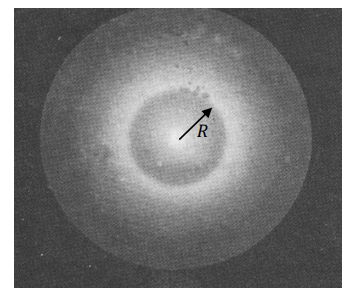
If the radius of the inner ring observed is \(R\), the refractive index of the glass must be
(a)
\(\sin{\left\{\tan^{-1}{\left(\frac{R}{2d}\right)}\right\}}\)
(b)
\(\sin{\left\{\tan^{-1}{\left(\frac{R}{d}\right)}\right\}}\)
(c)
\(\tan{\left\{\sin^{-1}{\left(\frac{R}{2d}\right)}\right\}}\)
(d)
\(\tan{\left\{\sin^{-1}{\left(\frac{R}{d}\right)}\right\}}\)
Check Answer
Option a
Q.No:16 TIFR-2020
A plane polarised light wave with electric field expressed as
\[
\vec{E}(z, t)=E_0 \hat{j}\cos{(kz-\omega t)}
\]
is incident from the left on the apparatus as sketched below.


The apparatus consists of (from left to right) a polariser with transmission axis at \(\pi/4\) w.r.t. the \(y\)-axis, followed by a quarter-wave plate with fast axis along the \(y\)-axis, and finally, a polariser with transmission axis at \(\pi/3\) about the \(x\)-axis.
If the incident intensity of the wave is \(I_0\), what will be the intensity of the light emerging out of the apparatus (on the right)?
(a)
\(I_0/4\)
(b)
\(I_0/8\)
(c)
\(3I_0/8\)
(d)
\(I_0/16\)
Check Answer
Option a
Q.No:17 TIFR-2022
Since the refractive index of water is 4/3, the angular velocity (in degrees per hour) of the Sun at noon is perceived by a fish in the ocean deep below the surface as around
(a)
11.3
(b)
15.0
(c)
13.2
(d)
20.0
Check Answer
Option a
Q.No:18 TIFR-2022
On a wet monsoon day at 12 noon, a thin film of oil of thickness 0.3 \(\mu\)m is formed on a wet road. If the refractive index of oil and water are 1.475 and 1.333, respectively, which of the following wavelengths of light will be reflected with maximum intensity?
(a)
590 nm
(b)
407 nm
(c)
443 nm
(d)
640 nm
Check Answer
Option a
Q.No:19 TIFR-2022
A satellite used to make Google Earth images carries on board a telescope which must be designed, when operating at a wavelength \(\lambda\), to be able to resolve objects on the ground of length as small as \(\delta\).
If the satellite goes around the Earth in a circular orbit with uniform speed \(v\), the minimum diameter \(D_{min}\) of the telescope mirror can be determined in terms of \(R\), the radius of the Earth, and \(g\), the acceleration due to gravity at the surface, to be
(a)
\(\frac{1.22 \lambda}{\delta} (\frac{gR^2}{v^2}-R)\)
(b)
\(\frac{1.22 \lambda}{\delta} \frac{gR^2}{v^2}(1+\frac{R}{\lambda})\)
(c)
\(\frac{1.22 \lambda}{\delta} \frac{gR^2}{\lambda v^2}\)
(d)
\(\frac{1.22 \lambda}{\delta} \sqrt{\frac{gR^3}{v^2}}\)
Check Answer
Option a
Q.No:20 TIFR-2022
According to a standard table, the refractive index of water at \(4^\circ C \) is 1.33 at a wavelength of 590 nm. However, a carefully performed experiment in the lab yielded a refractive index of 1.41.
Which one of the following statements could be the explanation of this discrepancy?
(a)
The experiment was performed at a wavelength lower than 590 nm.
(b)
The experiment was performed at a wavelength higher than 590 nm.
(c)
The water sample was at a temperature lower than \(4^\circ C \)
(d)
The water sample was at a temperature much higher than \(4^\circ C \)
Check Answer
Option a
Q.No:21 TIFR-2023
In a mercury vapour lamp an electric arc passing through mercury vapour proceeds light. When the lamp is switched on, the arc is struck, and the liquid mercury starts evaporating as the temperature gradually increases.
In a certain experiment, a Michelson interferometer is set up with a mercury vapour lamp as the light source, and the lamp is switched on. Which one of the following effect will be observed?
(a)
Initially, fringes will appear with high contract but low intensity, which will be reduced in contrast over the period of time as the light intensity builds up.
(b)
High contrast fringes will appear as soon as the lamp is switched on and will remain thus so long as the lamp is on.
(c)
Initially, no fringes will bw observed, but the fringes will emerge with high contrast as the lamp heats up.
(d)
No fringes will be observed as the source is incoherent and has many frequencies.
Check Answer
Option a
Q.No:22 TIFR-2023
(c)
Initially, no fringes will bw observed, but the fringes will emerge with high contrast as the lamp heats up.

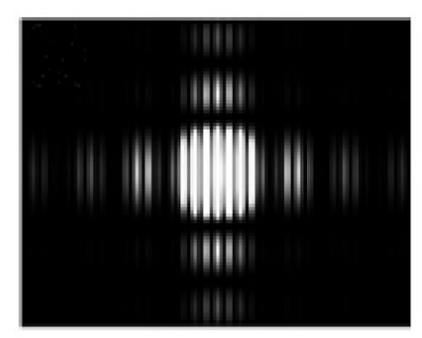
The aperture arrangement that would yield such a fringe pattern is




Check Answer
Option c
Q.No:23 TIFR-2023
An electromagnetic wave is described by the following expression
\[\vec{E}(z,t)=E_0 sin \hspace{0.5mm} kz\{\hat{i}\hspace{0.5mm} cos \hspace{0.5mm}\omega t+\hat{j} \hspace{0.5mm} cos (\omega t-\frac{\pi}{2})\}\]
Which one of the following correctly describes this waveform?
(a)
A left circular-polarised standing wave along the positive z-axis.
(b)
A right circular-polarised travelling wave along the positive z-axis.
(c)
A left circular-polarised travelling wave along the positive z-axis.
(d)
A right circular-polarised standing wave along the positive z-axis.
Check Answer
Option a
Q.No:24 TIFR-2023
A diffraction grating spectrograph is used to resolve the two sodium D lines (589 and 589.6 nm) in the first order of diffraction. If the width of the grating is 2 cm and the focal length of the spectrograph camera is 20 cm, what the linear separation at the focal plane of the two D lines will be about
(a)
6 \(\mu\)m
(b)
6 mm
(c)
60 \(\mu\)m
(d)
60 nm
Check Answer
Option a
Q.No:25 TIFR-2024
Unpolarised light of intensity 200 W/m\(^2\) is incident on a set of two perfect polarisers arranged one behind the other. The first polariser has its transmission axis at \(+55^\circ\) with respect to the vertical and the second polariser has its transmission axis at \(+100^\circ\) with respect to the vertical. What is the intensity of the transmitted light?
(a) 50 W/m\(^2\)
(b) 100 W/m\(^2\)
(c) 1.98 W/m\(^2\)
(d) 3.01 W/m\(^2\)
Check Answer
Option a
Q.No:26 TIFR-2024
Two small loudspeakers A and B, separated by 15 cm, were pointed toward a small microphone M at a distance 1.5 m away from the centre of the line AB, in the perpendicular direction as shown in the sketch below.


The following sound intensity pattern was observed as a function of the position of the microphone as it is moved parallel to AB.


The dips in the signal were repeated at the interval of 14.5 cm. The speed of sound in the experiment's background condition is 343 m/s. What can we conclude from this information?
(a) The two loudspeakers are vibrating at frequency 23.65 kHz and they are out of phase.
(b) The two loudspeakers are vibrating at frequency 23.65 kHz and they are in phase.
(c) The two loudspeakers are vibrating at frequency 47.3 kHz and they are in phase.
(d) The two loudspeakers are vibrating at frequency 47.3 kHz and they are out of phase.
Check Answer
Option a
Q.No:27 TIFR-2025
Laser light is incident normally on a thin film of material with a refractive index
\(n_{s}\) larger than that of air (\(n_{a}\approx 1\)). As the wavelength of the laser
light is varied, the intensity of the transmitted light through the film shows a peak
at \(633\,\text{nm}\). If the thickness of the film is \(118\,\text{nm}\), the minimum
\(n_{s}\) is closest to:
a) \(2.68\)
b) \(5.36\)
c) \(1.34\)
d) \(3.68\)
Check Answer
Option a
Q.No:28 TIFR-2025
A stream of electrons, each having an energy of \(0.5\,\text{eV}\), impinges on a pair of
extremely thin slits separated by \(10\,\mu\text{m}\). The distance between adjacent minima
on a screen \(20\,\text{m}\) behind the slits would be closest to:
a) \(3.48\,\text{mm}\)
b) \(1.74\,\text{mm}\)
c) \(6.96\,\text{cm}\)
d) \(5\,\text{m}\)
Check Answer
Option a
Q.No:29 TIFR-2026
A thin film of oil (refractive index, \(n_{\text{oil}} = 1.40\)) floats on a puddle of water (refractive index, \(n_{\text{water}} = 1.33\)) on a road. The film is illuminated at normal incidence from air by white light. In the light reflected vertically, green colour (with wavelength in air \(\lambda_0 = 560\,\mathrm{nm}\)) is enhanced. The smallest possible thickness of the oil film is approximately:
a) \(100\,\mathrm{nm}\)
b) \(2000\,\mathrm{nm}\)
c) \(200\,\mathrm{nm}\)
d) \(360\,\mathrm{nm}\)
Check Answer
Option a
Q.No:30 TIFR-2026
An electron beam is accelerated over a potential \(V\) and strikes a crystal with lattice constant \(5\,\text{Å}\). What is the minimum \(V\) needed to resolve the crystal?
a) \(5\,\mathrm{V}\)
b) \(30\,\mathrm{V}\)
c) \(300\,\mathrm{V}\)
d) \(0.5\,\mathrm{V}\)
Check Answer
Option a
Q.No:31 TIFR-2026
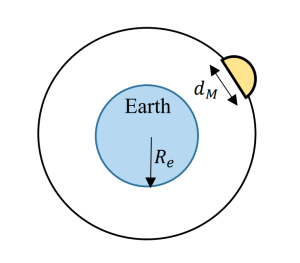
An earth imaging satellite is in a near earth circular orbit (see figure) with an orbital period of \(100\) minutes and observes earth with a light of wavelength \(550\,\mathrm{nm}\). If it can resolve the ground with \(0.5\,\mathrm{m}\), the minimum diameter of the mirror on the satellite should be closest to:
(Assume the system is diffraction limited. The mass and radius of Earth are \(5.97\times10^{24}\,\mathrm{kg}\) and \(6.4\times10^3\,\mathrm{km}\), respectively.)
(Assume the system is diffraction limited. The mass and radius of Earth are \(5.97\times10^{24}\,\mathrm{kg}\) and \(6.4\times10^3\,\mathrm{km}\), respectively.)

a) \(1\,\mathrm{m}\)
b) \(5\,\mathrm{m}\)
c) \(0.5\,\mathrm{m}\)
d) \(10\,\mathrm{m}\)
Check Answer
Option a
Q.No:32 TIFR-2026
In the experimental arrangement below, a plane polarised light of intensity \(I\) and wavelength \(500\,\mathrm{nm}\) is propagating along the \(z\)-axis. It is polarised along the \(y\)-axis and is incident on the first polarizer which has the transmission axis at an angle of \(\pi/4\) with respect to the \(y\)-axis, as shown.

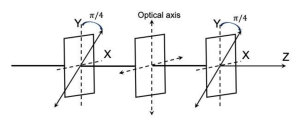
Subsequently, the beam passes through a flat birefringent crystal of thickness \(950\,\mu\mathrm{m}\) and optical axis along the \(y\)-axis. The crystal is kept normal to the \(z\)-axis. If the refractive indices of the crystal are \(n_o=1.514\) and \(n_e=1.519\), the beam intensity measured after the second polarizer whose transmission axis is parallel to that of the first one would be:
a) \(0\)
b) \(I/4\)
c) \(I/2\)
d) \(I\)