

CAUTION : Try solving the problem yourself for at least 5–10 minutes before clicking the AI Assistant. In the exam hall, you will be on your own.
Q.No:1 CSIR June-2015
In a two-state system, the transition rate of a particle from state 1 to state 2 is \(t_{12}\), and the transition rate from state 2 to state l is \(t_{21}\). In the steady state, the probability of
finding the particle in state 1 is
(1)
\(\frac{t_{21}}{{t_{12} + t_{21}}}\)
(2)
\(\frac{t_{12}}{{t_{12} + t_{21}}}\)
(3)
\(\frac{t_{12}-t_{21}}{{t_{12} + t_{21}}}\)
(4)
\(\frac{t_{12}t_{21}}{{t_{21} + t_{21}}}\)
Check Answer
Option 1
Q.No:2 CSIR June-2015
The Dirac Hamiltonian \(H=c \vec{\alpha} \cdot \vec{p}+\beta mc^{2}\) for a free electron corresponds to the classical relation \(E^2 = p^2c^2 + m^2c^4\). The classical energy-momentum relation of a particle of charge q in a electromagnetic potential \((\phi, \vec{A})\) is \((E-q \phi)^{2}=c^{2}\left(\vec{p}-\frac{q}{c} \vec{A}\right)^{2}+m^{2} c^{4}\).
Therefore, the Dirac Hamiltonian for an electron in an electromagnetic field is
(1)
\(c \vec{\alpha} \cdot \vec{p}+\frac{e}{c} \vec{A} \cdot \vec{A}+\beta m c^{2}-e \phi\)
(2)
\(c \vec{\alpha} \cdot \big(\vec{p}+\frac{e}{c} \vec{A}\big) +\beta m c^{2}+e \phi\)
(3)
\(c\left(\vec{\alpha} \cdot \vec{p}+e \phi+\frac{e}{c}|\vec{A}|\right)+\beta m c^{2}\)
(4)
\(c \vec{\alpha} \cdot\left(\vec{p}+\frac{e}{c} \vec{A}\right)+\beta m c^{2}-e \phi\)
Check Answer
Option 4
Q.No:3 CSIR June-2016
Using dimensional analysis, Planck defined a characteristic temperature \(T_P\) from powers of the gravitational constant \(G\), Planck's constant \(h\), Boltzmann constant \(k_B\) and the speed of light \(c\) in vacuum. The expression for \(T_P\) is proportional to
(1)
\(\sqrt{\frac{hc^5}{k_B^2 G}}\)
(2)
\(\sqrt{\frac{hc^3}{k_B^2 G}}\)
(3)
\(\sqrt{\frac{G}{hc^4 k_B^2}}\)
(4)
\(\sqrt{\frac{hk_B^2}{Gc^3}}\)
Check Answer
Option 1
Q.No:4 CSIR Dec-2016
Consider the operator \(\vec{\pi}=\vec{p}-q\vec{A}\), where \(\vec{p}\) is the momentum operator, \(\vec{A}=(A_x, A_y, A_z)\) is the vector potential and \(q\) denotes the electric charge. If \(\vec{B}=(B_x, B_y, B_z)\) denotes the magnetic field, the \(z\)-component of the vector operator \(\vec{\pi}\times \vec{\pi}\) is
(1)
\(iq\hbar B_z+q(A_x p_y-A_y p_x)\)
(2)
\(-iq\hbar B_z-q(A_x p_y-A_y p_x)\)
(3)
\(-iq\hbar B_z\)
(4)
\(iq\hbar B_z\)
Check Answer
Option 4
Q.No:5 CSIR Dec-2016
The dynamics of a free relativistic particle of mass \(m\) is governed by the Dirac Hamiltonian \(H=c\vec{\alpha}.\vec{p}+\beta mc^2\), where \(\vec{p}\) is the momentum operator and \(\vec{\alpha}=(\alpha_x, \alpha_y, \alpha_z)\) and \(\beta\) are four \(4\times 4\) Dirac matrices. The acceleration operator can be expressed as
(1)
\(\frac{2ic}{\hbar}(c\vec{p}-\vec{\alpha}H)\)
(2)
\(2ic^2\vec{\alpha}\beta\)
(3)
\(\frac{ic}{\hbar}H\vec{\alpha}\)
(4)
\(-\frac{2ic}{\hbar}(c\vec{p}+\vec{\alpha}H)\)
Check Answer
Option 1
Q.No:6 CSIR Dec-2016
A particle of charge \(q\) in one dimension is in a simple harmonic potential with angular frequency \(\omega\). It is subjected to a time-dependent electric field \(E(t)=Ae^{-(t/\tau)^2}\), where \(A\) and \(\tau\) are positive constants and \(\omega\tau \gg 1\). If in the distant past \(t\to -\infty\) the particle was in its ground state, the probability that it will be in the first excited state as \(t\to +\infty\) is proportional to
(1)
\(e^{-\frac{1}{2}(\omega \tau)^2}\)
(2)
\(e^{\frac{1}{2}(\omega \tau)^2}\)
(3)
\(0\)
(4)
\(\frac{1}{(\omega \tau)^2}\)
Check Answer
Option 1
Q.No:7 CSIR June-2017
A constant perturbation \(H'\) is applied to a system for time \(\Delta t\) (where \(H' \Delta t\ll \hbar\)) leading to a transition from a state with energy \(E_i\) to another with energy \(E_f\). If the time of application is doubled, the probability of transition will be
(1)
unchanged
(2)
doubled
(3)
quadrupled
(4)
halved
Check Answer
Option
Q.No:8 CSIR June-2017
In the usual notation \(|nlm\rangle\) for the states of a hydrogen like atom, consider the spontaneous transitions \(|210\rangle\to |100\rangle\) and \(|310\rangle\to |100\rangle\). If \(t_1\) and \(t_2\) are the lifetimes of the first and the second decaying states respectively, then the ratio \(\frac{t_1}{t_2}\) is proportional to
(1)
\(\left(\frac{32}{27}\right)^3\)
(2)
\(\left(\frac{27}{32}\right)^3\)
(3)
\(\left(\frac{2}{3}\right)^3\)
(4)
\(\left(\frac{3}{2}\right)^3\)
Check Answer
Option 1
Q.No:9 CSIR Dec-2017
Consider a system of identical atoms in equilibrium with blackbody radiation in a cavity at temperature \(T\). The equilibrium probabilities for each atom being in the ground state \(|0\rangle\) and an excited state \(|1\rangle\) are \(P_0\) and \(P_1\), respectively. Let \(n\) be the average number of photons in a mode in the cavity that causes transition between the two states. Let \(W_{0\to 1}\) and \(W_{1\to 0}\) denote, respectively, the squares of the matrix elements corresponding to the atomic transitions \(|0\rangle\to |1\rangle\) and \(|1\rangle\to |0\rangle\). Which of the following equations hold in equilibrium?
(1)
\(P_0 nW_{0\to 1}=P_1 W_{1\to 0}\)
(2)
\(P_0 W_{0\to 1}=P_1 nW_{1\to 0}\)
(3)
\(P_0 nW_{0\to 1}=P_1 W_{1\to 0}-P_1 nW_{1\to 0}\)
(4)
\(P_0 nW_{0\to 1}=P_1 W_{1\to 0}+P_1 nW_{1\to 0}\)
Check Answer
Option 4
Q.No:10 CSIR June-2019
A charged, spin-less particle of mass \(m\) is subjected to an attractive potential \(V(x, y, z)=\frac{1}{2}k(x^2+y^2+z^2)\), where \(k\) is a positive constant. Now a perturbation in the form of a weak magnetic field \(\mathbf{B}=B_0\hat{k}\) (where \(B_0\) is a constant) is switched on. Into how many distinct levels will the second excited state of the unperturbed Hamiltonian split?
(1)
\(5\)
(2)
\(4\)
(3)
\(2\)
(4)
\(1\)
Check Answer
Option 1
Q.No:11 CSIR June-2019
The range of the inter-atomic potential in gaseous hydrogen is approximately \(5\) Angstrom. In thermal equilibrium, the maximum temperature for which the atom-atom scattering is dominantly \(s\)-wave, is
(1)
\(500 K\)
(2)
\(1 K\)
(3)
\(100 K\)
(4)
\(1 mK\)
Check Answer
Option 3
Q.No:12 CSIR Feb-2022
The energies of a two-state quantum system are \(E_0\) and \(E_0+\alpha\hbar\) , (where \(\alpha>0\) is a
constant) and the corresponding normalized state vectors are \(|0\rangle\) and \(|1\rangle\) , respectively. At time \(t=0\) , when the system is in the state \(|0\rangle\) , the potential is altered by a time independent term
\(V\) such that \(\langle1|V|0\rangle=\hbar\alpha/10\) . The transition probability to the state \(|1\rangle\) at times \(t\ll 1/\alpha\) , is
(1)
\(\alpha^2t^2/25\)
(2)
\(\alpha^2t^2/50\)
(3)
\(\alpha^2t^2/100\)
(4)
\(\alpha^2t^2/200\)
Check Answer
Option 3
Q.No:13 CSIR Feb-2022
The \(|3,0,0\rangle\) state in the standard notation \(|n,l,m\rangle\) of the H -atom in the non-relativistic
theory decays to the state \(|1,0,0\rangle\) via two dipole transition. The transition route and the
corresponding probability are
(1)
\(|3,0,0\rangle\rightarrow |2,1,-1\rangle\rightarrow |1,0,0\rangle\) and \(1/4\)
(2)
\(|3,0,0\rangle\rightarrow |2,1,1\rangle\rightarrow |1,0,0\rangle\) and \(1/4\)
(3)
\(|3,0,0\rangle\rightarrow |2,1,0\rangle\rightarrow |1,0,0\rangle\) and \(1/3\)
(4)
\(|3,0,0\rangle\rightarrow |2,1,0\rangle\rightarrow |1,0,0\rangle\) and \(2/3\)
Check Answer
Option 3
Q.No:14 CSIR Sep-2022
At time \(t=0\), a particle in the ground state of the Hamiltonian
\[
H(t)=\frac{p^2}{2m} + \frac{1}{2} m \omega^2 x^2
+ \lambda x sin(\frac{\omega t}{2} )\]
where \(\lambda\) \(\omega\) and \(m\) are positive constants. To \(O(\lambda^2)\), the probability that at \(t=2\pi/\omega\), the particle would be in the first excited state of \(H(t=0)\) is
(1)
\(\frac{9 \lambda^2}{16 m \hbar \omega^3}\)
(2)
\(\frac{9 \lambda^2}{8 m \hbar \omega^3}\)
(3)
\(\frac{16 \lambda^2}{9 m \hbar \omega^3}\)
(4)
\(\frac{8 \lambda^2}{9 m \hbar \omega^3}\)
Check Answer
Option 4
Q.No:1 JEST-2017
If \(\hat{x}(t)\) be the position operator at a time \(t\) in the Heisenberg picture for a particle described by the Hamiltonian, \(\hat{H}=\frac{\hat{p}^2}{2m}+\frac{1}{2}m\omega^2 \hat{x}^2\), what is \(e^{i\omega t}\langle 0|\hat{x}(t)\hat{x}(0)|0\rangle\) in units of \(\frac{\hbar}{2m\omega}\) where \(|0\rangle\) is the ground state?
Check Answer
Ans 1
Q.No:2 JEST-2017
The normalized eigenfunctions and eigenvalues of the Hamiltonian of a particle confined to move between \(0\leq x\leq a\) in one dimension are
\[
\psi_n(x)=\frac{2}{a}\sin{\frac{n\pi x}{a}}
\]
and
\[
E_n=\frac{n^2\pi^2\hbar^2}{2ma^2}
\]
respectively. Here \(1, 2, 3, \cdots\). Suppose the state of the particle is
\[
\psi(x)=A\sin{\left(\frac{\pi x}{a}\right)}\left[1+\cos{\left(\frac{\pi x}{a}\right)}\right]
\]
where \(A\) is the normalization constant. If the energy of the particle is measured, the probability to get the result as \(\frac{\pi^2 \hbar^2}{2ma^2}\) is \(x/100\). What is the value of \(x\)?
Check Answer
Ans
Q.No:3 JEST-2021
Consider a \(4\)-dimensional vector space \(V\) that is a direct product of two \(2\)-dimensional vector spaces \(V_1\) and \(V_2\). A linear transformation \(H\) acting on \(V\) is specified by the direct product of linear transformations \(H_1\) and \(H_2\) acting on \(V_1\) and \(V_2\), respectively. In a particular basis,
\[
H_1=\begin{pmatrix}3&0\\0&2\end{pmatrix},
H_2=\begin{pmatrix}2&1\\1&1\end{pmatrix},
\]
what is the lowest eigenvalue of \(H\)?
(A)
\(1\)
(B)
\(\frac{3}{2}\)
(C)
\(3-\sqrt{5}\)
(D)
\(\frac{1}{2}(3-\sqrt{5})\)
Check Answer
Option C
Q.No:1 TIFR-2012
In a scanning tunnelling microscope, a fine Platinum needle is held close to a metallic surface in vacuum and electrons are allowed to tunnel across the tiny gap \(\delta\) between the surface and the needle. The tunnelling current \(I\) is related to the gap \(\delta\), through positive constants \(a\) and \(b\), as
(a)
\(I=a-b\delta\)
(b)
\(I=a+b\delta\)
(c)
\(\log{I}=a-b\delta\)
(d)
\(\log{I}=a+b\delta\)
Check Answer
Option c
Q.No:2 TIFR-2016
In the experiment shown in figure (i) below, the emitted electrons from the cathode (C) are made to pass through the mercury vapor filled in the tube by accelerating them using a grid (G) at potential \(V\), positive w.r.t. the cathode. The electrons are collected by the anode (A).


The variation of electron current (I) as a function of \(V\) is given in figure (ii). The shape of this curve must be interpreted as due to
(a)
ionization of mercury atoms.
(b)
an emission line from mercury atoms.
(c)
attachment of electrons to mercury atoms.
(d)
resonant backscattering of electrons to cathode from grid.
Check Answer
Option b
Q.No:3 TIFR-2017
A photomultiplier tube is used to detect identical light pulses each of which consists of a fixed number of photons. The photoelectric efficiency is \(10\%\), i.e. a photon has \(10\%\) probability of causing the emission of a detectable photoelectron. The photomultiplier gain is \(10^6\).

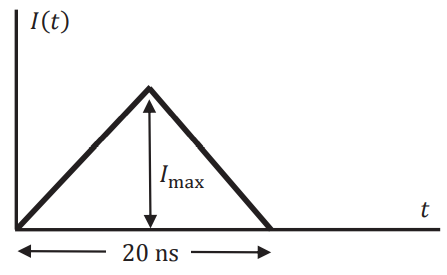
The typical output current, as a function of time, is shown by the figure below for a few pulses, where \(I_{\text{max}}\) is \(80 \hspace{1mm}\mu\text{A}\). It follows that the number of photons in each pulse is
(a)
\(5\times 10^6\)
(b)
\(5\)
(c)
\(800\)
(d)
\(50\)
Check Answer
Option d
Q.No:4 TIFR-2018
A particle in a one-dimensional harmonic oscillator potential is described by a wave-function \(\psi(x, t)\). If the wavefunction changes to \(\psi(\lambda x, t)\) then the expectation value of kinetic energy \(T\) and the potential energy \(V\) will change, respectively, to
(a)
\(\lambda^2 T\) and \(V/\lambda^2\)
(b)
\(T/\lambda^2\) and \(V/\lambda^2\)
(c)
\(T/\lambda^2\) and \(\lambda^2 V\)
(d)
\(\lambda^2 T\) and \(\lambda^2 V\)