

Q.No:1 JEST-2012
Consider a system of two spin-\(1/2\) particles with total spin \(\mathbf{S}=\mathbf{s}_1+\mathbf{s}_2\), where \(\mathbf{s}_1\) and \(\mathbf{s}_2\) are in terms of Pauli matrices \(\sigma_i\). The spin triplet projection operator is
(a)
\(\frac{1}{4}+\mathbf{s}_1\cdot \mathbf{s}_2\)
(b)
\(\frac{3}{4}-\mathbf{s}_1\cdot \mathbf{s}_2\)
(c)
\(\frac{3}{4}+\mathbf{s}_1\cdot \mathbf{s}_2\)
(d)
\(\frac{1}{4}-\mathbf{s}_1\cdot \mathbf{s}_2\)
Check Answer
Option c
Q.No:2 JEST-2013
A simple model of a helium-like atom with electron-electron interaction is replaced by Hooke's law force is described by hamiltonian \(\frac{-\hbar^2}{2m}(\nabla_1^2+\nabla_2^2)+\frac{1}{2}m\omega^2(r_1^2+r_2^2)-\frac{\lambda}{4}m\omega^2|\vec{r}_1-\vec{r}_2|^2\). What is the exact ground state energy?
(a)
\(E=3/2\hbar\omega(1+\sqrt{1+\lambda})\)
(b)
\(E=3/2\hbar\omega(1+\sqrt{\lambda})\)
(c)
\(E=3/2\hbar\omega\sqrt{1-\lambda}\)
(d)
\(E=3/2\hbar\omega(1+\sqrt{1-\lambda})\)
Check Answer
Option d
Q.No:3 JEST-2015
Consider a spin-\(\frac{1}{2}\) particle characterized by the Hamiltonian \(H=\omega S_z\). Under a perturbation \(H'=gS_x\), the second order correction to the ground state energy is given by,
(a)
\(-\frac{g^2}{4\omega}\)
(b)
\(\frac{g^2}{4\omega}\)
(c)
\(-\frac{g^2}{2\omega}\)
(d)
\(\frac{g^2}{2\omega}\)
Check Answer
Option a
Q.No:4 JEST-2015
A particle of mass \(m\) is confined in a potential well given by \(V(x)=0\) for \(\frac{-L}{2}<x<\frac{L}{2}\) \(L/2\) and \(V(x)=\infty\) elsewhere. A perturbing potential \(H'(x)=ax\) has been applied to the system. Let the first and second order corrections to the ground state be \(E_0^{(1)}\) and \(E_0^{(2)}\), respectively. Which one of the following statements is correct?
(a)
\(E_0^{(1)}0\)
(b)
\(E_0^{(1)}=0\) and \(E_0^{(2)}>0\)
(c)
\(E_0^{(1)}>0\) and \(E_0^{(2)}<0\)
(d)
\(E_0^{(1)}=0\) and \(E_0^{(2)}<0\)
Check Answer
Option d
Q.No:5 JEST-2016
Consider a quantum particle of mass \(m\) in one dimension in an infinite potential well, {\it i.e.}, \(V(x)=0\) for \(-a/2<x<a/2\), and \(V(x)=\infty\) for \(|x|\geq a/2\). A small perturbation, \(V'(x)=2\epsilon |x|/a\), is added. The change in the ground state energy to \(O(\epsilon)\) is:
(a)
\(\frac{\epsilon}{2\pi^2}(\pi^2-4)\)
(b)
\(\frac{\epsilon}{2\pi^2}(\pi^2+4)\)
(c)
\(\frac{\epsilon \pi^2}{2}(\pi^2+4)\)
(d)
\(\frac{\epsilon \pi^2}{2}(\pi^2-4)\)
Check Answer
Option a
Q.No:6 JEST-2017
Suppose the spin degrees of freedom of a \(2\)-particle system can be described by a \(21\)-dimensional Hilbert subspace. Which among the following could be the spin of one of the particles?
(a)
\(\frac{1}{2}\)
(b)
\(3\)
(c)
\(\frac{3}{2}\)
(d)
\(2\)
Check Answer
Option b
Q.No:7 JEST-2017
A particle is described by the following Hamiltonian
\[
\hat{H}=\frac{\hat{p}^2}{2m}+\frac{1}{2}m\omega^2 \hat{x}^2+\lambda \hat{x}^4,
\]
where the quartic term can be treated perturbatively. If \(\Delta E_0\) and \(\Delta E_1\) denote the energy correction of \(O(\lambda)\) to the ground state and the first excited state respectively, what is the fraction \(\Delta E_1/\Delta E_0\)?
Check Answer
Ans 5
Q.No:8 JEST-2018
What is the difference between the maximum and the minimum eigenvalues of a system of two electrons whose Hamiltonian is \(H+J\vec{S}_1\cdot \vec{S}_2\), where \(\vec{S}_1\) and \(\vec{S}_2\) are the corresponding spin angular momentum operators of the two electrons?
(a)
\(J/4\)
(b)
\(J/2\)
(c)
\(3J/4\)
(d)
\(J\)
Check Answer
Option d
Q.No:9 JEST-2018
Suppose the spin degree of freedom of two particles (nonzero rest mass and nonzero spin) is described completely by a Hilbert space of dimension twenty one. Which of the following could be the spin of one of the particles?
(a)
\(2\)
(b)
\(3/2\)
(c)
\(1\)
(d)
\(1/2\)
Check Answer
Option c
Q.No:10 JEST-2018
A harmonic oscillator has the following Hamiltonian
\[
H_0=\frac{\hat{p}^2}{2m}+\frac{1}{2}m\omega^2 \hat{x}^2
\]
It is perturbed with a potential \(V=\lambda \hat{x}^4\). Some of the matrix elements of \(\hat{x}^2\) in terms of its expectation value in the ground state are given as follows:
\[
\begin{array}{rcl}
\langle 0|\hat{x}^2|0\rangle & = & C \\
\langle 0|\hat{x}^2|2\rangle & = & \sqrt{2}C \\
\langle 1|\hat{x}^2|1\rangle & = & 3C \\
\langle 1|\hat{x}^2|3\rangle & = & \sqrt{6}C
\end{array}
\]
where \(|n\rangle\) is the normalized eigenstate of \(H_0\) corresponding to the eigenvalue \(E_n=\hbar\omega(n+1/2)\). Suppose \(\Delta E_0\) and \(\Delta E_1\) denote the energy correction of \(O(\lambda)\) to the ground state and the first excited state, respectively. What is the fraction \(\Delta E_1/\Delta E_0\)?
Check Answer
Ans 5
Q.No:11 JEST-2018
Consider two coupled harmonic oscillators of mass \(m\) each. The Hamiltonian describing the oscillators is
\[
\hat{H}=\frac{\hat{p}_1^2}{2m}+\frac{\hat{p}_2^2}{2m}+\frac{1}{2}m\omega^2(\hat{x}_1^2+\hat{x}_2^2+(\hat{x}_1-\hat{x}_2)^2).
\]
The eigenvalues of \(\hat{H}\) are given by (with \(n_1\) and \(n_2\) being non-negative integers)
(a)
\(E_{n_1, n_2}=\hbar \omega(n_1+n_2+1)\)
(b)
\(E_{n_1, n_2}=\hbar \omega(n_1+\frac{1}{2})+\frac{1}{\sqrt{3}}\hbar \omega(n_2+\frac{1}{2})\)
(c)
\(E_{n_1, n_2}=\hbar \omega(n_1+\frac{1}{2})+\sqrt{3}\hbar \omega(n_2+\frac{1}{2})\)
(d)
\(E_{n_1, n_2}=\frac{1}{\sqrt{3}}\hbar \omega(n_1+n_2+1)\)
Check Answer
Option c
Q.No:12 JEST-2019
Consider a quantum particle of mass \(m\) and charge \(e\) moving in a two dimensional potential given as:
\[
V(x, y)=\frac{k}{2}(x-y)^2+k(x+y)^2.
\]
The particle is also subject to an external electric field \(\vec{E}=\lambda(\hat{i}-\hat{j})\), where \(\lambda\) is a constant. \(\hat{i}\) and \(\hat{j}\) corresponds to unit vectors along \(x\) and \(y\) directions, respectively. Let \(E_1\) and \(E_0\) be the energies of the first excited state and ground state, respectively. What is the value of \(E_1-E_0\)?
(a)
\(\hbar\sqrt{2k/m}\)
(b)
\(\hbar\sqrt{2k/m}+e\lambda^2\)
(c)
\(3\hbar\sqrt{2k/m}\)
(d)
\(3\hbar\sqrt{2k/m}+e\lambda^2\)
Check Answer
Option a
Q.No:13 JEST-2023
Consider a two-level quantum system described by the Hamiltonian:
\[H=H_0+H'\]
where
\[H_0=\alpha \begin{pmatrix}1 & 0 \\ 0 & 1 \end{pmatrix}+\omega \begin{pmatrix}1 & 0 \\ 0 & -1 \end{pmatrix}, \hspace{4mm} H'= \epsilon \Gamma \begin{pmatrix}0 & 1 \\ 1 & 0 \end{pmatrix} \]
\(H'\) is a small perturbation to the free Hamiltonian \(H_0\). \(\epsilon\) is a small positive dimensionless number, while \(\alpha, \omega\) and \(\Gamma\) have dimensions of energy and are positive quantities. If we treat this problem perturbatively in the parameter \(\epsilon\), which of the following statements about the corrections to ground state energy is true?
1) First-order correction is \(\epsilon \Gamma\); second-order correction is \(- \frac{\epsilon^2 \Gamma^2}{2 \omega}\)
2) First-order correction is \(\epsilon \Gamma\); second-order correction is 0.
3) First-order correction is 0; second-order correction is \(- \frac{\epsilon^2 \Gamma^2}{2 \omega}\)
4) First-order correction is 0; second-order correction is \( \frac{\epsilon^2 \Gamma^2}{2 \omega}\)
Check Answer
Option 3
Q.No:14 JEST-2025
For a one-dimensional simple harmonic oscillator with mass \(m\) and angular frequency \(\omega\), consider a perturbation \(\lambda x^{4}\) in the Hamiltonian (\(\lambda > 0\)). What is the lowest order correction to the ground state energy?
(The position operator expressed in terms of the raising and lowering operators is
\(
\hat{x} = \sqrt{\frac{\hbar}{2m\omega}}\, (a + a^{\dagger}).
\))
1) \(\frac{3\lambda}{2}\left(\frac{\hbar}{m\omega}\right)^{2}\)
2) \(\frac{5\lambda}{4}\left(\frac{\hbar}{m\omega}\right)^{2}\)
3) \(\frac{3\lambda}{4}\left(\frac{\hbar}{m\omega}\right)^{2}\)
4) \(\frac{5\lambda}{2}\left(\frac{\hbar}{m\omega}\right)^{2}\)
Check Answer
Option 3
Q.No:1 TIFR-2014
A particle of mass \(m\) and charge \(e\) is in the ground state of a one-dimensional harmonic oscillator potential in the presence of a uniform external electric field \(E\). The total potential felt by the particle is
\[
V(x)=\frac{1}{2}kx^2-eEx
\]
If the electric field is suddenly switched off, then the particle will
(a)
make a transition to any harmonic oscillator state with \(x=-eE/k\) as origin without emitting any photon.
(b)
make a transition to any harmonic oscillator state with \(x=0\) as origin and absorb a photon.
(c)
settle into the harmonic oscillator ground state with \(x=0\) as origin after absorbing a photon.
(d)
oscillate back and forth with initial amplitude \(eE/k\), emitting multiple photons as it does so.
Check Answer
Option b
Q.No: 2 TIFR-2016
Consider two spin-\(1/2\) identical particles \(A\) and \(B\), separated by a distance \(r\), interacting through a potential
\[
V(r)=\frac{V_0}{r}\vec{S}_A. \vec{S}_B
\]
where \(V_0\) is a positive constant and the spins are \(\vec{S}_{A, B}=\vec{\sigma}=(\sigma_x, \sigma_y, \sigma_z)\) in terms of the Pauli spin matrices. The expectation values of this potential in the spin-singlet and triplet states are
(a)
Singlet: \(\frac{V_0}{3r}\), Triplet: \(\frac{V_0}{r}\)
(b)
Singlet: \(-\frac{3V_0}{r}\), Triplet: \(\frac{V_0}{r}\)
(c)
Singlet: \(\frac{3V_0}{r}\), Triplet: \(-\frac{V_0}{r}\)
(d)
Singlet: \(-\frac{V_0}{r}\), Triplet: \(\frac{3V_0}{r}\)
Check Answer
Option b
Q.No: 3 TIFR-2017
A quantum mechanical system which has stationary states \(|1\rangle, |2\rangle\) and \(|3\rangle\), corresponding to energy levels \(0 \hspace{1mm}\text{eV}, 1 \hspace{1mm}\text{eV}\) and \(2 \hspace{1mm}\text{eV}\) respectively, is perturbed by a potential of the form
\[
\hat{V}=\varepsilon |1\rangle\langle 3|+\varepsilon |3\rangle\langle 1|
\]
where, in \(\text{eV}\), \(0<\varepsilon\ll 1\).
The new ground state, correct to order \(\varepsilon\), is approximately.
(a)
\(\left(1-\frac{\varepsilon}{2}\right)|1\rangle+\frac{\varepsilon}{2}|3\rangle\)
(b)
\(|1\rangle+\frac{\varepsilon}{2}|2\rangle-\varepsilon |3\rangle\)
(c)
\(|1\rangle+\frac{\varepsilon}{2}|3\rangle\)
(d)
\(|1\rangle-\frac{\varepsilon}{2}|3\rangle\)
Check Answer
Option d
Q.No: 4 TIFR-2018
A particle of mass \(m\) moves in a two-dimensional space \((x, y)\) under the influence of a Hamiltonian
\[
H=\frac{1}{2m}(p_x^2+p_y^2)+\frac{1}{4}m\omega^2(5x^2+5y^2+6xy)
\]
Find the ground state energy of this particle in a quantum-mechanical treatment.
Check Answer
Ans
Q.No: 5 TIFR-2019
A system of two spin-\(1/2\) particles \(1\) and \(2\) has the Hamiltonian
\[
\hat{H}=\epsilon_0 \hat{h}_1\otimes \hat{h}_2
\]
where
\[
\hat{L}_1=\begin{pmatrix}2&0\\0&1\end{pmatrix},
\hat{L}_2=\begin{pmatrix}0&1\\1&0\end{pmatrix}
\]
and \(\epsilon_0\) is a constant with the dimension of energy. The ground state of this system has energy
(a)
\(\sqrt{2}\epsilon_0\)
(b)
\(0\)
(c)
\(-2\epsilon_0\)
(d)
\(-4\epsilon_0\)
Check Answer
Option c
Q.No: 6 TIFR-2021
What are the energy eigenvalues for relative motion in one-dimension of a two-body simple quantum harmonic oscillator (each body having mass \(m\)) with the following Hamiltonian?
\[
H=\frac{p_1^2}{2m}+\frac{p_2^2}{m}+\frac{1}{2}m\omega^2(x_1-x_2)^2
\]
(a)
\(\sqrt{2}\left(n+\frac{1}{2}\right)\hbar \omega\)
(b)
\(\left(n+\frac{1}{2}\right)\hbar \omega\)
(c)
\(\frac{1}{\sqrt{2}}\left(n+\frac{1}{2}\right)\hbar \omega\)
(d)
\(\sqrt{\frac{3}{2}}\left(n+\frac{1}{2}\right)\hbar \omega\)
Check Answer
Option a
Q.No: 7 TIFR-2021
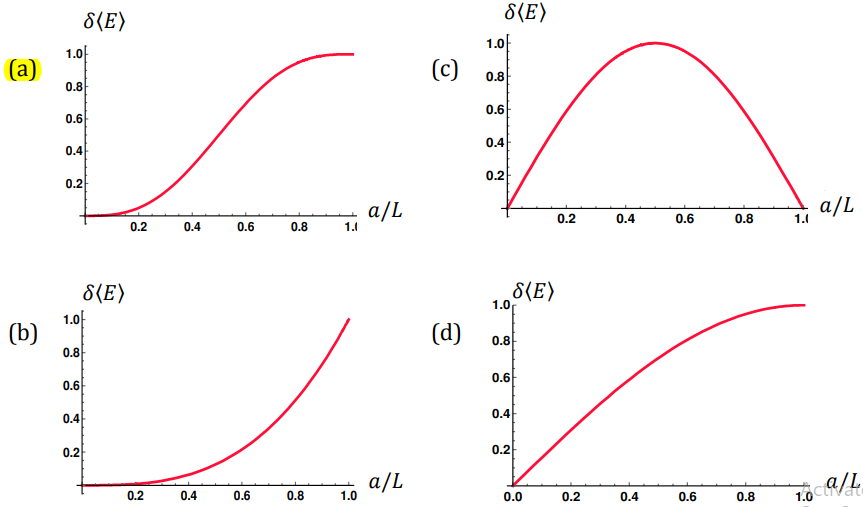
A particle of mass \(m\), confined in a one-dimensional box between \(x=-L\) and \(x=L\), is in its first excited quantum state. Now, a rectangular potential barrier of height \(V(x)=1\) and extending from \(x=-a\) to \(x=a\) is suddenly switched on, as shown in the figure below.


Which of the following curves most closely represents the resulting change in average energy \(\delta\langle E\rangle\) of the system when plotted as a function of \(a/L\), immediately after the barrier is created?

Check Answer
Option a
Q.No: 8 TIFR-2025
Consider a particle with mass \(m\) in a quantum harmonic oscillator potential with a frequency \(\omega\), such that its Hamiltonian is
\[
\hat{H} = \frac{\hat{p}^{2}}{2m} + \frac{m\omega^{2}\hat{x}^{2}}{2}
\]
The Hamiltonian is perturbed by adding a term to the potential
\[
\Delta \hat{H} = \lambda \sin \hat{x}
\]
where \(\lambda\) is small compared to \(\hbar\omega\). The relative change in the ground state energy, to the leading order in \(\lambda/(\hbar\omega)\), is given by:
a) \(O\left(\frac{\lambda^{2}}{(\hbar\omega)^{2}}\right)\)
b) \(O\left(\frac{\lambda}{\hbar\omega}\right)\)
c) \(O(1)\)
d) The ground state energy does not change