CAUTION : Try solving the problem yourself for at least 5–10 minutes before clicking the AI Assistant. In the exam hall, you will be on your own.
Q.No:1 CSIR Dec-2014
Consider two crystalline solids, one of which has a simple cubic structure, and the other has a tetragonal structure. The effective spring constant between atoms in the \(c\)-direction is half the effective spring constant between atoms in the \(a\) and \(b\) directions. At low temperatures, the behavior of the lattice contribution to the specific heat will depend as a function of temperature \(T\) as
(1)
\(T^2\) for the tetragonal solid, but as \(T^3\) for the simple cubic solid
(2)
\(T\) for the tetragonal solid and as \(T^3\) for the simple cubic solid
(3)
\(T\) for both solids
(4)
\(T^3\) for both solids
Check Answer
Option 4
Q.No:2 CSIR Dec-2018
Barium Titanate \({BaTiO_{3}})\) crystal has a cubic perovskite structure, where the \({Ba^{2+}}\) ions are at the vertices of a unit cube, the \({O^{2-}}\) ions are at the centres of the faces while the \({Ti^{2+}}\) is at the centre. The number of optical phonon modes of the crystal is


(1)
\(12\)
(2)
\(15\)
(3)
\(5\)
(4)
\(18\)
Check Answer
Option 1
Q.No:3 CSIR June-2024
The Debye temperature of a two-dimensional insulator is \(150 \, K\). The ratio of the heat required to raise its temperature from \(1 \, K\) to \(2 \, K\) and from \(2 \, K\) to \(3 \, K\) is
1) \(7:19\)
2) \(3:13\)
3) \(1:1\)
4) \(3:5\)
Check Answer
Option 1
Q.No:1 GATE-2013
Group I contains elementary excitations in solids. Group II gives the associated fields with these excitations. MATCH the excitations with their associated field and select your answer as per codes given below.


(A)
(P-iv), (Q-iii), (R-i), (S-ii)
(B)
(P-iv), (Q-iii), (R-ii), (S-i)
(C)
(P-i), (Q-iii), (R-ii), (S-iv)
(D)
(P-iv), (Q-iii), (R-i), (S-ii)
Check Answer
Option B
Q.No:2 GATE-2016
A one-dimensional linear chain of atoms contains two types of atoms of masses \(m_1\) and \(m_2\) (where \(m_2>m_1\)), arranged alternately. The distance between successive atoms is the same. Assume that the harmonic approximation is valid. At the first Brillouin zone boundary, which of the following statements is correct?
(A)
The atoms of mass \(m_2\) are at rest in the optical mode, while they vibrate in the acoustical mode.
(B)
The atoms of mass \(m_1\) are at rest in the optical mode, while they vibrate in the acoustical mode.
(C)
Both types of atoms vibrate with equal amplitudes in the optical as well as in the acoustical modes.
(D)
Both types of atoms vibrate, but with unequal, non-zero amplitudes in the optical as well as in the acoustical modes.
Check Answer
Option A
Q.No:3 GATE-2019
In order to estimate the specific heat of phonons, the appropriate method to apply would be
(A)
Einstein model for acoustic phonons and Debye model for optical phonons
(B)
Einstein model for optical phonons and Debye model for acoustic phonons
(C)
Einstein model for both optical and acoustic phonons
(D)
Debye model for both optical and acoustic phonons
Check Answer
Option B
Q.No:4 GATE-2020
Consider a two dimensional crystal with \(3\) atoms in the basis. The number of allowed optical branches (\(n\)) and acoustic branches (\(m\)) due to the lattice vibrations are
(A)
\((n, m)=(2, 4)\)
(B)
\((n, m)=(3, 3)\)
(C)
\((n, m)=(4, 2)\)
(D)
\((n, m)=(1, 5)\)
Check Answer
Option C
Q.No:5 GATE-2022
Electronic specific heat of a solid at temperature \(T\) is \(C=\gamma T\), where \(\gamma\) is a constant related to the thermal effective mass (\(m_{\text{eff}}\)) of the electrons. Then which of the following statements are correct?
(A)
\(\gamma \propto m_{\text{eff}}\)
(B)
\(m_{\text{eff}}\) is greater than free electron mass for all solids
(C)
Temperature dependence of \(C\) depends on the dimensionality of the solid
(D)
The linear temperature dependence of \(C\) is observed at \(T\ll \) Debye temperature
Check Answer
Option A,D
Q.No:6 GATE-2024
Apart from the acoustic modes, 9 optical modes are identified from the measurements of phonon dispersions of a solid with chemical formula \(A_nB_m\), where \(A\) and \(B\) denote the atomic species, and n and m are integers. Which of the following combination of \(n\) and \(m\) is/are possible?
(A) n = 1, m = 1
(B) n = 2, m = 2
(C) n = 3, m = 1
(D) n = 4, m = 4
Check Answer
Option B,C
Q.No:7 GATE-2025
Consider a monatomic chain of length \(L = 30\ \text{cm}\).
The phonon density of states is \(1.2 \times 10^{-4}\ \text{s}\).
Assuming the Debye model, the velocity of sound in m/s
(rounded off to one decimal place) is
Check Answer
ANS 794-797
Q.No:1 JEST-2014
The value of elastic constant for copper is about \(100 Nm^{-1}\) and the atomic spacing is \(0.256 nm\). What is the amplitude of the vibration of the \({Cu}\) atoms at \(300 K\) as a percentage of the equilibrium separation?
(a)
\(4.55 \%\)
(b)
\(3.55 \%\)
(c)
\(2.55 \%\)
(d)
\(1.55 \%\)
Check Answer
Option b
Q.No:1 TIFR-2014
A manufacturer is able to offer two models of heat-conserving windows, as described below.

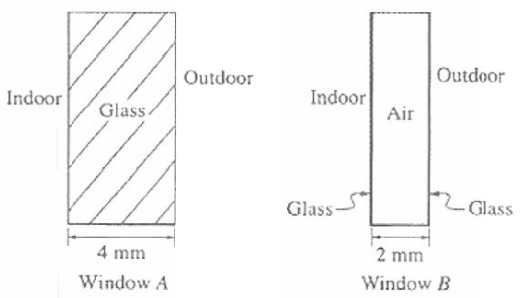
Window \(A\) is a simple pane of glass, \(4 mm\) thick. Window \(B\), on the other hand, consists of two extremely thin panes of glass, separated by an air gap of \(2 mm\), as shown in the figure above. If the thermal conductivity of glass is known to be \(0.8 W m^{-1} K^{-1}\) and that of air is \(0.025 W m^{-1} K^{-1}\), then the ratio of heat flow \(Q_A\) through Window \(A\) to the heat flow \(Q_B\) through Window \(B\) is given by \(\frac{Q_A}{Q_B}=\)
(a)
\(\frac{1}{16}\)
(b)
\(\frac{1}{4}\)
(c)
\(4\)
(d)
\(16\)
Check Answer
Option d
Q.No:2 TIFR-2014
Which of the following statement best explains why the specific heat of electrons in metals is much smaller than that expected in a non-interacting (free) electron gas model?
(a)
The mass of electron is much smaller than that of the ions in the crystal.
(b)
The Pauli exclusion principle restricts the number of electrons which can absorb thermal energy.
(c)
Electron spin can take only two different values.
(d)
Electrons in a metal cannot be modelled as non-interacting.
Check Answer
Option b
Q.No:3 TIFR-2017
Electrons in a metal are scattered by both impurities and phonons. The impurity scattering time is \(8\times 10^{-12} \hspace{1mm}\text{s}\) and the phonon scattering time is \(2\times 10^{-12} \hspace{1mm}\text{s}\). Taking the density of electrons to be \(3\times 10^{14} \hspace{1mm}\text{m}^{-3}\), find the conductivity of the metal in units of \(\text{A}\hspace{1mm}\text{V}^{-1}\hspace{1mm}\text{m}^{-1}\). [Assume that the effective mass of the electrons is the same as that of a free electron.]
Check Answer
Ans \(13.5\times 10^{-6}\)
Q.No:4 TIFR-2026
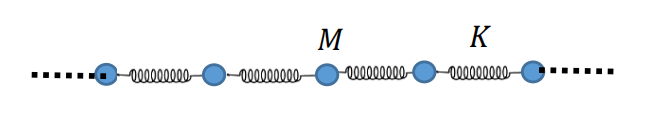
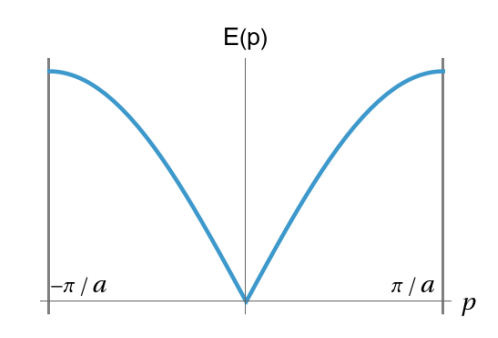
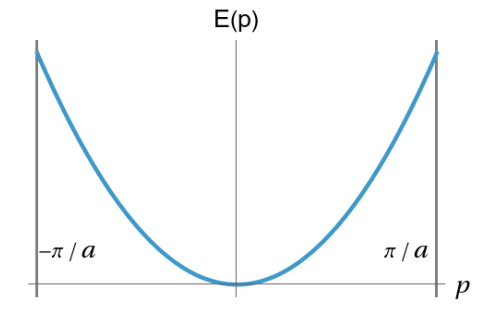
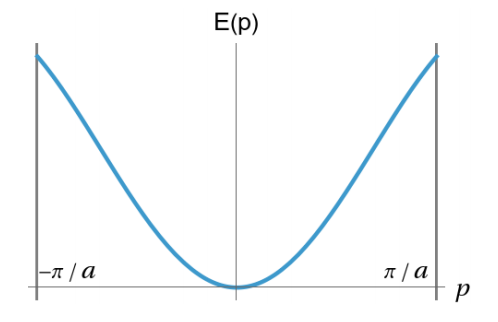
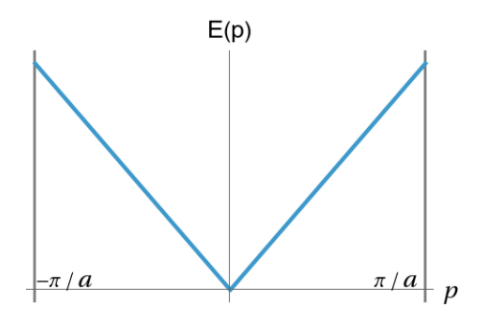
Consider a one-dimensional lattice where each site has mass \(M\) and the lattice constant is \(a\). Nearest neighbours are connected by springs of constant \(K\). Which of the following best represents the dispersion of longitudinal oscillations in the lattice?