
Q.No:1 JEST-2012
A planet orbits a massive star in a highly elliptical orbit, i.e., the total orbital energy \(E\) is close to zero. The initial distance of closest approach is \(R_0\). Energy is dissipated through tidal motions until the orbit is circularized with a final radius of \(R_f\). Assume that orbital angular momentum is conserved during the circularization process. Then
(a)
\(R_f=R_0/2\)
(b)
\(R_f=R_0\)
(c)
\(R_f=\sqrt{2}R_0\)
(d)
\(R_f=2R_0\)
Check Answer
Option d
Q.No:2 JEST-2012
A binary system consists of two stars of equal mass \(m\) orbiting each other in a circular orbit under the influence of gravitational forces. The period of the orbit is \(\tau\). At \(t=0\), the motion is stopped and the stars are allowed to fall towards each other. After what time \(t\), expressed in terms of \(\tau\), do they collide? The following integral may be useful (\(x=r^{1/2}\))
\[
\int \frac{x^2 dx}{\sqrt{\alpha-x^2}}=-\frac{x}{2}\sqrt{\alpha-x^2}+\frac{\alpha}{2}\sin^{-1}{\left(\frac{x}{\sqrt{\alpha}}\right)}.
\]
(a)
\(\sqrt{2}\tau\)
(b)
\(\frac{\tau}{\sqrt{2}}\)
(c)
\(\frac{\tau}{2\sqrt{2}}\)
(d)
\(\frac{\tau}{4\sqrt{2}}\)
Check Answer
Option d
Q.No:3 JEST-2013
If, in a Kepler potential, the pericentre distance of a particle in a parabolic orbit is \(r_p\) while the radius of the circular orbit with the same angular momentum is \(r_c\), then
(a)
\(r_c=2r_p\)
(b)
\(r_c=r_p\)
(c)
\(2r_c=r_p\)
(d)
\(r_c=\sqrt{2}r_p\)
Check Answer
Option d
Q.No:4 JEST-2013
A spherical planet of radius \(R\) has a uniform density \(\rho\) and does not rotate. If the planet is made up of some liquid, the pressure at any point \(r\) from the center is
(a)
\(\frac{4\pi \rho^2 G}{3}(R^2-r^2)\)
(b)
\(\frac{4\pi \rho G}{3}(R^2-r^2)\)
(c)
\(\frac{2\pi \rho^2 G}{3}(R^2-r^2)\)
(d)
\(\frac{\rho G}{2}(R^2-r^2)\)
Check Answer
Option c
Q.No:5 JEST-2014
The free fall time of a test mass on an object of mass \(M\) from a height \(2R\) to \(R\) is
(a)
\((\pi/2+1)\sqrt{\frac{R^3}{GM}}\)
(b)
\(\sqrt{\frac{R^3}{GM}}\)
(c)
\((\pi/2)\sqrt{\frac{R^3}{GM}}\)
(d)
\(\pi\sqrt{\frac{2R^3}{GM}}\)
Check Answer
Option a
Q.No:6 JEST-2015
A classical particle with total energy \(E\) moves under the influence of a potential \(V(x, y)=3x^3+2x^2 y+2xy^2+y^3\). The average potential energy, calculated over a long time is equal to,
(a)
\(\frac{2E}{3}\)
(b)
\(\frac{E}{3}\)
(c)
\(\frac{E}{5}\)
(d)
\(\frac{2E}{5}\)
Check Answer
Option d
Q.No:7 JEST-2015
How is your weight affected if the Earth suddenly doubles in radius, mass remaining the same?
(a)
Increases by a factor of \(4\)
(b)
Increases by a factor of \(2\)
(c)
Decreases by a factor of \(4\)
(d)
Decreases by a factor of \(2\)
Check Answer
Option c
Q.No:8 JEST-2016
The central force which results in the orbit \(r=a(1+\cos{\theta})\) for a particle is proportional to:
(A)
\(r\)
(B)
\(r^2\)
(C)
\(r^{-2}\)
(D)
None of the above
Check Answer
Option D
Q.No:9 JEST-2018
Consider a particle of mass \(m\) moving under the effect of an attractive central potential given as \(V=-kr^{-3}\), where \(k>0\). For a given angular momentum \(L\), \(r_0=3km/L^2\) corresponds to the radius of the possible circular orbit and the corresponding energy is \(E_0=L^2/(6mr_0^2)\). The particle is released from \(r>r_0\) with an inward velocity, energy \(E=E_0\) and angular momentum \(L\). How long will be particle take to reach \(r_0\)?
(A)
zero
(B)
\(2mr_0^2 L^{-1}\)
(C)
\(\sqrt{2}mr_0^2 L^{-1}\)
(D)
Infinite
Check Answer
Option D
Q.No:10 JEST-2019
In a fixed target elastic scattering experiment, a projectile of mass \(m\), having initial velocity \(v_0\), and impact parameter \(b\), approaches the scatterer. It experiences a central repulsive force \(f(r)=k/r^3\) (\(k>0\)). What is the distance of the closest approach \(d\)?
(A)
\(d=(b^2+\frac{k}{mv_0^2})^{\frac{1}{2}}\)
(B)
\(d=(b^2-\frac{k}{mv_0^2})^{\frac{1}{2}}\)
(C)
\(d=b\)
(D)
\(d=\sqrt{\frac{k}{mv_0^2}}\)
Check Answer
Option A
Q.No:11 JEST-2020
A particle of mass \(m\) carrying angular momentum \(l\) moves in a central potential \(V(r)=-\frac{ke^{-ar}}{r}\), where \(k, a\) are positive constants. If the particle undergoes circular motion, what is the equation determining its radius \(r_0\)?
(A)
\(\frac{l^2}{mr_0}=kar_0 e^{-ar_0}\)
(B)
\(\frac{l^2}{mr_0}=ke^{-ar_0}(1+ar_0)\)
(C)
\(\frac{l^2}{2mr_0}=ke^{-ar_0}\)
(D)
\(\frac{l^2}{2mr_0}=ke^{-ar_0}(1+ar_0)\)
Check Answer
Option B
Q.No:12 JEST-2020
A particle of mass \(m\) is placed in a potential well \(U(x)=cx^n\), where \(c\) is a positive constant and \(n\) is an even positive integer. If the particle is in equilibrium at constant temperature, which one of the following relations between average kinetic energy \(\langle K\rangle\) and average potential energy \(\langle U\rangle\) is correct?
(A)
\(\langle K\rangle=\frac{2}{n}\langle U\rangle\)
(B)
\(\langle K\rangle=\langle U\rangle\)
(C)
\(\langle K\rangle=\frac{n}{2}\langle U\rangle\)
(D)
\(\langle K\rangle=2\langle U\rangle\)
Check Answer
Option C
Q.No:13 JEST-2021
A particle of m ass \(m\) having a non-zero angular momentum of magnitude \(\ell\) is subject to a central force potential \(V(\vec{r})=k\ln{(r)}\), where \(k\) is a constant and \(r=|\vec{r}|\). What is the radius \(R\) at which it will have a circular orbit? Will the circular orbit be stable or unstable?
(A)
\(R=\frac{\ell}{\sqrt{2km}}\), unstable orbit
(B)
\(R=\frac{\ell}{\sqrt{2km}}\), stable orbit
(C)
\(R=\frac{\ell}{\sqrt{km}}\), unstable orbit
(D)
\(R=\frac{\ell}{\sqrt{km}}\), stable orbit
Check Answer
Option D
Q.No:14 JEST-2022
A particle of mass \(m\) is moving in a circular path of constant radius \(r\) such that its centripetal acceleration \(a_c\) is varying with time \(t\) as \(a_c=k^2 rt^2\) where, \(k\) is a constant. The power delivered to the particle by the force acting on it is
(a)
\(mk^2 r^2 t\)
(b)
\(2\pi mk^{\frac{3}{2}} r^2\)
(c)
\(\frac{1}{2}mk^2 r^2 t\)
(d)
\(0\)
Check Answer
Option a
Q.No:15 JEST-2022
A particle moving in a central force field centered at \(r=0\), follows a trajectory given by \(r=e^{-\alpha \theta}\) where, \((r, \theta)\) is the polar coordinate of the particle and \(\alpha>0\) is a constant. The magnitude of the force is proportional to
(a)
\(r^{-3}\)
(b)
\(r^{2}\)
(c)
\(r^{-1}\)
(d)
\(r^{3}\)
Check Answer
Option a
Q.No:15 JEST-2023
A particle of mass 1 kg, angular momentum \(L=\sqrt{2}\) kg \(m^2\)/s and total energy E = 3 J is subjected to a central force field \(\vec{F}=-k\vec{r}\) where \(k\) = 2 kg/\(s^2\). Which of the following
statements is true? [Note: The centres of all the circles in the options below are at the origin.]
1) The particle is constrained to be in the region outside the circle with radius \(R=\sqrt{ \frac{3+\sqrt{5}}{2}}\).
2) The particle is bounded within the annular region described by the two circles with radii \(r_1=\sqrt{ \frac{5-\sqrt{3}}{2}}\) and \(r_2=\sqrt{ \frac{5+\sqrt{3}}{2}}\)
3) The particle is bounded within the annular region described by the two circles with radii \(r_1=\sqrt{ \frac{3-\sqrt{5}}{2}}\) and \(r_2=\sqrt{ \frac{3+\sqrt{5}}{2}}\)
4) The particle is constrained to be in the region outside the circle with radius \(R=\sqrt{ \frac{5+\sqrt{3}}{2}}\)
Check Answer
Option 3
Q.No:16 JEST-2024
Consider a particle of mass \( m \) and nonzero angular momentum \( \ell \) subjected to a central force potential \( V(r) = k \ln r \), where \( k \) is a positive constant. What is the radius \( R \) at which it can have a circular orbit? Will the circular orbit be stable or unstable?
1) \( R = \frac{\ell}{\sqrt{km}} \) and stable.
2) \( R = \frac{\ell}{\sqrt{km}} \) and unstable.
3) \( R = \frac{\ell}{\sqrt{km}} \) and unstable.
4) \( R = \frac{\ell}{\sqrt{2km}} \) and unstable.
Check Answer
Option 1
Q.No:17 JEST-2024
A satellite of mass \( 2000 \) kg is placed in an elliptic orbit around Earth with semi major axis \( A \). Assume that the total energy of the orbiting satellite is \( E \) and the angular momentum is \( L \). Through a series of manoeuvres, the elliptic orbit is changed to a circular orbit with radius \( A \). For the orbit change described, which of the following is true?
1) \( E \) does not change, but \( L \) changes.
2) \( E \) changes, but \( L \) does not change.
3) Both \( E \) and \( L \) change.
4) Neither \( E \) nor \( L \) changes.
Check Answer
Option 1
Q.No:18 JEST-2025
Suppose the mass of the Sun is reduced to half of its original value very slowly
(e.g., over a billion years). What will be the effect of this on the Earth's orbit?
1) Remains elliptical with the same mean radius
2) Remains elliptical, but the mean radius changes
3) Orbit remains closed but not elliptical
4) The Earth flies away
Check Answer
Option 2
Q.No:1 TIFR-2012
Consider a spherical planet, rotating about an axis passing through its centre. The velocity of a point on its equator is \(v_{eq}\). If the acceleration due to gravity \(g\) measured at the equator is half of the value of \(g\) measured at one of the poles, then the escape velocity for a particle shot upwards from that pole will be
(a)
\(v_{eq}/2\)
(b)
\(v_{eq}/\sqrt{2}\)
(c)
\(\sqrt{2}v_{eq}\)
(d)
\(2v_{eq}\)
Check Answer
Option d
Q.No:2 TIFR-2013
Two planets \(A\) and \(B\) move around the Sun in elliptic orbits with time periods \(T_A\) and \(T_B\) respectively. If the eccentricity of the orbit of \(B\) is \(\varepsilon\) and its distance of closest approach to the Sun is \(R\), then the maximum possible distance between the planets is
[ Eccentricity of an ellipse: \(\varepsilon=\frac{r_{max}-r_{min}}{r_{max}+r_{min}}\)]
(a)
\(\frac{1+\varepsilon^2}{1-\varepsilon^2}\left(1+\frac{T_A^{3/2}}{T_B^{3/2}}\right)R\)
(b)
\(\sqrt{\frac{1+\varepsilon}{1-\varepsilon}\left(1+\frac{T_A^{3}}{T_B^{3}}\right)}R\)
(c)
\(\frac{1+\varepsilon}{1-\varepsilon}\left(1+\frac{T_A^{2/3}}{T_B^{2/3}}\right)R\)
(d)
\(\sqrt{\frac{1+\varepsilon^2}{1-\varepsilon^2}}\left(1+\frac{T_A^{2/3}}{T_B^{2/3}}\right)R\)
Check Answer
Option c
Q.No:3 TIFR-2015
A particle moves under the influence of a central potential in an orbit \(r=k\theta^4\), where \(k\) is a constant and \(r\) is the distance from the origin. It follows that the angle \(\theta\) varies with time \(t\) as
(a)
\(\theta\propto t^{1/9}\)
(b)
\(\theta\propto t^{1/8}\)
(c)
\(\theta\propto t^{1/7}\)
(d)
\(\theta\propto t^{1/6}\)
Check Answer
Option a
Q.No:4 TIFR-2016
On a planet having the same mass and diameter as the Earth, it is observed that objects become weightless at the equator. Find the time period of rotation of this planet in minutes (as defined on the Earth).
Check Answer
Ans 85
Q.No:5 TIFR-2021
A planet is moving around a star of mass \(M_0\) in a circular orbit of radius \(R\). The star starts to lose its mass very slowly (adiabatically), and after some time, it reaches a mass \(M\) (\(M<M_0\)). If the motion of the planet is still circular at that time, the radius of its orbit will become
(a)
\(R\left(\frac{M_0}{M}\right)^2\)
(b)
\(R\left(\frac{M}{M_0}\right)^2\)
(c)
\(R\left(\frac{M_0}{M}\right)^{1/2}\)
(d)
\(R\left(\frac{M}{M_0}\right)\)
Check Answer
Option a
Q.No:6 TIFR-2021
A star moves in an orbit under the influence of massive but invisible object with the effective one-dimensional potential
\[
V(r)=-\frac{1}{r}+\frac{L^2}{2r^2}-\frac{L^2}{r^3}
\]
where \(L\) is the angular momentum of the star. There would be two possible circular orbits of the star if
(a)
\(L^2>12\)
(b)
\(L^2>6\)
(c)
\(L^2>3\)
(d)
\(L^2>9\)
Check Answer
Option a
Q.No:7 TIFR-2021
Three stars, each of mass \(M\), are rotating under gravity around a fixed common axis such that they are always at the vertices of an equilateral triangle of side \(L\) (see figure).
The time period of rotation of this triple star system is

(a)
\(\frac{2\pi L^{3/2}}{\sqrt{3G_N M}}\)
(b)
\(\frac{2\pi L^{3/2}}{3\sqrt{G_N M}}\)
(c)
\(\frac{\pi L^{3/2}}{\sqrt{3G_N M}}\)
(d)
\(\frac{\pi L^{3/2}}{3\sqrt{G_N M}}\)
Check Answer
Option a
Q.No:7 TIFR-2022
A particle of mass \(m\) moves under the action of a central potential
\[V(r)=-\frac{e^2}{r}\]
where \(e\) is a constant. Two vectors which remain conserved during the motion are
(i) the angular momentum \(\vec{L}=\vec{r} \times \vec{p}\)
(ii) the Runge-Lenz vector \(\vec{K}=\vec{p} \times \vec{L}- me^2 \hat{r}\) (where \(\hat{r}=\vec{r}/r\))
The conserved energy \(E\) of the particle can be written as
(a)
\(\frac{K^2 -m^2 e^4}{2mL^2}\)
(b)
\(\frac{m^2 e^4-K^2}{2mL^2}\)
(c)
\(\frac{2mL^2}{K^2 -m^2 e^4}\)
(d)
\(\frac{2mL^2}{m^2 e^4-K^2}\)
Check Answer
Option a
Q.No:8 TIFR-2023
A spherical planet of mass \(M\), radius \(R\) and uniform density is rotating anticlockwise about an axis passing through its centre, which, in the figure below, is normal to the plane of the paper. The duration of a ‘day’ on this planet is \(T\).

A small asteroid of mass \(m\) approaches the above planet from far away with a uniform speed \(v_1\) along a straight line at a perpendicular distance \(r_1\) from the centre of the planet (see figure). This path gets distorted by the gravitational field of the planet, and the
asteroid leaves with a final uniform speed \(v_2\) along a straight line at a perpendicular distance \(r_2\) from the centre of the planet.
It is observed that after the passage of the asteroid, the length of the day on the planet has changed by \(\delta T\) =
(a)
\(\frac{5 T^2}{4\pi} \frac{m(v_2 r_2- v_1 r_1)}{MR^2}\)
(b)
\(\frac{4\pi}{5} \frac{MR^2}{m(v_2 r_2- v_1 r_1)}\)
(c)
\(\frac{5}{4\pi} \frac{MR^2}{m(v_2 r_2- v_1 r_1)}\)
(d)
0
Check Answer
Option a
Q.No:9 TIFR-2024
In an infinite fluid of density \( \rho \) there are two spherical gas bubbles of radii \( r_1 \) and \( r_2 \) respectively. The gas has density \( \rho_g < \rho \). The centres of the bubbles are separated by a distance \( R \gg r_1, r_2 \). If the space has no other forces than gravity, the bubbles will:
(a) Move towards each other due to an attractive gravitational force
\[ F = G(\rho - \rho_g)^2 \left( \frac{4\pi}{3}\right)^2 r_1^3r_2^3 \frac{1}{R^2} \]
(b) Move towards each other due to an attractive gravitational force
\[ F = G(\rho - \rho_g)^2 \left( \frac{4\pi}{3} r_1^3r_2^3 \right) \frac{1}{R^2} \]
(c) Move away from each other due to a repulsive gravitational force
\[ F = G(\rho - \rho_g)^2 \left( \frac{4\pi}{3} \right)^2 r_1^3r_2^3 \frac{1}{R^2} \]
(d) Move away from each other due to a repulsive gravitational force
\[ F = G(\rho - \rho_g)^2 \left( \frac{4\pi}{3} r_1^3r_2^3 \right) \frac{1}{R^2} \]
Check Answer
Option a
Q.No:10 TIFR-2024
Consider a particle of mass \( m \) orbiting around a central potential \( V(r) = -\frac{a}{r} - \frac{b}{r^3} \) with \( a, b > 0 \). What is the smallest angular momentum it must have to be in a stable orbit?
(a) \( (12abm^2)^{1/4} \)
(b) \( (4abm^2)^{1/4} \)
(c) \( (3abm^2)^{1/4} \)
(d) \( (6abm^2)^{1/4} \)
Check Answer
Option a
Q.No:11 TIFR-2024
A tidal force is exerted on the oceans by the Moon. This can be estimated by the differential acceleration (\( \Delta g \)) which is the difference between the gravitational acceleration at \( B \) and \( C \) due to the moon (see figure below).

If \( R \) and \( M \) are the radius and mass of Earth, \( d \) the distance of separation of the centre of Earth and the moon, and \( m \) the mass of moon, which of the following answers is closest to the magnitude of \( \Delta g \)?
(a) \( \frac{2GmR}{d^3} \)
(b) \( \frac{4GmR}{d^3} \)
(c) \( \frac{GmR}{2d^3} \)
(d) \( \frac{GmR^2}{d^4} \)
Check Answer
Option a
Q.No:12 TIFR-2025
The figure shows a rocket launched from the Earth, which is now at a point A where
the Earth's gravitational field is negligible. The rocket thrusters have stopped.
In the rest frame of the Sun, the velocity of the rocket at A is the same in magnitude
but opposite in direction to that of the Earth when it was at the same point.
Which of the following statements is correct?
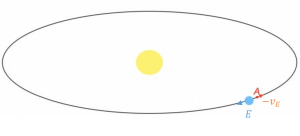
a) The rocket will move exactly on the Earth’s elliptical orbit shown in the figure
and eventually collide with the Earth
b) The rocket will eventually escape the Sun’s gravitational field
c) The rocket will eventually reverse its direction and follow the Earth
d) The rocket will turn towards the Sun and eventually collide with it
Check Answer
Option a
Q.No:13 TIFR-2025
Consider a spherical planet with radius \(R = 6400\ \text{km}\).
The density varies with radius as \(\rho(r) \propto r\), where \(r\) is the distance
from the centre of the planet.
A tunnel is dug through the centre, and the escape speed is measured at various
distances \(r\).
At the planet’s surface, the escape speed is \(11.2\ \text{km s}^{-1}\).
At a distance of \(3200\ \text{km}\) from the centre, the escape speed is
\(12.7\ \text{km s}^{-1}\).
What is the escape speed at the centre of the planet?
a) \(12.9\ \text{km s}^{-1}\)
b) \(14.2\ \text{km s}^{-1}\)
c) \(13.2\ \text{km s}^{-1}\)
d) \(0\ \text{km s}^{-1}\)
Check Answer
Option a
Q.No:14 TIFR-2025
A relativistic particle moving under the central force of gravity experiences
the following effective potential:
\[
V_{\text{eff}}(r)
= -\frac{GMm}{r}
+ \frac{l^{2}}{2mr^{2}}
- \frac{GMl^{2}}{mc^{2}r^{3}},
\]
where the last term is the relativistic correction to the Newtonian formula.
The smallest radius at which a stable circular orbit can exist for some value
of the angular momentum \(l\) is given by:
a) \(\frac{6GM}{c^{2}}\)
b) \(\frac{3GM}{c^{2}}\)
c) \(\frac{2GM}{c^{2}}\)
d) There are no stable circular orbits
Q.No.1 Discussion (JEST) :
Jest Q. No. 1
Q.No.2 Discussion (JEST) :
Q.No.3 Discussion (JEST) :
JEST q no. 3 solution
Q.No.4 Discussion (JEST) :
Planet density r<R
Q.No.5 Discussion (JEST) :