
CAUTION : Try solving the problem yourself for at least 5–10 minutes before clicking the AI Assistant. In the exam hall, you will be on your own.
Q.No:1 JAM-2015
A mass m, lying on a horizontal, frictionless surface, is connected to one end of a spring. The other
end of the spring is connected to a wall, as shown in the figure. At \(t=0\) , the mass is given an
impulse.
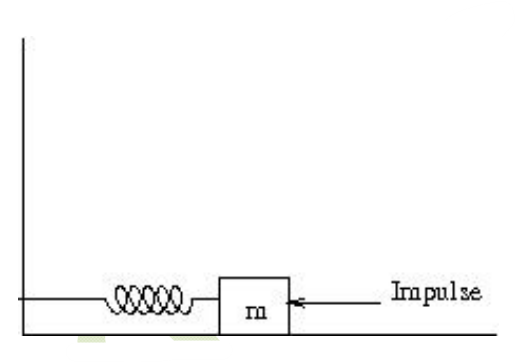
The time dependence of the displacement and the velocity of the mass (in terms of non-zero
constants A and B) are given by
(A)
\(x(t)=A \hspace{1mm} sin \hspace{1mm}\omega t\), \(v(t)=B \hspace{1mm} cos \hspace{1mm}\omega t\)
(B)
\(x(t)=A \hspace{1mm} sin \hspace{1mm}\omega t\), \(v(t)=B \hspace{1mm} sin \hspace{1mm}\omega t\)
(C)
\(x(t)=A \hspace{1mm} cos \hspace{1mm}\omega t\), \(v(t)=B \hspace{1mm} sin \hspace{1mm}\omega t\)
(D)
\(x(t)=A \hspace{1mm} cos \hspace{1mm}\omega t\), \(v(t)=B \hspace{1mm} cos \hspace{1mm}\omega t\)
Check Answer
Option A
Q.No:2 JAM-2015
At room temperature, the speed of sound in air is 340 m/sec. An organ pipe with both ends open
has a length L= 29 cm. An extra hole is created at the position L/2. The lowest frequency of sound
produced is
(A)
\(293 \hspace{2mm} \)Hz
(B)
\(586 \hspace{2mm} \)Hz
(C)
\(1172 \hspace{2mm} \)Hz
(D)
\(2344 \hspace{2mm} \)Hz
Check Answer
Option C
Q.No:3 JAM-2015
A satellite moves around the earth in a circular orbit of radius \(R\) centered at the earth. A second satellite moves in an elliptic orbit of major axis 8R, with the earth at one of the foci. If the former takes 1 day to complete a revolution, the latter would take
(A)
\(21.6\) days
(B)
\(8\) days
(C)
\(3\) hours
(D)
\(1.1\) hour
Check Answer
Option B
Q.No:4 JAM-2015
Doppler effect can be used to measure the speed of blood through vessels. Sound of frequency \(1.0522\) MHz is sent through the vessels along the direction of blood flow. The reflected sound
generates a beat signal of frequency \(100\) Hz. The speed of sound in blood is \(1545\) m/sec. The speed of blood through the vessel, in m/sec, is
(A)
\(14.68\)
(B)
\(1.468\)
(C)
\(0.1468\)
(D)
\(0.01468\)
Check Answer
Option
Q.No:5 JAM-2015
An observer is located on a horizontal, circular turntable which rotates about a vertical axis passing through its center, with a uniform angular speed of 2 rad/sec. A mass of 10 grams is sliding without friction on the turntable. At an instant when the mass is at a distance of 8 cm from the axis, it is observed to move towards the center with a speed of 6 cm/sec. The net force on the mass, as seen by the observer at that instant, is
(A)
\(0.0024\) N
(B)
\(0.0032\) N
(C)
\(0.004\) N
(D)
\(0.006\) N
Check Answer
Option C
Q.No:6 JAM-2015
A particle of mass is moving in x-y plane. At any given time \(t\) ,its position vector is given by \(\vec{r}(t)= A \hspace{1mm} cos \hspace{1mm}\omega t\hspace{1mm} \hat{i}+B \hspace{1mm} sin \hspace{1mm}\omega t\hspace{1mm} \hat{j}\), where \(A,B\) and \(\omega\) are constants with \(A\neq B\).Which of the following statements are true?
(A)
Orbit of the particle is an ellipse
(B)
Speed of the particle is constant
(C)
At any given time \(t\),the particle experiences a force towards origin
(D)
The angular momentum of the particle is \(m\omega AB\hat{k}\)
Check Answer
Option A,C,D
Q.No:7 JAM-2015
A rod is hanging vertically from a pivot. A particle, traveling in horizontal direction, collides with the rod as shown in the figure. For the rod-particle system, consider the linear momentum and the angular momentum about the pivot. Which of the following statements are \(\textbf{NOT}\) true?

(A)
Both linear momentum and angular momentum are conserved
(B)
Linear momentum is conserved but angular momentum is not
(C)
Linear momentum is not conserved but angular momentum is conserved
(D)
Neither linear momentum nor angular momentum are conserved
Check Answer
Option A,B,D
Q.No:8 JAM-2015
A nozzle is in the shape of a truncated cone, as shown in the figure. The area at the wide end is 25 \(cm^2\) and the narrow end has an area of 1 \(cm^2\). Water enters the wider end at a rate of 500 gm/sec. The height of the nozzle is 50 cm and it is kept vertical with the wider end at the bottom. The magnitude of the pressure difference in kPa (1 kPa = \(10^3\) N/\(m^2\)) between the two ends of the nozzle is ____________.

Check Answer
Ans 17-18
Q.No:9 JAM-2015
A block of mass 2 kg is at rest on a horizontal table. The coefficient of friction between the block and the table is 0.1. A horizontal force 3 N is applied to the block. The speed of the block (in m/s) after it has moved a distance 10 m is _____________.
Check Answer
Ans 3.0-3.3
Q.No:10 JAM-2016
Consider a particle of mass \(m\) following a trajectory given by \(x=x_0\cos{\omega_1 t}\) and \(y=y_0\sin{\omega_2 t}\), where \(x_0, y_0, \omega_1\), and \(\omega_2\) are constants of appropriate dimensions. The force on the particle is
(A)
central only if \(\omega_1=\omega_2\).
(B)
central only if \(x_0=y_0\) and \(\omega_1=\omega_2\).
(C)
always central.
(D)
central only if \(x_0=y_0\) and \(\omega_1\neq\omega_2\).
Check Answer
Option A
Q.No:11 JAM-2016
A train passes through a station with a constant speed. A stationary observer at the station platform measures the tone of the train whistle as \(484 \hspace{1mm}\text{Hz}\) when it approaches the station and \(442 \hspace{1mm}\text{Hz}\) when it leaves the station. If the sound velocity in air is \(330 \hspace{1mm}\text{m}/\text{s}\), then the tone of the whistle and the speed of the train are
(A)
\(462 \hspace{1mm}\text{Hz}, 54 \hspace{1mm}\text{km}/\text{h}\).
(B)
\(463 \hspace{1mm}\text{Hz}, 52 \hspace{1mm}\text{km}/\text{h}\).
(C)
\(463 \hspace{1mm}\text{Hz}, 56 \hspace{1mm}\text{km}/\text{h}\).
(D)
\(464 \hspace{1mm}\text{Hz}, 52 \hspace{1mm}\text{km}/\text{h}\).
Check Answer
Option A
Q.No:12 JAM-2016
A cylindrical rod of length \(L\) has a mass density distribution given by \(\rho(x)=\rho_0\left(1+\frac{x}{L}\right)\), where \(x\) is measured from one end of the rod and \(\rho_0\) is a constant of appropriate dimensions. The center of mass of the rod is
(A)
\(\frac{5}{9}L\).
(B)
\(\frac{4}{9}L\).
(C)
\(\frac{1}{9}L\).
(D)
\(\frac{1}{2}L\).
Check Answer
Option A
Q.No:13 JAM-2016
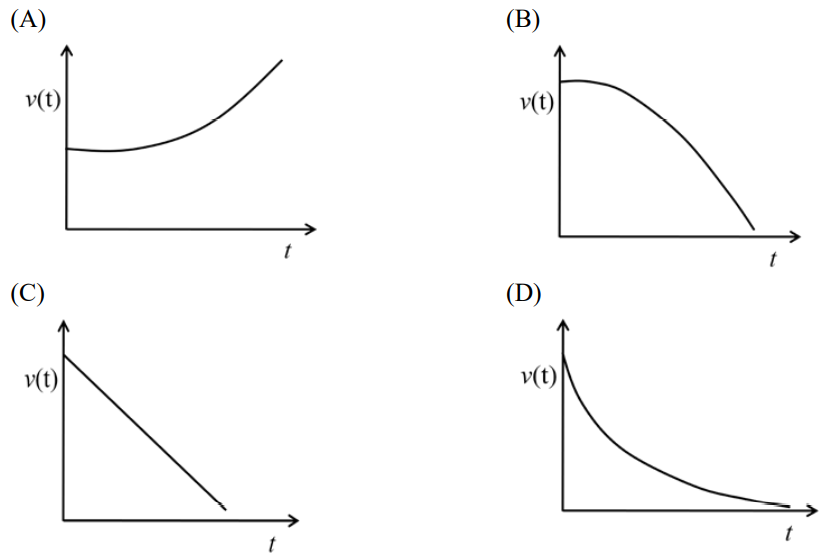
A particle travels in a medium along a horizontal linear path. The initial velocity of the particle is \(\nu_0\) and the viscous force acting on it is proportional to its instantaneous velocity. In the absence of any other forces, which one of the following figures correctly represents the velocity of the particle as a function of time?
Check Answer
Option D
Q.No:14 JAM-2016
A lightly damped harmonic oscillator with natural frequency \(\omega_0\) is driven by a periodic force of frequency \(\omega\). The amplitude of oscillation is maximum when
(A)
\(\omega\) is slightly lower than \(\omega_0\).
(B)
\(\omega=\omega_0\)
(C)
\(\omega\) is slightly higher than \(\omega_0\).
(D)
the force is in phase with the displacement.
Check Answer
Option A
Q.No:15 JAM-2016
A block of mass \(0.38 \hspace{1mm}\text{kg}\) is kept at rest on a frictionless surface and attached to a wall with a spring of negligible mass. A bullet weighing \(0.02 \hspace{1mm}\text{kg}\) moving with a speed of \(200 \hspace{1mm}\text{m}/\text{s}\) hits the block at time \(t=0\) and gets stuck to it. The displacement of the block (in metre) with respect to the equilibrium position is given by

(Spring constant \(=640 \hspace{1mm}\text{N}/\text{m}\).)
(A)
\(2\sin{5t}\)
(B)
\(\cos{10t}\)
(C)
\(0.4\cos{25t}\)
(D)
\(0.25\sin{40t}\)
Check Answer
Option D
Q.No:16 JAM-2016
A particle moves in a circular path in the \(xy\)-plane centered at the origin. If the speed of the particle is constant, then its angular momentum
(A)
about the origin is constant both in magnitude and direction.
(B)
about \((0, 0, 1)\) is constant in magnitude but not in direction.
(C)
about \((0, 0, 1)\) varies both in magnitude and direction.
(D)
about \((0, 0, 1)\) is constant in direction but not in magnitude.
Check Answer
Option A,B
Q.No:17 JAM-2016
The maximum and minimum speeds of a comet that orbits the Sun are \(80\) and \(10\) km/s respectively. The ratio of the aphelion distance of the comet to the radius of the Earth’s orbit is _____________.
(Assume that Earth moves in a circular orbit of radius \(1.5\times 10^8\) km with a speed of 30 km/s.)
Check Answer
Ans 1.9-2.1
Q.No:18 JAM-2017
Consider a uniform thin circular disk of radius \(R\) and mass \(M\) . A concentric square of side \(R/2\) is cut out from the disk (see figure). What is the moment of inertia of the
resultant disk about an axis passing through the centre of the disk and perpendicular to it?

(A)
\(I=\frac{MR^2}{4}[1-\frac{1}{48\pi}]\)
(B)
\(I=\frac{MR^2}{2}[1-\frac{1}{48\pi}]\)
(C)
\(I=\frac{MR^2}{4}[1-\frac{1}{24\pi}]\)
(D)
\(I=\frac{MR^2}{2}[1-\frac{1}{24\pi}]\)
Check Answer
Option B
Q.No:19 JAM-2017
A uniform rigid meter-scale is held horizontally with one of its end at the edge of a table and the other supported by hand. Some coins of negligible mass are kept on the meter scale as shown in the figure

As the hand supporting the scale is removed, the scale starts rotating about its edge on the table and the coins start moving. If a photograph of the rotating scale is taken soon after, it will look closest to:

Check Answer
Option B
Q.No:20 JAM-2017
A pendulum is made of a massless string of length \(L\) and a small bob of negligible size and mass \(m\) . It is released making an angle \(\theta_0(\ll\)1rad) from the vertical. When passing through the vertical, the string slips a bit from the pivot so that its length increases by a small amount \(\delta (\delta\ll L)\) in negligible time. If it swings up to angle \(\theta_1\) on the other side before starting to swing back, then to a good approximation which of the following expressions
is correct?

(A)
\(\theta_1=\theta_0\)
(B)
\(\theta_1=\theta_0(1-\frac{\delta}{2L})\)
(C)
\(\theta_1=\theta_0(1-\frac{\delta}{L})\)
(D)
\(\theta_1=\theta_0(1-\frac{3\delta}{2L})\)
Check Answer
Option D
Q.No:21 JAM-2017
The linear mass density of a rod of length \(L\) varies from one end to the other as \(\lambda_0(1+\frac{x^2}{L^2})\), where \(x\) is the distance from one end with tensions \(T_1\) and \(T_2\) in them (see figure), and \(\lambda_0\)is a constant. The rod is suspended from a ceiling by two massless strings. Then, which of the following statement(s) is (are) correct?

(A)
The mass of the rod is \(\frac{2\lambda_0 L}{3}\)
(B)
The centre of gravity of the rod is located at \(x=\frac{9L}{16}\)
(C)
The tension \(T_1\) in the left string is \(\frac{7\lambda_0 L g}{12}\)
(D)
The tension \(T_2\) in the right string is \(\frac{3\lambda_0 L g}{2}\)
Check Answer
Option B,C
Q.No:22 JAM-2017
An object of mass \(m\) with non-zero angular momentum \(l\) is moving under the influence of gravitational force of a much larger mass (ignore drag). Which of the following statement(s) is (are) correct?
(A)
If the total energy of the system is negative, then the orbit is always circular
(B)
The motion of \(m\) always occurs in a two-dimensional plane
(C)
If the total energy of the system is 0 , then the orbit is a parabola
(D)
If the area of the particle’s bound orbit is \(S\) , then its time period is \(2mS/l\)
Check Answer
Option B,C,D
Q.No:23 JAM-2017
A particle of mass \(m\) fixed in space is observed from a frame rotating about its z - axis with angular speed \(\omega\). The particle is in the frame’s xy plane at a distance \(R\) from its
origin. If the Coriolis and centrifugal forces on the particle are \(\vec{F}_{COR}\) and \(\vec{F}_{CFG}\),respectively, then (all the symbols have their standard meaning and refer to the rotating
frame),
(A)
\(\vec{F}_{COR}+\vec{F}_{CFG}=0\)
(B)
\(\vec{F}_{COR}+\vec{F}_{CFG}=-m\omega^2 R \hat{r}\)
(C)
\(\vec{F}_{COR}=-2m\omega^2 R \hat{r}\)
(D)
\(\vec{F}_{CFG}=-m\omega^2 R \hat{r}\)
Check Answer
Option B,C
Q.No:24 JAM-2017
A particle of unit mass is moving in a one-dimensional potential \(V(x)=x^2-x^4\). The minimum mechanical energy (in the same units as \(V(x)\) ) above which the motion of the particle cannot be bounded for any given initial condition is ____________.
(Specify your answer to two digits after the decimal point)
Check Answer
Ans 0.24-0.26
Q.No:25 JAM-2017
Sand falls on a conveyor belt at the rate of 1.5/kg s. If the belt is moving with a constant speed of 7/m s, the power needed to keep the conveyor belt running is ____________.
(Specify your answer in Watts to two digits after the decimal point)
Check Answer
Ans 73.01-73.99
Q.No:26 JAM-2018
There are three planets in circular orbits around a star at distances \(a\),\(4a\) and \(9a\) respectively. At time \(t_0\), the star and the three planets are in a straight line. The period of revolution of the closest planet is \(T\). How long after \(t_0\) will they again be in the same straight line?
(A)
\(8T\)
(B)
\(27T\)
(C)
\(216T\)
(D)
\(512T\)
Check Answer
Option C
Q.No:27 JAM-2018
A disc of radius \(R_1\) having uniform surface density has a concentric hole of radius \(R_2<R_1\). If its mass is \(M\), the principal moments of inertia are
(A)
\(\frac{M(R_1^2-R_2^2)}{2},\frac{M(R_1^2-R_2^2)}{4},\frac{M(R_1^2-R_2^2)}{4}\)
(B)
\(\frac{M(R_1^2+R_2^2)}{2},\frac{M(R_1^2+R_2^2)}{4},\frac{M(R_1^2+R_2^2)}{4}\)
(C)
\(\frac{M(R_1^2+R_2^2)}{2},\frac{M(R_1^2+R_2^2)}{4},\frac{M(R_1^2+R_2^2)}{8}\)
(D)
\(\frac{M(R_1^2-R_2^2)}{2},\frac{M(R_1^2-R_2^2)}{4},\frac{M(R_1^2-R_2^2)}{8}\)
Check Answer
Option B
Q.No:28 JAM-2018
A raindrop falls under gravity and captures water molecules from atmosphere. Its mass changes at the rate \(\lambda m(t)\), where \(\lambda\) is a positive constant and \(m(t)\) is the instantaneous mass. Assume that acceleration due to gravity is constant and water molecules are at rest with respect to earth before capture. Which of the following statements is correct?
(A)
The speed of the raindrop increases linearly with time.
(B)
The speed of the raindrop increases exponentially with time.
(C)
The speed of the raindrop approaches a constant value when \(\lambda t \gg 1\)
(D)
The speed of the raindrop approaches a constant value when \(\lambda t \ll 1\)
Check Answer
Option C
Q.No:29 JAM-2018
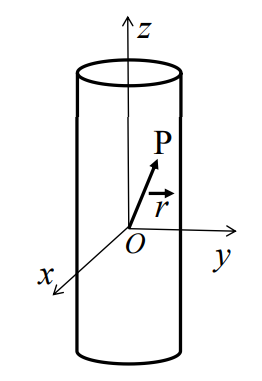
A particle \(P\) of mass \(m\) is constrained to move on the surface of a cylinder under a force \(-k\vec{r}\) as
shown in figure (k is the positive constant). Which of the following statements is correct? (Neglect friction.)
(A)
Total energy of the particle is not conserved.
(B)
The motion along z direction is simple harmonic.
(C)
Angular momentum of the particle about O increases with time.
(D)
Linear momentum of the particle is conserved.
Check Answer
Option B
Q.No:30 JAM-2018
Two projectiles of identical mass are projected from the ground with same initial angle \((\alpha)\) with respect to earth surface and same initial velocity \((u)\) in the same plane. They collide at the highest point of their trajectories and stick to each other. Which of the following statements is (are) correct?

(A)
The momentum of the combined object immediately after the collision is zero.
(B)
Kinetic energy is conserved in the collision.
(C)
The combined object moves vertically downward.
(D)
The combined object moves in a parabolic path.
Check Answer
Option A,C
Q.No:31 JAM-2018
A particle of mass \(m\) is moving along the positive \(x\) direction under a potential \(V(x)=\frac{1}{2}kx^2+\frac{\lambda}{2x^2}\) (\(k\) and \(\lambda\) are positive constants). If the particle is slightly displaced from its equilibrium position, it oscillates with an angular frequency \((\omega)\) ______.
(Specify your answer in units of \(\sqrt{\frac{k}{m}}\) as an integer.)
Check Answer
Ans 2
Q.No:32 JAM-2018
A planet has average density same as that of the earth but it has only \(1⁄8\) of the mass of the earth. If the acceleration due to gravity at the surface is \(g_P\) and \(g_e\) for the planet and earth, respectively, then \(\frac{g_P}{g_e}\) is _____________ .
(Specify your answer upto one digit after the decimal point.)
Check Answer
Ans 0.4-0.6
Q.No:33 JAM-2018
A system of 8 non-interacting electrons is confined by a three dimensional potential \(V(r)=\frac{1}{2}m \omega^2 r^2\). The ground state energy of the system in units of \(\hbar \omega\) is ______________.
(Specify your answer as an integer.)
Check Answer
Ans 18
Q.No:34 JAM-2018
A body of mass 1 kg is moving under a central force in an elliptic orbit with semi major axis 1000 m and semi minor axis 100 m. The orbital angular momentum of the body is 100 kg \(m^2 s^{-1}\). The time period of motion of the body is ____________ hours.
(Specify your answer in hours upto two digits after the decimal point.)
Check Answer
Ans 1.70-1.80
Q.No:35 JAM-2018
The moon moves around the earth in a circular orbit with a period of 27 days. The radius of the earth \((R)\) is \(6.4 \times 10^6\) m and the acceleration due to gravity on the earth surface is \(9.8 ms^{-2}\). If \(D\) is the distance of the moon from the center of the earth, the value of \(D/R\) will be ______________ .
(Specify your answer upto one digit after the decimal point.)
Check Answer
Ans 59-60
Q.No:36 JAM-2018
A syringe is used to exert 1.5 atmospheric pressure to release water horizontally. The speed of water immediately after ejection is __________-. (take 1 atmospheric pressure = \(10^5\) Pascal, density of water =\(10^3\)kg\(m^{-3}\))
(Specify your answer in \(ms^{-1}\) as an integer.)