
CAUTION : Try solving the problem yourself for at least 5–10 minutes before clicking the AI Assistant. In the exam hall, you will be on your own.
Q.No:1 JEST-2012
The value of the integral \(\int_{0}^{\infty} \frac{\ln{x}}{(x^2+1)^2} dx\) is
(a)
\(0\)
(b)
\(-\pi/4\)
(c)
\(\pi/2\)
(d)
\(-\pi/2\)
Check Answer
Option b
Q.No:2 JEST-2013
Compute
\[
\lim_{z\to 0} \frac{\text{Re}(z^2)+\text{Im}(z^2)}{z^2}.
\]
(a)
The limit does not exist.
(b)
\(1\)
(c)
\(-i\)
(d)
\(-1\)
Check Answer
Option a
Q.No:3 JEST-2014
The value of limit
\[
\lim_{z\to i}\frac{z^{10}+1}{z^6+1}
\]
is equal to
(a)
\(1\)
(b)
\(0\)
(c)
\(-10/3\)
(d)
\(5/3\)
Check Answer
Option d
Q.No:4 JEST-2014
The value of integral
\[
I=\oint_c \frac{\sin{z}}{2z-\pi} dz
\]
with \(c\) a circle \(|z|=2\), is
(a)
\(0\)
(b)
\(2\pi i\)
(c)
\(\pi i\)
(d)
\(-\pi i\)
Check Answer
Option c
Q.No:5 JEST-2015
Given an analytic function \(f(z)=\phi(x, y)+i\psi(x, y)\), where \(\phi(x, y)=x^2+4x-y^2+2y\). If \(C\) is a constant, which of the following relations is true?
(a)
\(\psi(x, y)=x^2 y+4y+C\)
(b)
\(\psi(x, y)=2xy-2x+C\)
(c)
\(\psi(x, y)=2xy+4y-2x+C\)
(d)
\(\psi(x, y)=x^2 y-2x+C\)
Check Answer
Option c
Q.No:6 JEST-2016
The value of the integral \(\int_{0}^{\infty} \frac{\ln{x}}{(x^2+1)}dx\) is:
(A)
\(\pi^2/4\)
(B)
\(\pi^2/2\)
(C)
\(\pi^2\)
(D)
\(0\)
Check Answer
Option D
Q.No:7 JEST-2017
Which one is the image of the complex domain \(\{z\mid xy\geq 1, x+y>0\}\) under the mapping \(f(z)=z^2\), if \(z=x+iy\)?
(A)
\(\{x\mid xy\geq 1, x+y>0\}\)
(B)
\(\{z\mid x\geq 2, x+y>0\}\)
(C)
\(\{z\mid y\geq 2\forall x\}\)
(D)
\(\{z\mid y\geq 1\forall x\}\)
Check Answer
Option C
Q.No:8 JEST-2017
The integral \(I=\int_{1}^{\infty} \frac{\sqrt{x-1}}{(1+x)^2}dx\) is
(A)
\(\frac{\pi}{\sqrt{2}}\).
(B)
\(\frac{\pi}{2\sqrt{2}}\).
(C)
\(\frac{\sqrt{\pi}}{2}\).
(D)
\(\sqrt{\frac{\pi}{2}}\).
Check Answer
Option B
Q.No:9 JEST-2018
The integral
\[
\int_{-\infty}^{\infty} \frac{\cos{x}}{x^2+1}dx
\]
is
(A)
\(\pi/e\)
(B)
\(\pi e^{-2}\)
(C)
\(\pi\)
(D)
zero
Check Answer
Option A
Q.No:10 JEST-2019
Consider the function \(f(x, y)=|x|-i|y|\). In which domain of the complex plane is this function analytic?
(A)
First and second quadrants
(B)
Second and third quadrants
(C)
Second and fourth quadrants
(D)
Nowhere
Check Answer
Option C
Q.No:11 JEST-2020
What is the value of the following contour integral \(I\) taken counterclockwise around the circle \(|z|=2\)?\[
I=\oint_C \frac{dz}{z^3(z+4)}
\]
(A)
\(\frac{\pi i}{2}\)
(B)
\(\frac{\pi i}{32}\)
(C)
\(\frac{\pi i}{16}\)
(D)
\(\frac{\pi i}{4}\)
Check Answer
Option B
Q.No:12 JEST-2022
Consider a complex function
\[
f(z)=\frac{1}{6z^3+3z^2+2z+1}.
\]
What is the sum of the residues at its poles?
(a)
\(0\)
(b)
\(\frac{4}{7}\)
(c)
\(\frac{2}{7}\)
(d)
\(\frac{i\sqrt{3}}{7}\)
Check Answer
Option a
Q.No:13 JEST-2022
Consider a complex number \(z=x+iy\). Where do all the zeros of \(\cos{(z)}\) lie?
(a)
On the \(y=0\) line.
(b)
On the \(x=0\) line.
(c)
On the \(x=y\) line.
(d)
On the \(x=-y\) line.
Check Answer
Option a
Q.No:14 JEST-2023
Calculate the contour integral
\[I=\oint_C \frac{cos^2 (z)-z^2}{(z-a)^3} dz\]
where the clockwise contour \(C\) is encircling the point \(z = a\) in the complex plane.
(a) \(-(sin \hspace{1mm} 2a+1) 2\pi i\)
(b) \(-(cos \hspace{1mm} 2a+1) 2\pi i\)
(c)\((cos \hspace{1mm} 2a+1) 2\pi i\)
(d) \((sin \hspace{1mm} 2a+1) 2\pi i\)
Check Answer
Option c
Q.No:15 JEST-2023
Compute the contour integral:
\[I=\oint \frac{z dz}{sinh (2 \pi z)}\]
where the contour is a circle of radius \(\frac{3}{4}\) centred around the origin and the direction is counterclockwise
(a) \(0\)
(b) \(-1\)
(c) \(\pi\)
(d) \(1\)
Check Answer
Option a
Q.No:16 JEST-2024
What is the value of the integral
\[ \int_{0}^{\infty} \frac{dx}{1 + x^3}? \]
(a) \( \frac{2\pi}{3\sqrt{3}} \)
(b) \( \frac{\pi}{3\sqrt{3}} \)
(c) \( \frac{2\pi}{\sqrt{3}} \)
(d) \( \frac{\pi}{3} \)
Check Answer
Option a
Q.No:17 JEST-2025
What is the value of the integral
\[
I = \frac{3}{2\pi i}\oint_C \frac{dz}{1+z^2},
\]
where the contour \(C\) is a circle of radius \(2\) centered at the origin?
Check Answer
ANS 0
Q.No:18 JEST-2026
What is the value of the integral
\[
\int_0^\infty \frac{k\sin(kr)}{k^2+m^2}\,dk
\]
for \(r>0\)?
a) \(
\frac{1}{4\pi r}e^{-mr}
\)
b) \(
\frac{\pi r}{1+m^2r^2}
\)
c) \(
\frac{\pi}{2}e^{-mr}
\)
d) \(
\frac{1}{r\sqrt{1+m^2r^2}}
\)
Check Answer
Option c
Q.No:1 TIFR-2012
Consider the integral
\[
\int_{-p^2}^{+p^2} \frac{dx}{\sqrt{x^2-p^2}}
\]
where \(p\) is a constant. This integral has a real, nonsingular value if
(a)
\(p<-1\)
(b)
\(p>1\)
(c)
\(p=1\)
(d)
\(p\to 0\)
(e)
\(p\to \infty\)
Check Answer
Option d
Q.No:2 TIFR-2013
If \(z=x+iy\) then the function
\[
f(x, y)=(1+x+y)(1+x-y)+a(x^2-y^2)-1+2iy(1-x-ax)
\]
where \(a\) is a real parameter, is analytic in the complex \(z\) plane if \(a=\)
(a)
\(-1\)
(b)
\(+1\)
(c)
\(0\)
(d)
\(i\)
Check Answer
Option a
Q.No:3 TIFR-2014
The integral
\[
\int_0^{\infty} \frac{dx}{4+x^4}
\]
evaluates to
(a)
\(\pi\)
(b)
\(\frac{\pi}{2}\)
(c)
\(\frac{\pi}{4}\)
(d)
\(\frac{\pi}{8}\)
Check Answer
Option d
Q.No:4 TIFR-2015
The integral
\[
\int_{0}^{2\pi} \frac{d\theta}{1-2a\cos{\theta}+a^2}
\]
where \(0<a<1\), evaluates to
(a)
\(2\pi\)
(b)
\(\frac{2\pi}{1+a^2}\)
(c)
\(\frac{2\pi}{1-a^2}\)
(d)
\(\frac{4\pi}{1-a^2}\)
Check Answer
Option c
Q.No:5 TIFR-2016
The value of the integral
\[
\oint_C \frac{\sin{z}}{z^6} dz
\]
where \(C\) is the circle of centre \(z=0\) and radius \(=1\)
(a)
\(i\pi\)
(b)
\(i\pi/120\)
(c)
\(i\pi/60\)
(d)
\(-i\pi/6\)
Check Answer
Option c
Q.No:6 TIFR-2017
The value of the integral
\[
\int_0^{\infty} \frac{dx}{x^4+4}
\]
Is
(a)
\(\pi\)
(b)
\(\frac{\pi}{2}\)
(c)
\(\frac{\pi}{4}\)
(d)
\(\frac{\pi}{8}\)
Check Answer
Option d
Q.No:7 TIFR-2018
The value of the integral
\[
\frac{1}{\pi}\int_{-\infty}^{\infty} \frac{\cos{x}}{x^2+a^2}
\]
is
(a)
\(1/2a\)
(b)
\(1/2\pi a\)
(c)
\(\pi a\exp{(-a)}\)
(d)
\(\exp{(-a)}/a\)
Check Answer
Option d
Q.No:8 TIFR-2019
Consider the complex function
\[
f(x, y)=u(x, y)+i\nu(x, y)
\]
where
\[
\begin{array}{lll}
u(x, y) &=& x^2(2+x)-y^2(2+3x) \\
\nu(x, y) &=& y(\lambda x+3x^2-y^2)
\end{array}
\]
and \(\lambda\) is real. If it is known that \(f(x, y)\) is analytic in the complex plane of \(z=x+iy\), then it can be written
(a)
\(f=z^2(2+z)\)
(b)
\(f=\bar{z}(2+\bar{z}^2)\)
(c)
\(f=2z\bar{z}+z^2-\bar{z}^2\)
(d)
\(f=z^2+z^3\)
Check Answer
Option a
Q.No:9 TIFR-2020
The value of the integral
\[
\int_0^{\infty} \frac{dx}{x^4+4}
\]
is
(a)
\(\frac{\pi}{8}\)
(b)
\(\frac{3\pi}{8}\)
(c)
\(2\pi\)
(d)
\(\frac{\pi}{4}\)
Check Answer
Option a
Q.No:10 TIFR-2021
How many distinct values can the following function take at a given value of \(z\)?
\[
f(z)=\sqrt{\frac{z^2-1}{\sqrt{z}}}(z-i)^{1/3}
\]
(a)
\(12\)
(b)
\(3\)
(c)
\(4\)
(d)
\(24\)
Check Answer
Option a
Q.No:11 TIFR-2023
A complex analytic function \(\omega=f(z)\) transforms an equilateral triangle in the complex z-plane to another equilateral triangle in the complex \(\omega\)-plane as shown in the figure.
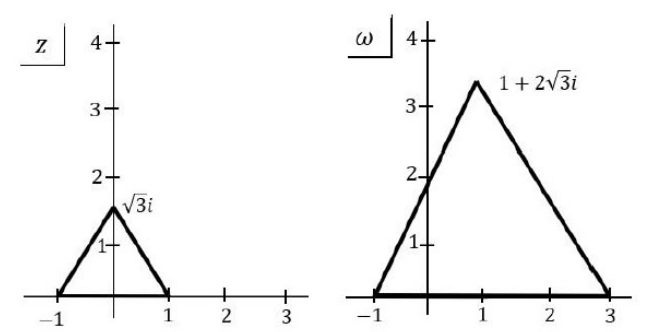
Which one of the options below \(\textbf{CANNOT}\) be \(f(z)\)?
(a)
\(f(z)=2z+1\)
(b)
\(f(z)=e^{5\pi i/6}z+2i\sqrt{3}\)
(c)
\(f(z)=2e^{2\pi i/3}z+2+i\sqrt{3}\)
(d)
\(f(z)=2 i e^{5\pi i/6}z+i\sqrt{3}\)
Check Answer
Option d
Q.No:12 TIFR-2025
(NB: Due to an ambiguity in the question all test takers will be awarded the full score.)
Evaluate the integral
\[
\int_{-\infty}^{+\infty} \frac{e^{-ikx}}{k^2 + 1}\, dk .
\]
a) \(\pi e^{-x}\)
b) \(\pi e^{x}\)
c) \(-\pi e^{-x}\)
d) \(-\pi e^{x}\)
Check Answer
no options are correct
Q.No:13 TIFR-2026
Consider the series:
\[
S=\sum_{n=1}^{\infty}\frac{1}{n^{3/2}}
\]
Which of the following statements is correct?
a) \(S\) is convergent and is greater than \(2\)
b) \(S\) is convergent and is less than \(2\)
c) \(S\) is convergent and is equal to \(2\)
d) \(S\) is not convergent
Check Answer
Option a
Q.No:14 TIFR-2026
An analytic transformation:
\[
w=z^2
\]
is applied on the complex plane. Consider the circle \(C\) in \(z\) as shown in figure. Which of the following represents the image of \(C\) in the \(w\)-plane?
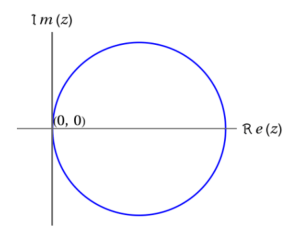
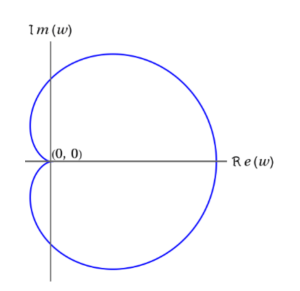
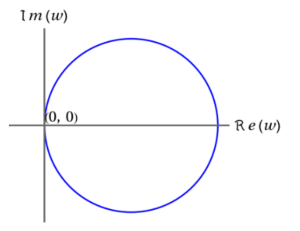

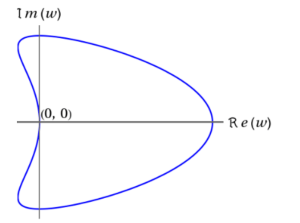
Check Answer
Option a
Q.No:15 TIFR-2026
What is the value of the following integral:
\[
\int_0^\infty dx\,\frac{\sin x}{x}\frac{1}{x^2+a^2}
\]
(Assume \(a>0\).)
a) \(\frac{\pi}{2a^2}(1-e^{-a})\)
b) \(\frac{\pi}{2a^2}(1+e^{-a})\)
c) \(\frac{\pi\sinh a}{2a^2}\)
d) \(\frac{\pi\sin a}{2a^2}\)
14.Jest 2023 solution: happy solving🤗