
Q.No:1 GATE-2012
The space-time dependence of the electric field of a linearly polarized light in free space is given by \(xE_0\cos{(\omega t-kz)}\) where \(E_0, \omega\) and \(k\) are the amplitude, the angular frequency and the wavevector, respectively. The time averaged energy density associated with the electric field is
(A)
\(\frac{1}{4}\varepsilon_0 E_0^2\)
(B)
\(\frac{1}{2}\varepsilon_0 E_0^2\)
(C)
\(\varepsilon_0 E_0^2\)
(D)
\(2\varepsilon_0 E_0^2\)
Check Answer
Option A
Q.No:2 GATE-2012
A plane electromagnetic wave traveling in free space is incident normally on a glass plate of refractive index \(3/2\). If there is no absorption by the glass, its reflectivity is
(A)
\(4\%\)
(B)
\(16\%\)
(C)
\(20\%\)
(D)
\(50\%\)
Check Answer
Option A
Q.No:3 GATE-2012
The electric and the magnetic fields \(\vec{E}(z, t)\) and \(\vec{B}(z, t)\), respectively corresponding to the scalar potential \(\phi(z, t)=0\) and vector potential \(\vec{A}(z, t)=\hat{i}tz\) are
(A)
\(\vec{E}=\hat{i}z\) and \(\vec{B}=-jt\)
(B)
\(\vec{E}=\hat{i}z\) and \(\vec{B}=jt\)
(C)
\(\vec{E}=-\hat{i}z\) and \(\vec{B}=-jt\)
(D)
\(\vec{E}=-\hat{i}z\) and \(\vec{B}=jt\)
Check Answer
Option D
Q.No:4 GATE-2012
A plane polarized electromagnetic wave in free space at time \(t=0\) is given by \(\vec{E}(x, z)=10j\exp{[i(6x+8z)]}\). The magnetic field \(\vec{B}(x, z, t)\) is given by
(A)
\(\vec{B}(x, z, t)=\frac{1}{c}(6k-8\hat{i})\exp{[i(6x+8z-10ct)]}\)
(B)
\(\vec{B}(x, z, t)=\frac{1}{c}(6k+8\hat{i})\exp{[i(6x+8z-10ct)]}\)
(C)
\(\vec{B}(x, z, t)=\frac{1}{c}(6k-8\hat{i})\exp{[i(6x+8z-ct)]}\)
(D)
\(\vec{B}(x, z, t)=\frac{1}{c}(6k+8\hat{i})\exp{[i(6x+8z+ct)]}\)
Check Answer
Option A
Q.No:5 GATE-2013
A circularly polarized monochromatic plane wave is incident on a dielectric interface at Brewster angle. Which one of the following statements is CORRECT?
(A)
The reflected light is plane polarized in the plane of incidence and the transmitted light is circularly polarized.
(B)
The reflected light is plane polarized perpendicular to the plane of incidence and the transmitted light is plane polarized in the plane of incidence.
(C)
The reflected light is plane polarized perpendicular to the plane of incidence and the transmitted light is elliptically polarized.
(D)
There will be no reflected light and the transmitted light is circularly polarized.
Check Answer
Option C
Q.No:6 GATE-2013
A monochromatic plane wave at oblique incidence undergoes reflection at a dielectric interface. If \(\hat{k}_i, \hat{k}_r\) and \(\hat{n}\) are the unit vectors in the directions of incident wave, reflected wave and the normal to the surface respectively, which one of the following expressions is correct?
(A)
\((\hat{k}_i-\hat{k}_r)\times \hat{n}\neq 0\)
(B)
\((\hat{k}_i-\hat{k}_r)\times \hat{n}=0\)
(C)
\((\hat{k}_i\times \hat{n})\cdot \hat{k}_r=0\)
(D)
\((\hat{k}_i\times \hat{n})\cdot \hat{k}_r\neq 0\)
Check Answer
Option C
Q.No:7 GATE-2014
Which one of the following quantities is invariant under Lorentz transformation?
(A)
Charge density
(B)
Charge
(C)
Current
(D)
Electric field
Check Answer
Option B
Q.No:8 GATE-2014
An unpolarized light wave is incident from air on a glass surface at the Brewster angle. The angle between the reflected and the refracted wave is
(A)
\(0^{\circ}\)
(B)
\(45^{\circ}\)
(C)
\(90^{\circ}\)
(D)
\(120^{\circ}\)
Check Answer
Option C
Q.No:9 GATE-2014
The electric field of a uniform plane wave propagating in a dielectric, non-conducting medium is given by,
\[
\vec{E}=\hat{x} 10\cos{(6\pi \times 10^7 t-0.4 \pi z)} V/m.
\]
The phase velocity of the wave is ___________(\times 10^8 m/s\).
Check Answer
Ans 1.49-1.51
Q.No:10 GATE-2014
If the vector potential
\[
\vec{A}=\alpha x\hat{x}+2y\hat{y}-3z\hat{z},
\]
satisfies the Coulomb gauge, the value of the constant \(\alpha\) is ____________.
Check Answer
Ans 0.99-1.01
Q.No:11 GATE-2014
The intensity of a laser in free space is \(150 mW/m^2\). The corresponding amplitude of the electric field of the laser is ___________V/m. (\(\varepsilon_0=8.854\times 10^{-12} C^2/N.m^2\))
Check Answer
Ans 10.58-10.70
Q.No:12 GATE-2015
A long solenoid is embedded in a conducting medium and is insulated from the medium. If the current through the solenoid is increased at a constant rate, the induced current in the medium as a function of the radial distance \(r\) from the axis of the solenoid is proportional to
(A)
\(r^2\) inside the solenoid and \(\frac{1}{r}\) outside
(B)
\(r\) inside the solenoid and \(\frac{1}{r^2}\) outside
(C)
\(r^2\) inside the solenoid and \(\frac{1}{r^2}\) outside
(D)
\(r\) inside the solenoid and \(\frac{1}{r}\) outside
Check Answer
Option D
Q.No:13 GATE-2016
The electric field component of a plane electromagnetic wave travelling in vacuum is given by \(\vec{E}(z, t)=E_0 \cos{(kz-\omega t)}\hat{i}\). The Poynting vector for the wave is
(A)
\((c\varepsilon_0/2)E_0^2\cos^2{(kz-\omega t)}\hat{j}\)
(B)
\((c\varepsilon_0/2)E_0^2\cos^2{(kz-\omega t)}\hat{k}\)
(C)
\(c\varepsilon_0 E_0^2\cos^2{(kz-\omega t)}\hat{j}\)
(D)
\(c\varepsilon_0 E_0^2\cos^2{(kz-\omega t)}\hat{k}\)
Check Answer
Option D
Q.No:14 GATE-2017
A monochromatic plane wave in free space with electric field amplitude of \(1 V/m\) is normally incident on a fully reflecting mirror. The pressure exerted on the mirror is _________\(\times 10^{-12} Pa\). (up to two decimal places) (\(\varepsilon_0=8.854\times 10^{-12} F/m\)).
Check Answer
Ans 8.80-8.90
Q.No:15 GATE-2017
An infinite solenoid carries a time varying current \(I(t)=At^2\), with \(A\neq 0\). The axis of the solenoid is along the \(\hat{z}\) direction. \(\hat{r}\) and \(\hat{\theta}\) are the usual radial and polar directions in cylindrical polar coordinates. \(\vec{B}=B_r \hat{r}+B_{\theta} \hat{\theta}+B_z \hat{z}\) is the magnetic field at a point outside the solenoid. Which one of the following statements is true?
(A)
\(B_r=0, B_{\theta}=0, B_z=0\)
(B)
\(B_r\neq 0, B_{\theta}\neq 0, B_z=0\)
(C)
\(B_r\neq 0, B_{\theta}\neq 0, B_z\neq 0\)
(D)
\(B_r=0, B_{\theta}=0, B_z\neq 0\)
Check Answer
Option D
Q.No:16 GATE-2017
A uniform volume charge density is placed inside a conductor (with resistivity \(10^{-2} \Omega m\)). The charge density becomes \(1/(2.718)\) of its original value after time _________ femto seconds. (up to two decimal places) (\(\varepsilon_0=8.854\times 10^{-12} F/m\))
Check Answer
Ans 87.50-89.50
Q.No:17 GATE-2017
Consider a metal with free electron density of \(6\times 10^{22} cm^{-3}\). The lowest frequency electromagnetic radiation to which this metal is transparent is \(1.38\times 10^{16} Hz\). If this metal had a free electron density of \(1.8\times 10^{23} cm^{-3}\) instead, the lowest frequency electromagnetic radiation to which it would be transparent is __________ \(\times 10^{16} Hz\). (up to two decimal places).
Check Answer
Ans 2.35-2.45
Q.No:18 GATE-2018
A light beam of intensity \(I_0\) is falling normally on a surface. The surface absorbs \(20\%\) of the intensity and the rest is reflected. The radiation pressure on the surface is given by \(XI_0/c\), where \(X\) is __________ (up to one decimal place). Here \(c\) is the speed of light.
Check Answer
Ans 1.8
Q.No:19 GATE-2018
The number of independent components of a general electromagnetic field tensor is ____________.
Check Answer
Ans 6
Q.No:20 GATE-2018
Consider an infinitely long solenoid with \(N\) turns per unit length, radius \(R\) and carrying a current \(I(t)=\alpha \cos{\omega t}\), where \(\alpha\) is a constant and \(\omega\) is the angular frequency. The magnitude of electric field at the surface of the solenoid is
(A)
\(\frac{1}{2}\mu_0 NR\omega \alpha \sin{\omega t}\)
(B)
\(\frac{1}{2}\mu_0 \omega NR \cos{\omega t}\)
(C)
\(\mu_0 NR\omega \alpha \sin{\omega t}\)
(D)
\(\mu_0 \omega NR \cos{\omega t}\)
Check Answer
Option A
Q.No:21 GATE-2018
A constant and uniform magnetic field \(\vec{B}=B_0 \hat{k}\) pervades all space. Which one of the following is the correct choice for the vector potential in Coulomb gauge?
(A)
\(-B_0(x+y)\hat{i}\)
(B)
\(B_0(x+y)\hat{j}\)
(C)
\(B_0x\hat{j}\)
(D)
\(-\frac{1}{2}B_0(x\hat{i}-y\hat{j})\)
Check Answer
Option C
Q.No:22 GATE-2018
A long straight wire, having radius \(a\) and resistance per unit length \(r\), carries a current \(I\). The magnitude and direction of the Poynting vector on the surface of the wire is
(A)
\(I^2 r/2\pi a\), perpendicular to axis of the wire and pointing inwards
(B)
\(I^2 r/2\pi a\), perpendicular to axis of the wire and pointing outwards
(C)
\(I^2 r/\pi a\), perpendicular to axis of the wire and pointing inwards
(D)
\(I^2 r/\pi a\), perpendicular to axis of the wire and pointing outwards
Check Answer
Option A
Q.No:23 GATE-2018
An electromagnetic plane wave is propagating with an intensity \(I=1.0\times 10^5 Wm^{-2}\) in a medium with \(\epsilon=3\epsilon_0\) and \(\mu=\mu_0\). The amplitude of the electric field inside the medium is ____________\(\times 10^3 Vm^{-1}\) (up to one decimal place).
(\(\epsilon_0=8.85 \times 10^{-12} C^2 N^{-1} m^{-2}, \mu_0=4\pi\times 10^{-7} NA^{-2}, c=3\times 10^8 ms^{-1}\))
Check Answer
Ans 6.5-6.7
Q.No:24 GATE-2019
A circular loop made of a thin wire has radius \(2 cm\) and resistance \(2 \Omega\). It is placed perpendicular to a uniform magnetic field of magnitude \(|\vec{B}_0|=0.01 Tesla\). At time \(t=0\) the field starts decaying as \(\vec{B}=\vec{B}_0 e^{-t/t_0}\), where \(t_0=1 s\). The total charge that passes through a cross section of the wire during the decay is \(Q\). The value of \(Q\) in \(\mu C\) (rounded off to two decimal places) is ________
Check Answer
Ans 6.26-6.30
Q.No:25 GATE-2019
The electric field of an electromagnetic wave in vacuum is given by
\[
\vec{E}=E_0 \cos{(3y+4z-1.5\times 10^9 t)} \hat{x}.
\]
The wave is reflected from the \(z=0\) surface. If the pressure exerted on the surface is \(\alpha \epsilon_0 E_0^2\), the value of \(\alpha\) (rounded off to one decimal place) is _____________
Check Answer
Ans 0.8
Q.No:26 GATE-2019
The vector potential inside a long solenoid, with \(n\) turns per unit length and carrying current \(I\), written in cylindrical coordinates is \(\vec{A}(s, \phi, z)=\frac{\mu_0 nI}{2}s\hat{\phi}\). If the term \(\frac{\mu_0 nI}{2}s(\alpha \cos{\phi}\hat{\phi}+\beta \sin{\phi}\hat{s})\), where \(\alpha\neq 0, \beta\neq 0\), is added to \(\vec{A}(s, \phi, z)\), the magnetic field remains the same if
(A)
\(\alpha=\beta\)
(B)
\(\alpha=-\beta\)
(C)
\(\alpha=2\beta\)
(D)
\(\alpha=\frac{\beta}{2}\)
\[
\left[
\begin{array}{c}
\text{Useful formulae:} \vec{\nabla}t=\frac{\partial t}{\partial s}\hat{s}+\frac{1}{s}\frac{\partial t}{\partial \phi}\hat{\phi}+\frac{\partial t}{\partial z}\hat{z}; \\
\vec{\nabla}\times \vec{v}=\left(\frac{1}{s}\frac{\partial v_z}{\partial \phi}-\frac{\partial v_{\phi}}{\partial z}\right)\hat{s}+\left(\frac{\partial v_s}{\partial z}-\frac{\partial v_z}{\partial s}\right)\hat{\phi}+\frac{1}{s}\left(\frac{\partial (sv_{\phi})}{\partial s}-\frac{\partial v_s}{\partial \phi}\right)\hat{z}
\end{array}
\right]
\]
Check Answer
Option D
Q.No:27 GATE-2020
A medium (\(\varepsilon_r>1, \mu_r=1, \sigma>0\)) is semi-transparent to an electromagnetic wave when
(A)
\(\text{Conduction current}\gg \text{Displacement current}\)
(B)
\(\text{Conduction current}\ll \text{Displacement current}\)
(C)
\(\text{Conduction current}= \text{Displacement current}\)
(D)
Both Conduction current and Displacement current are zero
Check Answer
Option B
Q.No:28 GATE-2020
If \(\vec{E}\) and \(\vec{B}\) are the electric and magnetic fields respectively, then \(\vec{E}\cdot \vec{B}\) is
(A)
odd under parity and even under time reversal
(B)
even under parity and odd under time reversal
(C)
odd under parity and odd under time reversal
(D)
even under parity and even under time reversal
Check Answer
Option C
Q.No:29 GATE-2020
A uniform magnetic field \(\vec{B}=B_0\hat{y}\) exists in an inertial frame \(K\). A perfect conducting sphere moves with a constant velocity \(\vec{\nu}=\nu_0 \hat{x}\) with respect to this inertial frame. The rest frame of the sphere is \(K'\) (see figure). The electric and magnetic fields in \(K\) and \(K'\) are related as
\[
\left.
\begin{array}{ll}
\vec{E}_{\parallel}' & \vec{E}_{\parallel}'=\gamma\left(\vec{E}_{\perp}+\vec{\nu}\times \vec{B}\right) \\
\vec{B}_{\parallel}' & \vec{B}_{\parallel}'=\gamma\left(\vec{B}_{\perp}-\frac{\vec{\nu}}{c^2}\times \vec{E}\right)
\end{array}
\right\}, \gamma=\frac{1}{\sqrt{1-(\nu/c)^2}}.
\]
The induced surface charge density on the sphere (to the lowest order in \(\nu/c\)) in the frame \(K'\) is

(A)
maximum along \(z'\)
(B)
maximum along \(y'\)
(C)
maximum along \(x'\)
(D)
uniform over the sphere
Check Answer
Option A
Q.No:30 GATE-2020
A plane electromagnetic wave of wavelength \(\lambda\) is incident on a circular loop of conducting wire. The loop radius is \(a\) (\(a\ll \lambda\)). The angle (in degrees), made by the Poynting vector with the normal t the plane of the loop to generate a maximum induced electrical signal, is ______________.
Check Answer
Ans (-270)-(-90) OR 90-270
Q.No:31 GATE-2020
A sinusoidal voltage of the form \(V(t)=V_0 \cos{(\omega t)}\) is applied across a parallel plate capacitor placed in vacuum. Ignoring the edge effects, the induced \(emf\) within the region between the capacitor plates can be expressed as a power series in \(\omega\). The lowest non-vanishing exponent in \(\omega\) is ____________.
Check Answer
Ans 2
Q.No:32 GATE-2021
A matter wave is represented by the wave function
\[
\Psi(x, y, z, t)=Ae^{i(4x+3y+5z-10\pi t)}
\]
where \(A\) is a constant. The unit vector representing the direction of propagation of this matter wave is
(A)
\(\frac{4}{5\sqrt{2}}\hat{x}+\frac{3}{5\sqrt{2}}\hat{y}+\frac{1}{\sqrt{2}}\hat{z}\)
(B)
\(\frac{3}{5\sqrt{2}}\hat{x}+\frac{4}{5\sqrt{2}}\hat{y}+\frac{1}{\sqrt{2}}\hat{z}\)
(C)
\(\frac{1}{5\sqrt{2}}\hat{x}+\frac{3}{5\sqrt{2}}\hat{y}+\frac{1}{\sqrt{2}}\hat{z}\)
(D)
\(\frac{1}{5\sqrt{2}}\hat{x}+\frac{4}{5\sqrt{2}}\hat{y}+\frac{3}{\sqrt{2}}\hat{z}\)
Check Answer
Option A
Q.No:33 GATE-2021
Consider a tiny current loop driven by a sinusoidal alternating current. If the surface integral of its time-averaged Poynting vector is constant, then the magnitude of the time-averaged magnetic field intensity, at any arbitrary position, \(\vec{r}\), is proportional to
(D)
\(\frac{1}{r^3}\)
(D)
\(\frac{1}{r^2}\)
(D)
\(\frac{1}{r}\)
(D)
\(r\)
Check Answer
Option C
Q.No:34 GATE-2021
As shown in the figure, an electromagnetic wave with intensity \(I_I\) is incident at the interface of two media having refractive indices \(n_1=1\) and \(n_2=\sqrt{3}\). The wave is reflected with intensity \(I_R\) and transmitted with intensity \(I_T\). Permeability of each medium is the same. (Reflection coefficient \(R=I_R/I_I\) and Transmission coefficient \(T=I_T/I_I\)).

Choose the correct statement(s).
(A)
\(R=0\) if \(\theta_I=0^{\circ}\) and polarization of incident light is parallel to the plane of incidence.
(B)
\(T=1\) if \(\theta_I=60^{\circ}\) and polarization of incident light is parallel to the plane of incidence.
(C)
\(R=0\) if \(\theta_I=60^{\circ}\) and polarization of incident light is perpendicular to the plane of incidence.
(D)
\(T=1\) if \(\theta_I=60^{\circ}\) and polarization of incident light is perpendicular to the plane of incidence.
Check Answer
Option B
Q.No:35 GATE-2021
An electromagnetic wave having electric field \(E=8\cos{(kz-\omega t)}\hat{y} V cm^{-1}\) is incident at \(90^{\circ}\) (normal incidence) on a square slab from vacuum (with refractive index \(n_0=1.0\)) as shown in the figure. The slab is composed of two different materials with refractive indices \(n_1\) and \(n_2\). Assume that the permeability of each medium is the same. After passing through the slab for the first time, the electric field amplitude, in \({V cm^{-1}}\), of the electromagnetic wave, which emerges from the slab in region 2, is closest to

(A)
\(\frac{11}{1.6}\)
(B)
\(\frac{11}{3.2}\)
(C)
\(\frac{11}{13.8}\)
(D)
\(\frac{11}{25.6}\)
Check Answer
Option A
Q.No:36 GATE-2022
A point charge \(q\) is performing simple harmonic oscillations of amplitude \(A\) at angular frequency \(\omega\). Using Larmor's formula, the power radiated by the charge is proportional to
(a)
\(q\omega^2 A^2\)
(b)
\(q\omega^4 A^2\)
(c)
\(q^2 \omega^2 A^2\)
(d)
\(q^2 \omega^4 A^2\)
Check Answer
Option d
Q.No:37 GATE-2022
For the refractive index \(n=n_r(\omega)+in_{im}(\omega)\) of a material, which of the following statements are correct?
(a)
\(n_r\) can be obtained from \(n_{im}\) and vice versa
(b)
\(n_{im}\) could be zero
(c)
\(n\) is an analytic function in the upper half of the complex \(\omega\) plane
(d)
\(n\) is independent of \(\omega\) for some materials
Check Answer
Option a,c
Q.No:38 GATE-2022
A spectrometer is used to detect plasma oscillations in a sample. The spectrometer can work in the range of \(3\times 10^{12} \hspace{1mm}\text{rad}\hspace{1mm}\text{s}^{-1}\) to \(30 \times 10^{12}\hspace{1mm}\text{rad}\hspace{1mm}\text{s}^{-1}\). The minimum carrier concentration that can be detected by using this spectrometer is \(n\times 10^{21}\hspace{1mm}\text{m}^{-3}\). The value of \(n\) is ------------- (Round off to two decimal places)
(Charge of an electron \(=-1.6\times 10^{-1} \hspace{1mm}\text{C}\), mass of an electron \(=9.1\times 10^{-31}\hspace{1mm}\text{kg}\) and \(\epsilon_0=8.85\times 10^{-12} \hspace{1mm}\text{C}^2 \text{N}^{-1}\text{m}^{-2}\))
Check Answer
Ans 2.70-2.96
Q.No:39 GATE-2022
A plane polarized electromagnetic wave propagating in \(y\)-\(z\) plane is incident at the interface of two media at Brewster's angle. Taking \(z=0\) as the boundary between the two media, the electric field of the reflected wave is given by
\[
\vec{E}_R=A_R \cos{\left[k_0\left\{\frac{\sqrt{3}}{2}y-\frac{1}{2}z\right\}-\omega t\right]}\hat{x}
\]
then which among the following statements are correct?
(a)
The angle of refraction is \(\frac{\pi}{6}\)
(b)
Ratio of permittivity of the medium of refraction (\(\epsilon_2\)) with respect to the medium on incidence (\(\epsilon_1\)), \(\frac{\epsilon_2}{\epsilon_1}=3\)
(c)
The incident wave can have components of its electric field in \(y\)-\(z\) plane
(d)
The angle of reflection is \(\frac{\pi}{6}\)
Check Answer
Option a,b,c
Q.No:40 GATE-2023
Under parity and time reversal transformations, which of the following statements is(are) TRUE about the electric dipole moment \(p\) and the magnetic dipole moment \(\mu\) ?
(A)
is odd under parity and \(\mu\) is odd under time reversal
(B)
is odd under parity and \(\mu\) is even under time reversal
(C)
is even under parity and \(\mu\) is odd under time reversal
(D)
is even under parity and \(\mu\) is even under time reversal
Check Answer
Option A
Q.No:41 GATE-2023
Consider an electromagnetic wave propagating in the z-direction in vacuum, with the magnetic field given by \(\vec{B} = \vec{B}_0 e^{i(kz-\omega t)}\). If \(\vec{B}_0=10^{-8} T\), the average power passing through a circle of radius 1.0 m placed in the xy plane is \(P\) (in
Watts). Using \(\epsilon_0 =10^{-11} \frac{c^2}{N \hspace{0.5mm}m^2 }\), what is the value of \(\frac{10^3 P}{\pi}\) (rounded off to one decimal place) ?
Check Answer
Ans 11.5-13.7
Q.No:42 GATE-2024
An unpolarized plane electromagnetic wave in a dielectric medium 1 is incident on a plane interface that separates medium 1 from another dielectric medium 2. Medium 1 and medium 2 have refractive indices \( n_1 \) and \( n_2 \), respectively, with \( n_2 > n_1 \). If the angle of incidence is \( \tan^{-1}\left(\frac{n_2}{n_1}\right) \), which one of the following statements is true?
(A) The reflected wave is unpolarized
(B) The reflected wave is polarized parallel to the plane of incidence
(C) The reflected wave is polarized perpendicular to the plane of incidence
(D) There is no transmitted wave
Check Answer
option C
Q.No:42 GATE-2024
An oscillating electric dipole of moment \(\vec{d}(t) = d_0 \cos(\omega t) \hat{z}\) is placed at origin as shown in figure.
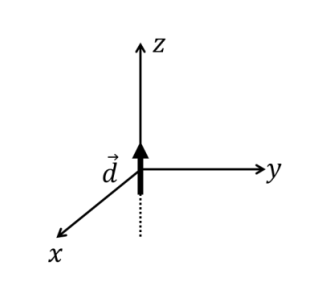
Consider a point \(P(r, \theta, \phi)\) at a very large distance from the dipole. Here \(r, \theta\) and \(\phi\) are spherical polar coordinates. Which of the following statement is/are true for intensity of radiation?
(A) Intensity is zero if P is on the z axis
(B) Intensity is zero at \(P \left( r = R, \theta = \frac{\pi}{2}, \phi = \frac{\pi}{4} \right)\)
(C) Intensity at \(P \left( r = R, \theta = \frac{\pi}{2}, \phi = \frac{\pi}{4} \right)\) is greater than that at \(P \left( r = R, \theta = \frac{\pi}{4}, \phi = \frac{\pi}{4} \right)\)
(D) Intensity at P \(\left( r = R, \theta = \frac{\pi}{2}, \phi = \frac{\pi}{4} \right)\) is equal to that at \(P \left( r = R, \theta = \frac{\pi}{4}, \phi = \frac{\pi}{4} \right)\)
Check Answer
option A , C
Q.No:43 GATE-2025
In coordinates \((t,x)\), a contravariant second rank tensor \(A\) has non-zero
diagonal components \(A^{tt}=P\) and \(A^{xx}=Q\), with all other components
vanishing, and \(P,Q\) being real constants. Here, \(t\) is time and \(x\) is
space coordinate. Consider a Lorentz transformation \((t,x)\to (t',x')\) to
another frame that moves with relative speed \(v\) in the \(+x\) direction, so
that \(A\to A'\). If \(A'^{tt}\) and \(A'^{xx}\) are the diagonal components of
\(A'\), then setting the speed of light \(c=1\), and with
\(\gamma=\frac{1}{\sqrt{1-v^{2}}}\), which of the following option(s) is/are
correct?
A) \(A'^{tt}=\gamma^{2}P+\gamma^{2}v^{2}Q\)
B) \(A'^{tt}=\gamma^{2}v^{2}P+v^{2}Q\)
C) \(A'^{xx}=\gamma^{2}v^{2}P+\gamma^{2}Q\)
D) \(A'^{xx}=v^{2}P+\gamma^{2}Q\)