
Q.No:1 GATE-2013
\(f(x)\) is a symmetric periodic function of \(x\) i.e. \(f(x)=f(-x)\). Then, in general, the Fourier series of the function \(f(x)\) will be of the form
(A)
\(f(x)=\sum_{n=1}^{\infty} (a_n\cos{(nkx)}+b_n\sin{(nkx)})\)
(B)
\(f(x)=a_0+\sum_{n=1}^{\infty} (a_n\cos{(nkx)})\)
(C)
\(f(x)=\sum_{n=1}^{\infty} (b_n\sin{(nkx)})\)
(D)
\(f(x)=a_0+\sum_{n=1}^{\infty} (b_n\sin{(nkx)})\)
Check Answer
Option B
Q.No:2 GATE-2013
Which of the following pairs of the given function \(F(t)\) and its Laplace transform \(f(s)\) is NOT CORRECT?
(A)
\(F(t)=\delta(t), f(s)=1\), (Singularity at \(+0\))
(B)
\(F(t)=1, f(s)=\frac{1}{s}\), (\(s>0\))
(C)
\(F(t)=\sin{kt}, f(s)=\frac{s}{s^2+k^2}\), (\(s>0\))
(D)
\(F(t)=te^{kt}, f(s)=\frac{1}{(s-k)^2}\), (\(s>k, s>0\))
Check Answer
Option C
Q.No:3 GATE-2015
The value of \(\int_{0}^{3} t^2 \delta(3t-6) dt\) is _____________ (upto one decimal place)
Check Answer
Ans 1.3
Q.No:4 GATE-2015
The Heaviside function is defined as \(\left\{\begin{array}{ll}+1 & \text{for }t>0 \\-1 & \text{for }t<0\end{array}\right.\) and its Fourier transform is given by \(-2i/\omega\). The Fourier transform of \(\frac{1}{2}[H(t+1/2)-H(t-1/2)]\) is
(A)
\(\frac{\sin{\left(\frac{\omega}{2}\right)}}{\frac{\omega}{2}}\)
(B)
\(\frac{\cos{\left(\frac{\omega}{2}\right)}}{\frac{\omega}{2}}\)
(C)
\(\sin{\left(\frac{\omega}{2}\right)}\)
(D)
\(0\)
Check Answer
Option A
Q.No:5 GATE-2016
A periodic function \(f(x)\) of period \(2\pi\) is defined in the interval (\(-\pi<x<\pi\)) as:
\[
f(x)=
\left\{
\begin{array}{ll}
-1, & -\pi<x<0 \\
1, & 0<x<\pi
\end{array}
\right.
\]
The appropriate Fourier series expansion for \(f(x)\) is
(A)
\(f(x)=(4/\pi)[\sin{x}+(\sin{3x})/3+(\sin{5x})/5+...]\)
(B)
\(f(x)=(4/\pi)[\sin{x}-(\sin{3x})/3+(\sin{5x})/5-...]\)
(C)
\(f(x)=(4/\pi)[\cos{x}+(\cos{3x})/3+(\cos{5x})/5+...]\)
(D)
\(f(x)=(4/\pi)[\cos{x}-(\cos{3x})/3+(\cos{5x})/5-...]\)
Check Answer
Option A
Q.No:6 GATE-2017
The coefficient of \(e^{ikx}\) in the Fourier expansion of \(u(x)=A\sin^2{(\alpha x)}\) for \(k=-2\alpha\) is
(A)
\(A/4\)
(B)
\(-A/4\)
(C)
\(A/2\)
(D)
\(-A/2\)
Check Answer
Option B
Q.No:7 GATE-2019
Let \(\theta\) be a variable in the range \(-\pi\leq \theta<\pi\). Now consider a function
\[
\begin{array}{lll}
\psi(\theta) & =1 & \text{for }-\pi/2\leq \theta<\pi/2 \\
& =0 & \text{otherwise}
\end{array}
\]
If its Fourier-series is written as \(\psi(\theta)=\sum_{m=-\infty}^{\infty} C_m e^{-im\theta}\), then the value of \(|C_3|^2\) (rounded off to three decimal places) is _______________
Check Answer
Ans 0.010-0.013
Q.No:8 GATE-2020
If \(x=\sum_{k=1}^{\infty} a_k \sin{kx}\), for \(-\pi\leq x\leq \pi\), the value of \(a_2\) is ________________.
Check Answer
Ans (-1)
Q.No:9 GATE-2022
If \(g(k)\) is the Fourier transform of \(f(x)\), then which of the following are true?
(a)
\(g(-k)=+g^*(k)\) implies \(f(x)\) is real
(b)
\(g(-k)=-g^*(k)\) implies \(f(x)\) is purely imaginary
(c)
\(g(-k)=+g^*(k)\) implies \(f(x)\) is purely imaginary
(d)
\(g(-k)=-g^*(k)\) implies \(f(x)\) is real
Check Answer
Option a,b
Q.No:10 GATE-2024
The Fourier transform and its inverse transform are respectively defined as \(\tilde{f} (\omega) = \frac{1}{\sqrt{2\pi}} \int_{-\infty}^{+\infty} f(x)e^{i\omega x}dx\) and \(f(x) = \frac{1}{\sqrt{2\pi}} \int_{-\infty}^{+\infty} \tilde{f}(\omega)e^{-i\omega x}d\omega.\) Consider two functions f and g. Another function \(f * g\) is defined as
\[(f * g)(x) = \frac{1}{\sqrt{2\pi}} \int_{-\infty}^{+\infty} f(y)g(x - y)dy\]
Which of the following relation is/are true?
Note: Tilde (\textasciitilde) denotes the Fourier transform.
(A) f * g = g * f
(B) \(\widetilde{f * g} =\widetilde{g *f}\)
(C) \(\widetilde{f * g} = \widetilde{fg}\)
(D) \(\widetilde{f * g} = \tilde{f}\tilde{g}\)
Check Answer
Option A,B,D
Q.No:1 CSIR June-2015
Consider the periodic function f(t)with time period T as shown in the figure below.

The spikes. located at t = ½(2n-1). where n = 0, ±1, ±2, ..·. are Dirac-delta func tions of strength ±1. The amplitudes a in
the Fourier expansion
\( f ( t )\) = \(\sum_{n=-\infty}^{\infty}a_n e^{\frac{2\pi int}{T}}\)
is given by
(1)
\( (-1)^n\)
(2)
\(\frac{1}{n\pi}\)sin\(\frac{n\pi}{2}\)
(3)
i sin \(\frac{n\pi}{2}\)
(4)
\(n\pi\)
Check Answer
Option 3
Q.No:2 CSIR Dec-2015
The Fourier transform of \(f(x)\) is \(\tilde{f}(k)=\int_{-\infty}^{+\infty} dx e^{ikx} f(x)\). If \(f(x)=\alpha \delta(x)+\beta \delta'(x)+\gamma \delta''(x)\), where \(\delta(x)\) is the Dirac delta-function (and prime denotes derivative), what is \(\tilde{f}(k)\)?
(1)
\(\alpha+i\beta k+i\gamma k^2\)
(2)
\(\alpha+\beta k-\gamma k^2\)
(3)
\(\alpha-i\beta k-\gamma k^2\)
(4)
\(i\alpha+\beta k-i\gamma k^2\)
Check Answer
Option 3
Q.No:3 CSIR Dec-2015
A function \(f(x)\) satisfies the differential equation \(\frac{d^2 f}{dx^2}-\omega^2 f=-\delta(x-a)\), where \(\omega\) is positive. The Fourier transform \(\tilde{f}(k)=\int_{-\infty}^{+\infty} dx e^{ikx} f(x)\) of \(f\), and the solution of the equation are, respectively,
(1)
\(\frac{e^{ika}}{k^2+\omega^2}\) and \(\frac{1}{2\omega}(e^{-\omega |x-a|}+e^{\omega |x-a|})\)
(2)
\(\frac{e^{ika}}{k^2+\omega^2}\) and \(\frac{1}{2\omega}e^{-\omega |x-a|}\)
(3)
\(\frac{e^{ika}}{k^2-\omega^2}\) and \(\frac{1}{2\omega}(e^{-i\omega |x-a|}+e^{i\omega |x-a|})\)
(4)
\(\frac{e^{ika}}{k^2-\omega^2}\) and \(\frac{1}{2i\omega}(e^{-i\omega |x-a|}-e^{i\omega |x-a|})\)
Check Answer
Option 2
Q.No:4 CSIR June-2018
The value of the integral \(\int_{-\pi/2}^{+\pi/2} dx \int_{-1}^{+1} dy \delta(\sin{2x}) \delta(x-y)\) is
(1)
\(0\)
(2)
\(\frac{1}{2}\)
(3)
\(\frac{1}{\sqrt{2}}\)
(4)
\(1\)
Check Answer
Option 2
Q.No:5 CSIR June-2018
The Fourier transform \(\int_{-\infty}^{\infty} dx f(x) e^{ikx}\) of the function \(f(x)=e^{-|x|}\) is
(1)
\(-\frac{2}{1+k^2}\)
(2)
\(-\frac{1}{2(1+k^2)}\)
(3)
\(\frac{2}{1+k^2}\)
(4)
\(\frac{2}{(2+k^2)}\)
Check Answer
Option 3
Q.No:6 CSIR Dec-2019
The function \(f(t)\) is a periodic function of period \(2\pi\). In the range \((-\pi, \pi)\), it equals \(e^{-t}\). If \(f(t)=\sum_{-\infty}^{\infty} c_n e^{int}\) denotes its Fourier series expansion, the sum \(\sum_{-\infty}^{\infty} |c_n|^2\) is
(1)
\(1\)
(2)
\(\frac{1}{2\pi}\)
(3)
\(\frac{1}{2\pi} \cosh{(2\pi)}\)
(4)
\(\frac{1}{2\pi} \sinh{(2\pi)}\)
Check Answer
Option 4
Q.No:7 CSIR June-2016
What is the Fourier transform \(\int dx e^{ikx} f(x)\) of
\[
f(x)=\delta(x)+\sum_{n=1}^{\infty} \frac{d^n}{dx^n} \delta(x),
\]
where \(\delta(x)\) is the Dirac delta-function?
(1)
\(\frac{1}{1-ik}\)
(2)
\(\frac{1}{1+ik}\)
(3)
\(\frac{1}{k+i}\)
(4)
\(\frac{1}{k-i}\)
Check Answer
Option 2
Q.No:8 CSIR Dec-2016
The Fourier transform \(\int_{-\infty}^{\infty} dx f(x) e^{ikx}\) of the function \(f(x)=\frac{1}{x^2+2}\) is
(1)
\(\sqrt{2}\pi e^{-\sqrt{2}|k|}\)
(2)
\(\sqrt{2}\pi e^{-\sqrt{2}k}\)
(3)
\(\frac{\pi}{\sqrt{2}} e^{-\sqrt{2}k}\)
(4)
\(\frac{\pi}{\sqrt{2}} e^{-\sqrt{2}|k|}\)
Check Answer
Option 4
Q.No:9 CSIR June-2023
The value of the integral \(\int_{-\infty}^\infty dx 2^{-\frac{|x|}{\pi}}\delta(\sin x)\) where \(\delta(x)\) is the Dirac delta function, is
1) \(3\)
2) \(0\)
3) \(5\)
4) \(1\)
Check Answer
Option 1
Q.No:10 CSIR Dec-2023
An infinite waveform \( V(t) \) varies as shown in the figure below
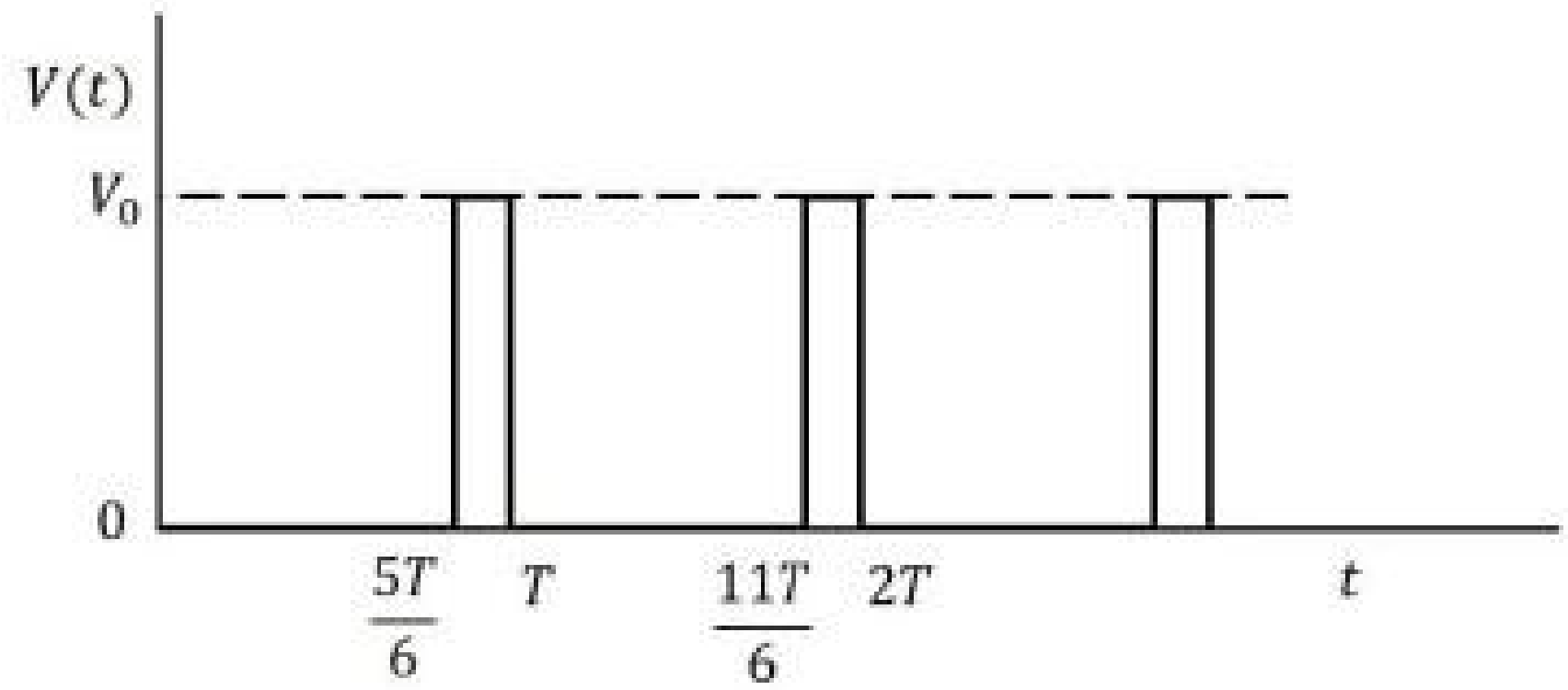
The lowest harmonic that vanishes in the Fourier series of \( V(t) \) is
1) 2
2) 3
3) 6
4) None
Check Answer
Option 3
Q.No:11 CSIR June-2024
An integral transform \(\tilde{f}(x)\) of a function \(f(x)\) can be regarded as a result of applying an operator \(F\) to the function such that
\[
(Ff)(x) \equiv \tilde{f}(x) = \int_{-\infty}^{\infty} dy \, e^{-ixy}f(y).
\]
If \( I \) is the identity operator, then the operator \( F^4 \) is given by
1) \( (2\pi)^4 I \)
2) \( (2\pi) I \)
3) \( I \)
4) \( (2\pi)^2 I \)
Check Answer
Option 4
Q.No:12 CSIR June-2025
The value of the integral
\[
\int_{1}^{e} dy \int_{0}^{5} dx \; \delta(x^2 - y^2)\,\ln(xy)
\]
is
1) \(\frac{1}{2}\)
2) \(\frac{1}{3}\)
3) \(\frac{1}{e}\)
4) \(\frac{e}{5}\)
Check Answer
Option 1
Q.No:1 JEST-2014
The Dirac delta function \(\delta(x)\) satisfies the relation \(\int_{-\infty}^{\infty} f(x)\delta(x)dx=f(0)\) for a well behaved function \(f(x)\). If \(x\) has the dimension of momentum then
(a)
\(\delta(x)\) has the dimension of momentum
(b)
\(\delta(x)\) has the dimension of \((\text{momentum})^2\)
(c)
\(\delta(x)\) is dimensionless
(d)
\(\delta(x)\) has the dimension of \((\text{momentum})^{-1}\)
Check Answer
Option d
Q.No:2 JEST-2017
\(\int_{-\infty}^{\infty} (x^2+1)\delta(x^2-3x+2)dx=\)?
(A)
\(1\)
(B)
\(2\)
(C)
\(5\)
(D)
\(7\)
Check Answer
Option D
Q.No:3 JEST-2017
The Fourier transform of the function \(\frac{1}{x^4+3x^2+2}\) up to a proportionality constant is
(A)
\(\sqrt{2}\exp{(-k^2)}-\exp{(-2k^2)}\).
(B)
\(\sqrt{2}\exp{(-|k|)}-\exp{(-\sqrt{2}|k|)}\).
(C)
\(\sqrt{2}\exp{(-\sqrt{|k|})}-\exp{(-\sqrt{2|k|})}\).
(D)
\(\sqrt{2}\exp{(-\sqrt{2}k^2)}-\exp{(-2k^2)}\).
Check Answer
Option B
Q.No:4 JEST-2017
The function \(f(x)=\cosh{x}\) which exists in the range \(-\pi\leq x\leq \pi\) is periodically repeated between \(x=(2m-1)\pi\) and \((2m+1)\pi\), where \(m=-\infty\) to \(+\infty\). Using Fourier series, indicate the correct relation at \(x=0\).
(A)
\(\sum_{n=-\infty}^{\infty} \frac{(-1)^n}{1-n^2}=\frac{1}{2}\left(\frac{\pi}{\cosh{\pi}}-1\right)\)
(B)
\(\sum_{n=-\infty}^{\infty} \frac{(-1)^n}{1-n^2}=2\frac{\pi}{\cosh{\pi}}\)
(C)
\(\sum_{n=-\infty}^{\infty} \frac{(-1)^{-n}}{1+n^2}=2\frac{\pi}{\sinh{\pi}}\)
(D)
\(\sum_{n=-\infty}^{\infty} \frac{(-1)^n}{1+n^2}=\frac{1}{2}\left(\frac{\pi}{\sinh{\pi}}-1\right)\)
Check Answer
Option D
Q.No:5 JEST-2018
\(\pi\int_{-\infty}^{\infty}\exp{(-|x|)}\delta(\sin{(\pi x)})dx\), where \(\delta(\cdots)\) is Dirac delta distribution, is
(A)
\(1\)
(B)
\(\frac{e+1}{e-1}\)
(C)
\(\frac{e-1}{e+1}\)
(D)
\(\frac{e}{e+1}\)
Check Answer
Option B
Q.No:6 JEST-2019
What is the value of the integral \(\int_{-\infty}^{\infty} dx\delta(x^2-\pi^2)\cos{x}\)?
(A)
\(\pi\)
(B)
\(-\frac{1}{2\pi}\)
(C)
\(-\frac{1}{\pi}\)
(D)
\(0\)
Check Answer
Option C
Q.No:7 JEST-2020
If \(f(t)\) is a real and even function of \(t\), which one of the following statements is true about its Fourier transform \(F(\omega)\) (here \(*\) indicates complex conjugation)?
(A)
\(F^*(\omega)=-F(\omega)\)
(B)
\(F^*(\omega)=F(\omega)\)
(C)
\(F(-\omega)=F(\omega)\)
(D)
\(F(-\omega)=F^*(\omega)\)
Check Answer
Option B
Q.No:8 JEST-2020
What is the value of the following integral?
\[
I=\frac{100\sqrt{2}}{\pi} \int_{0}^{\pi/2} x\delta(2\sin{x}-\sqrt{2})dx
\]
Check Answer
Ans 25
Q.No:9 JEST-2024
Consider the Fourier transform of a function \( f(x) \) defined as
\[
g(p) = \int_{-\infty}^{\infty} f(x) \exp(i p x)dx, \quad \text{where} \quad f(x) = \frac{1}{\sqrt{|x|}}
\]
Which of the following is the correct form of \( g(p) \) for some constant \( \beta \)?
(a) \( g(p) = \frac{\beta}{\sqrt{|p|}} \)
(b) \( g(p) = \frac{\beta}{p} \)
(c) \( g(p) = \frac{\beta}{p^2} \)
(d) \( g(p) = \frac{\beta}{|p|} \)
Check Answer
option a
Q.No:1 TIFR-2012
The function \(f(x)\) represents the nearest integer less than \(x\), e.g.
\[
f(3.14)=3.
\]
The derivative of this function (for arbitrary \(x\)) will be given in terms of the integers \(n\) as \(f'(x)=\)
(a)
\(0\)
(b)
\(\sum_n \delta(x-n)\)
(c)
\(\sum_n |x-n|\)
(d)
\(\sum_n f(x-n)\)
Check Answer
Option b
Q.No:2 TIFR-2013
The integral
\[
\int_{-\infty}^{\infty} dx \delta(x^2-\pi^2)\cos{x}
\]
evaluates to
(a)
\(-1\)
(b)
\(0\)
(c)
\(1/\pi\)
(d)
\(-1/\pi\)
Check Answer
Option d
Q.No:3 TIFR-2014
In spherical polar coordinates \(\vec{r}=(r, \theta, \varphi)\) the delta function \(\delta(\vec{r}_1-\vec{r}_2)\) can be written as
(a)
\(\delta(r_1-r_2)\delta(\theta_1-\theta_2)\delta(\varphi_1-\varphi_2)\)
(b)
\(\frac{1}{r_1^2}\delta(r_1-r_2)\delta(\cos{\theta_1}-\cos{\theta_2})\delta(\varphi_1-\varphi_2)\)
(c)
\(\frac{1}{|\vec{r}_1-\vec{r}_2|^2}\delta(r_1-r_2)\delta(\cos{\theta_1}-\cos{\theta_2})\delta(\varphi_1-\varphi_2)\)
(d)
\(\frac{1}{r_1^2\cos{\theta_1}}\delta(r_1-r_2)\delta(\theta_1-\theta_2)\delta(\varphi_1-\varphi_2)\)
Check Answer
Option b
Q.No:4 TIFR-2014
A student is asked to find a series approximation for the function \(f(x)\) in the domain \(-1\leq x\leq +1\), as indicated by the thick line in the figure below.
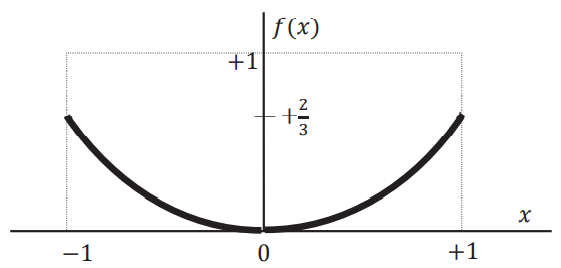
The student represents the function by a sum of three terms
\[
f(x)\approx a_0+a_1 \cos{\frac{\pi x}{2}}+a_2 \sin{\frac{\pi x}{2}}
\]
Which of the following would be the best choices for the coefficients \(a_0, a_1\) and \(a_2\)?
(a)
\(a_0=1, a_1=-\frac{1}{3}, a_2=0\)
(b)
\(a_0=\frac{2}{3}, a_1=0, a_2=-\frac{2}{3}\)
(c)
\(a_0=\frac{2}{3}, a_1=-\frac{2}{3}, a_2=0\)
(d)
\(a_0=-\frac{1}{3}, a_1=0, a_2=-1\)
Check Answer
Option b
Q.No:5 TIFR-2017
Consider the waveform \(x(t)\) shown in the diagram below.

The Fourier series for \(x(t)\) which gives the closest approximation to this waveform is
(a)
\(x(t)=\frac{2}{\pi}\left[\cos{\frac{\pi t}{T}}-\frac{1}{2}\cos{\frac{4\pi t}{T}}+\frac{1}{3}\cos{\frac{3\pi t}{T}}+\cdots\right]\)
(b)
\(x(t)=\frac{2}{\pi}\left[-\sin{\frac{\pi t}{T}}+\frac{1}{2}\sin{\frac{2\pi t}{T}}-\frac{1}{3}\sin{\frac{3\pi t}{T}}+\cdots\right]\)
(c)
\(x(t)=\frac{2}{\pi}\left[\sin{\frac{\pi t}{T}}-\frac{1}{2}\sin{\frac{2\pi t}{T}}+\frac{1}{3}\sin{\frac{3\pi t}{T}}+\cdots\right]\)
(d)
\(x(t)=\frac{2}{\pi}\left[-\cos{\frac{2\pi t}{T}}+\frac{1}{2}\cos{\frac{4\pi t}{T}}-\frac{1}{3}\cos{\frac{6\pi t}{T}}+\cdots\right]\)
Check Answer
Option c
Q.No:6 TIFR-2018
The Fourier series which reproduces, in the interval \(0\leq x<1\), the function
\[
f(x)=\sum_{n=-\infty}^{+\infty} \delta(x-n)
\]
where \(n\) is an integer, is
(a)
\(\cos{\pi x}+\cos{2\pi x}+\cos{3\pi x}+\cdots \) (to \(\infty\))
(b)
\(1+2\cos{2\pi x}+2\cos{4\pi x}+2\cos{6\pi x}+\cdots \) (to \(\infty\))
(c)
\(1+\cos{\pi x}+\cos{2\pi x}+\cos{3\pi x}+\cdots \) (to \(\infty\))
(d)
\((\cos{\pi x}+\sin{\pi x})+\frac{1}{2}(\cos{2\pi x}+\sin{2\pi x})+\frac{1}{3}(\cos{3\pi x}+\sin{3\pi x})+\cdots\) (to \(\infty\))
Check Answer
Option b
Q.No:7 TIFR-2019
The integral
\[
I=\int_0^{\infty} dx e^{-x}\delta(\sin{x})
\]
where \(\delta(x)\) denotes the Dirac delta function, is
(a)
\(1\)
(b)
\(\frac{\exp{\pi}}{\exp{\pi}+1}\)
(c)
\(\frac{\exp{\pi}}{\exp{\pi}-1}\)
(d)
\(\frac{1}{\exp{\pi}-1}\)
Check Answer
Option c
Q.No:8 TIFR-2025
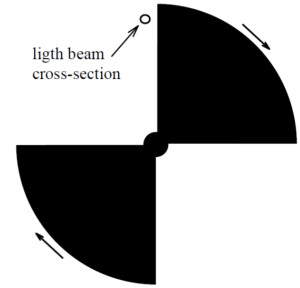
Consider a fan with blades rotating with frequency \(f\), as shown in the figure.
It is used to periodically block a light beam of intensity \(I_0\).
The beam has a very small cross-sectional area and hits the blade near its outer edge.
The transmitted beam is detected by a photo-detection unit which gives out a voltage
signal \(V\) proportional to the transmitted intensity \(I\).
If this voltage signal pattern is displayed on an oscilloscope, what would best
describe the signal pattern?
a) \( V_0 \left[ \frac{1}{2} + \sum_{n} \frac{4}{\pi n}\,\sin(2\pi n f t) \right],
\quad n = 2,6,10,14,\ldots \)
b) \( V_0 \sum_{n} \left[ \cos^2(2\pi n f t) - \sin^2(2\pi n f t) \right],
\quad n = 2,6,10,14,\ldots \)
c) \( V_0 \left[ \frac{1}{2} + \frac{1}{2}\,\sin(4\pi f t) \right] \)
d) \( V_0 \cos^2(4\pi f t) \)