
Q.No:1 CSIR Dec-2014
A superconducting ring carries a steady current in the presence of a magnetic field \(\vec{\mathbf{B}}\) normal to the plane of the ring. Identity the \({\bf incorrect}\) statement.
(1)
The flux passing through the superconductor is quantized in units of \(hc/e\)
(2)
The current and the magnetic field in the superconductor are time independent.
(3)
The current density \(\vec{\mathbf{j}}\) and \(\vec{\mathbf{B}}\) are related by the equation \(\vec{\mathbf{\nabla}}\times \vec{\mathbf{j}}+\Gamma^2 \vec{\mathbf{B}}=0\), where \(\Gamma\) is a constant
(4)
The superconductor shows an energy gap which is proportional to the transition temperature of the superconductor
Check Answer
Option 1
Q.No:2 CSIR June-2015
The critical magnetic fields of a super
conductor at temperatures 4 K and 8 K are 11 mA/m and 5.5 mA/m respectively. The transition temperature is approximately
(1)
8.4K
(2)
10.6K
(3)
12.9K
(4)
15.0K
Check Answer
Option 2
Q.No:3 CSIR Dec-2015
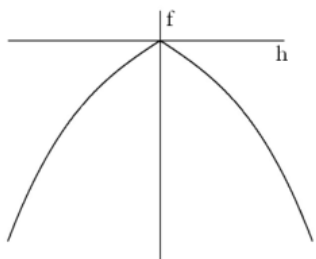
Which of the following graphs shows the qualitative dependence of the free energy \(f(h, T)\) of a ferromagnet in an external magnetic field \(h\), and at a fixed temperature \(T< T_c\) where \(T_c\) is the critical temperature?



Check Answer
Option 2
Q.No:4 CSIR Dec-2015
A crystal of \({MnO}\) has \({NaCl}\) structure. It has a paramagnetic to anti-ferromagnetic transition at \(120 K\). Below \(120 K\), the spins within a single [111] plane are parallel but the spins in adjacent [111] planes are anti-parallel. If neutron scattering is used to determine the lattice constants, respectively, \(d\) and \(d'\), below and above the transition temperature of \({MnO}\) then
(1)
\(d=d'/2\)
(2)
\(d=d'/\sqrt{2}\)
(3)
\(d=2d'\)
(4)
\(d=\sqrt{2}d'\)
Check Answer
Option 3
Q.No:5 CSIR June-2019
The free energy of a magnetic system, as a function of its magnetisation \(m\), is \(F=\frac{1}{2}am^2-\frac{1}{4}bm^4+\frac{1}{6}m^6\), where \(a\) and \(b\) are positive constants. At a fixed value of \(a\), the critical value of \(b\), above which the minimum of \(F\) will be at a non-zero value of magnetisation, is
(1)
\(\sqrt{10a/3}\)
(2)
\(\sqrt{16a/3}\)
(3)
\(\frac{10}{3}\sqrt{a}\)
(4)
\(\frac{16}{3}\sqrt{a}\)
Check Answer
Option 2
Q.No:6 CSIR Dec-2019
In the AC Josephson effect, a supercurrent flows across two superconductors separated by a thin insulating layer and kept at an electric potential difference \(\Delta V\). The angular frequency of the resultant supercurrent is given by
(1)
\(\frac{2e\Delta V}{\hbar}\)
(2)
\(\frac{e\Delta V}{\hbar}\)
(3)
\(\frac{e\Delta V}{\pi\hbar}\)
(4)
\(\frac{e\Delta V}{2\pi\hbar}\)
Check Answer
Option 1
Q.No:7 CSIR Feb-2022
To measure the height \(h\) of a column of liquid helium in a container, a constant current \(I\)
is sent through an \(NbTi\) wire of length \(l\) , as shown in the figure. The normal state resistance of
the \(NbTi\) wire is \(R\) .
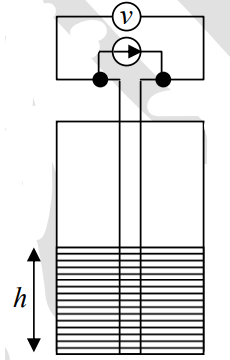
If the superconducting transition temperature of \(NbTi\) is \(\approx 10\) K , then the measured voltage \(V(h)\) is best described by the expression
(1)
\(IR(\frac{1}{2}-\frac{2h}{l})\)
(2)
\(IR(1-\frac{h}{l})\)
(3)
\(IR(\frac{1}{2}-\frac{h}{l})\)
(4)
\(IR(1-\frac{2h}{l})\)
Check Answer
Option 4
Q.No:8 CSIR Feb-2022
Lead is superconducting below \(7K\) and has a critical magnetic field \(800\times 10^4\) tesla close
to \(0K\) . At \(2K\) the critical current that flows through a long lead wire of radius 5\(mm\) is closest to
(1)
\(1760 \hspace{1mm} A\)
(2)
\(1670 \hspace{1mm} A\)
(3)
\(1950 \hspace{1mm} A\)
(4)
\(1840 \hspace{1mm} A\)
Check Answer
Option 4
Q.No:9 CSIR Dec-2024
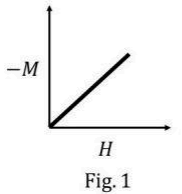
Magnetization \(M\) as a function of applied magnetic field \(H\) for two different
solid samples at temperature \(T\) are shown below. These samples are known to be
superconducting below their respective critical temperatures (\(T_c\)).
The correct set of statements is

1) Fig. 1: Type I superconductor above \(T_c\);
Fig. 2: Type II superconductor below \(T_c\) and up to upper critical field.
2) Fig. 1: Type II superconductor below \(T_c\) and up to upper critical field;
Fig. 2: Type II superconductor below \(T_c\) and up to lower critical field.
3) Fig. 1: Type I superconductor below \(T_c\) and below critical field;
Fig. 2: Type II superconductor below \(T_c\) up to upper critical field.
4) Fig. 1: Type I superconductor below \(T_c\) and below critical field;
Fig. 2: Type II superconductor below \(T_c\) and below lower critical field.
Check Answer
Option 3
Q.No:10 CSIR June-2025
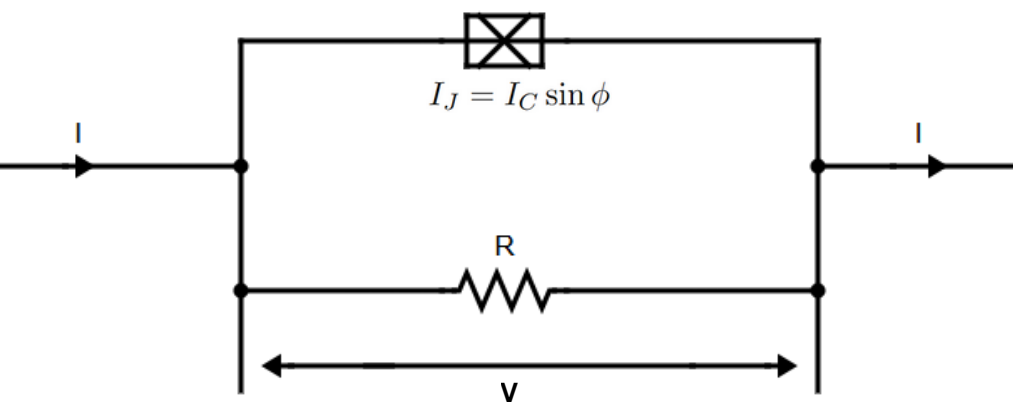
The current \(I_J(t)\) through a Josephson junction (shown by the crossed box in the
figure) and the voltage \(V(t)\) across it are given by
\[
I_J(t) = I_C \sin \phi(t),
\]
\[
\frac{d\phi(t)}{dt} = \frac{2eV(t)}{\hbar},
\]
where \(I_C\) is the critical current of the junction and \(\phi(t)\) is the phase
difference across the junction.
A resistor \(R\) is connected in parallel to the junction and a constant current
\(I > I_C\) flows through the combination as shown.
The energy dissipated in \(R\) in the time \(\phi\) changes by \(2\pi\) is
1) \(\frac{\hbar}{2e}\, I\)
2) \(\frac{\hbar}{2e}\, I_C\)
3) \(\frac{\hbar}{2e}\, (I - I_C)\)
4) \(\frac{\hbar}{2e}\, (I + I_C)\)
Check Answer
Option 1
Q.No:11 CSIR June-2025
Consider \(2N\) Ising spins, \(s_i\) (\(s_i = \pm 1\)), in a one-dimensional lattice
with periodic boundary conditions. The Hamiltonian is given by
\[
H = -J \sum_{i=1}^{2N} s_i s_{i+1},
\]
where \(J\) denotes the strength of the nearest-neighbour interaction with \(J > 0\).
Let \(F\) be the fully ferromagnetic state and let \(A\) be the lowest energy state
with zero magnetization.
The energy difference between these two states is
1) \(\frac{3J}{2}\)
2) \(4J\)
3) \(\frac{J}{2}\)
4) \(2J\)
Check Answer
Option 2
Q.No:1 GATE-2012
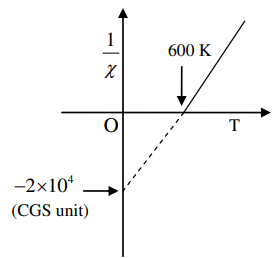
Inverse susceptibility (\(1/\chi\)) as a function of temperature, \(T\) for a material undergoing paramagnetic to ferromagnetic transition is given in the figure, where \(O\) is the origin. The values of the Curie constant, \(C\), and the Weiss molecular field constant, \(\lambda\), in CGS units, are
(A)
\(C=5\times 10^{-5}, \lambda=3\times 10^{-2}\)
(B)
\(C=3\times 10^{-2}, \lambda=5\times 10^{-5}\)
(C)
\(C=3\times 10^{-2}, \lambda=2\times 10^{4}\)
(D)
\(C=2\times 10^{4}, \lambda=3\times 10^{-2}\)
Check Answer
Option C
Q.No:2 GATE-2013
Considering the BCS theory of superconductors, which one of the following statements is NOT CORRECT? (\(h\) is the Planck's constant and \(e\) is the electronic charge)
(A)
Presence of energy gap at temperatures below the critical temperature
(B)
Different critical temperatures for isotopes
(C)
Quantization of magnetic flux in superconducting ring in the unit of \(\left(\frac{h}{e}\right)\)
(D)
Presence of Meissner effect
Check Answer
Option C
Q.No:3 GATE-2014
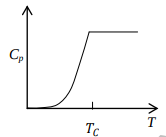
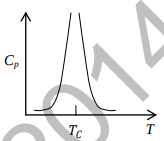
The plot of specific heat versus temperature across the superconducting transition temperature (\(T_C\)) is most appropriately represented by


Check Answer
Option A
Q.No:4 GATE-2014
For Nickel the number density is \(8\times 10^{23} atoms/cm^3\) and electronic configuration is \(1s^2 2s^2 2p^6 3s^2 3p^6 3d^8 4s^2\). The value of the saturation magnetization of Nickel in its ferromagnetic state is _______________\(\times 10^9 A/m\). (Given the value of Bohr magneton \(\mu_B=9.21\times 10^{-21} Am^2\))
Check Answer
Ans 40-43
Q.No:5 GATE-2015
Which one of the following represents the electron occupancy for a superconductor in its normal and superconducting states?


Check Answer
Option B
Q.No:6 GATE-2016
A solid material is found to have a temperature independent magnetic susceptibility, \(\chi=C\). Which of the following statements is correct?
(A)
If \(C\) is positive, the material is a diamagnet.
(B)
If \(C\) is positive, the material is a ferromagnet.
(C)
If \(C\) is negative, the material could be a type I superconductor.
(D)
If \(C\) is positive, the material could be a type I superconductor.
Check Answer
Option C
Q.No:7 GATE-2018
The high temperature magnetic susceptibility of solids having ions with magnetic moments can be described by \(\chi\propto \frac{1}{T+\theta}\) with \(T\) as absolute temperature and \(\theta\) as constant. The three behaviors i.e. paramagnetic, ferromagnetic and anti-ferromagnetic are described, respectively, by
(A)
\(\theta0, \theta=0\)
(B)
\(\theta>0, \theta<0, \theta=0\)
(C)
\(\theta=0, \theta0\)
(D)
\(\theta=0, \theta>0, \theta<0\)
Check Answer
Option C
Q.No:8 GATE-2018
Amongst electrical resistivity (\(\rho\)), thermal conductivity (\(\kappa\)), specific heat (\(C\)), Young's modulus (\(Y\)), and magnetic susceptibility (\(\chi\)), which quantities show a sharp change at the superconducting transition temperature?
(A)
\(\rho, \kappa, C, Y\)
(B)
\(\rho, C, \chi\)
(C)
\(\rho, \kappa, C, \chi\)
(D)
\(\kappa, Y, \chi\)
Check Answer
Option B
Q.No:9 GATE-2019
The relative magnetic permeability of a type-I superconductor is
(A)
\(0\)
(B)
\(-1\)
(C)
\(2\pi\)
(D)
\(\frac{1}{4\pi}\)
Check Answer
Option A
Q.No:10 GATE-2019
A conventional type-I superconductor has a critical temperature of \(4.7 K\) at zero magnetic field and a critical magnetic field of \(0.3 Tesla\) at \(0 K\). The critical field in Tesla at \(2 K\) (rounded off to three decimal places) is __________
Check Answer
Ans 0.244-0.248
Q.No:11 GATE-2021
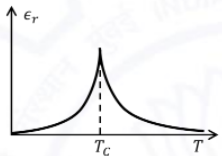
Choose the graph that best describes the variation of dielectric constant (\(\epsilon_r\)) with temperature (\(T\)) in a ferroelectric material.
(\(T_C\) is the Curie temperature)
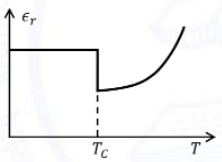
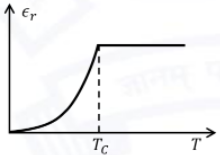
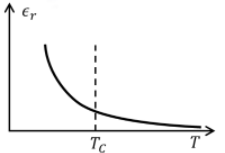
Check Answer
Option A
Q.No:12 GATE-2021
The free energy of a ferromagnet is given by \(F=F_0+a_0(T-T_C)M^2+bM^4\), where \(F_0, a_0\), and \(b\) are positive constants, \(M\) is the magnetization, \(T\) is the temperature, and \(T_C\) is the Curie temperature. The relation between \(M^2\) and \(T\) is best depicted by
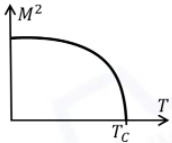


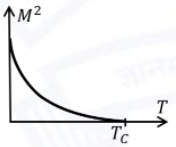
Check Answer
Option B
Q.No:13 GATE-2021
As shown in the figure, inverse magnetic susceptibility (\(1/\chi\)) is plotted as a function of temperature (\(T\)) for three different materials in paramagnetic states.
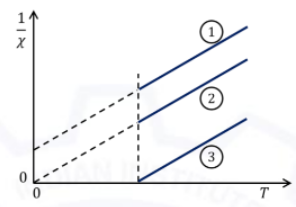
(\(\text{Curie temperature of ferromagnetic material}=T_C\) \\
\(\text{N{\'e}el temperature of antiferromagnetic material}=T_N\))
Choose the correct statement from the following
(A)
Material 1 is antiferromagnetic (\(T<T_N\)), 2 is paramagnetic, and 3 is ferromagnetic (\(T<T_C\)).
(B)
Material 1 is paramagnetic, 2 is antiferromagnetic (\(T<T_N\)), and 3 is ferromagnetic (\(T<T_C\)).
(C)
Material 1 is ferromagnetic (\(T<T_C\)), 2 is antiferromagnetic (\(T<T_N\)), and 3 is paramagnetic.
(D)
Material 1 is ferromagnetic (\(T<T_C\)), 2 is paramagnetic, and 3 is antiferromagnetic (\(T<T_N\)).
Check Answer
Option A
Q.No:14 GATE-2021
Consider an atomic gas with number density \(n=10^{20} m^3\), in the ground state at \(300 K\). The valence electronic configuration of atoms is \(f^7\). The paramagnetic susceptibility of the gas \(\chi=m\times 10^{-11}\). The value of \(m\) (rounded off to two decimal places) is ________.
Given: Magnetic permeability of free space \(\mu_0=4\pi\times 10^{-7} H m^{-1}\)
Bohr magneton \(\mu_B=9.274\times 10^{-24} A m^2\)
Boltzmann constant \(k_B=1.3807\times 10^{-23} JK^{-1}\))
Check Answer
Ans 5.40-5.50
Q.No:15 GATE-2022
Potassium metal has electron concentration of \(1.4\times 10^{28}\hspace{1mm}\text{m}^{-3}\) and the corresponding density of states at Fermi level is \(6.2\times 10^{46} \hspace{1mm}\text{Joule}^{-1}\text{m}^{-3}\). If the Pauli paramagnetic susceptibility of Potassium is \(n\times 10^{-k}\) in standard scientific form, then the value \(k\) (an integer) is _____________ (Magnetic moment of electron is \(9.3\times 10^{-24} \hspace{1mm}\text{Joule}\hspace{1mm}\text{T}^{-1}\); permeability of free space is \(4\pi \times 10^{-7} \hspace{1mm}\text{T}\hspace{1mm}\text{m}\hspace{1mm}\text{A}^{-1}\))
Check Answer
Ans 6
Q.No:16 GATE-2022
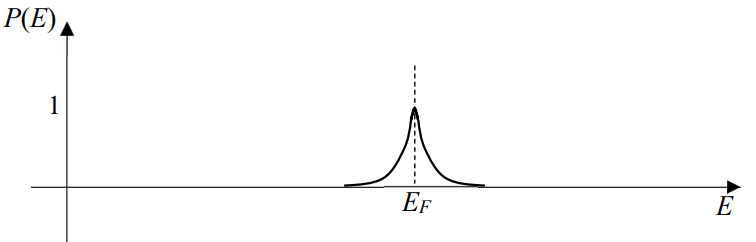
At \(T=0 \hspace{1mm}\text{K}\) which of the following diagram represents the occupation probability \(P(E)\) of energy states of electrons in a BCS type superconductor?

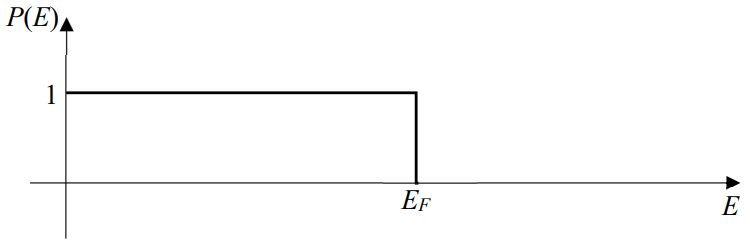
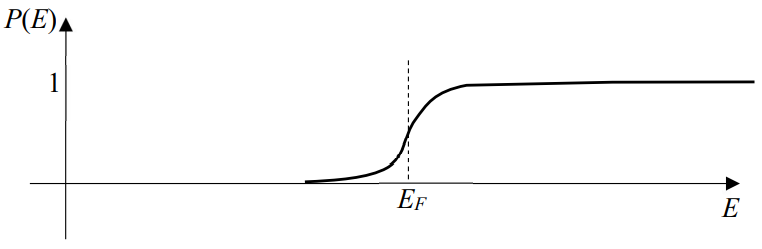
Check Answer
Option A
Q.No:17 GATE-2023
The figure schematically shows the M (magnetization) - H (magnetic field) plots for certain types of materials. Here M and H are plotted in the same scale and units. Which one of the following is the most appropriate combination?

(A)
(Q) - Paramagnet; (R) - Type-I Superconductor; (S) - Antiferromagnet
(B)
(P) - Paramagnet; (Q) - Diamagnet; (R) - Type-I Superconductor
(C)
(P) - Paramagnet; (Q) - Antiferromagnet; (R) - Type-I Superconductor
(D)
(P) - Diamagnet; (R) - Paramagnet; (S) - Type-I Superconductor
Check Answer
Option B
Q.No:18 GATE-2024
An infinite one-dimensional lattice extends along x-axis. At each lattice site there exists an ion with spin \(\frac{1}{2}\). The spin can point either in \(+z\) or \(-z\) direction only. Let \(S_P\), \(S_F\), and \(S_A\) denote the entropies of paramagnetic, ferromagnetic and antiferromagnetic configurations, respectively. Which of the following relation is/are true?
(A) \(S_P > S_F\)
(B) \(S_A > S_F\)
(C) \(S_A = 4S_F\)
(D) \(S_P > S_A\)
Check Answer
Option A,D
Q.No:19 GATE-2024
A material behaves as a superconductor below a critical temperature \( T_c \) and as a normal conductor above \( T_c \). A magnetic field \( \mathbf{B} = B\hat{z} \) is applied when \( T > T_c \). The material is then cooled below \( T_c \) in the presence of \( \mathbf{B} \). Which of the following figure represent the correct configuration of magnetic field lines?


Check Answer
Option A,C
Q.No:20 GATE-2024
The temperature T dependence of magnetic susceptibility \(\chi\) (Column 1) of certain magnetic materials (Column 2) are given below. Which of the following option is/are correct?
Column 1
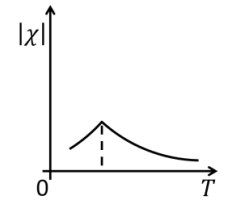
Column 2
(P) Diamagnetic
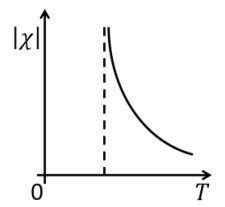
(Q) Paramagnetic
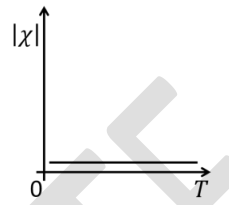
(R) Ferromagnetic
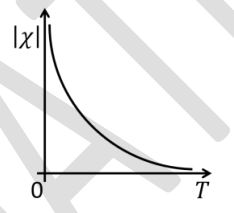
(S) Antiferromagnetic
(A) 2 -- P, 4 -- Q, 3 -- S
(B) 4 -- P, 1 -- Q, 2 -- R
(C) 4 -- Q, 2 -- R, 1 -- S
(D) 3 -- P, 4 -- Q, 2 -- R
Check Answer
Option C,D
Q.No:21 GATE-2025
Which of the following option(s) is/are correct for a Type I superconductor?
A) The phase transition to the normal state in the absence of a magnetic field is of
second order.
B) With increase in temperature, the critical magnetic field decreases linearly to zero.
C) Below the critical temperature, the entropy in the superconducting state is less than
that in the normal state.
D) The phase transition to the normal state in the presence of a magnetic field is of
first order.
Check Answer
Option A,C,D
Q.No:1 TIFR-2013
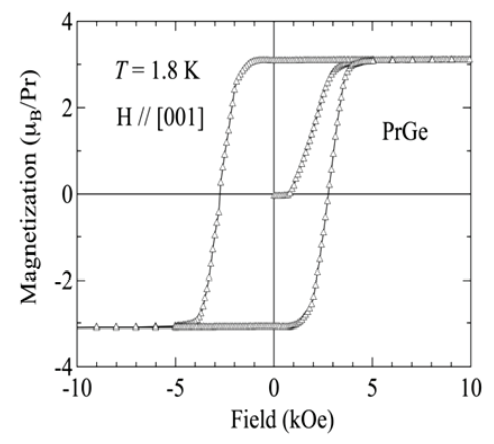
The Curie temperature of a single crystal of \({Pr Ge}\) is known to be \(41 K\). The magnetization data of this sample is measured at \(1.8 K\) for the magnetic field applied parallel to the [001] direction is shown in the figure on the left. At a temperature of \(38 K\), the hysteresis loop in the figure will
(a)
have the same width
(b)
increase in width
(c)
decrease in width
(d)
shrink to a line
Check Answer
Option c
Q.No:2 TIFR-2013
The magnetic susceptibility \(\chi\) of three samples A, B and C, is measured as a function of their absolute temperature \(T\), leading to the graphs shown below.
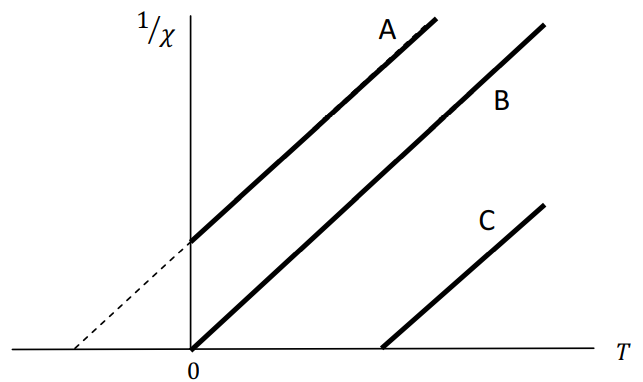
From these graphs, the magnetic nature of the samples can be inferred to be
(a)
A: anti-ferromagnet B: paramagnet C: ferromagnet
(b)
A: diamagnet B: paramagnet C: anti-ferromagnet
(c)
A: paramagnet B: anti-ferromagnet C: ferromagnet
(d)
A: anti-ferromagnet B: diamagnet C: paramagnet
Check Answer
Option a
Q.No:3 TIFR-2014
A solid sample has the property that, when cooled below a certain temperature, it expels any small applied magnetic field from within the material. Which of the following best describes this sample in the cooled state?
(a)
Paramagnet
(b)
Diamagnet
(c)
Ferromagnet
(d)
Anti-ferromagnet
Check Answer
Option b
Q.No:4 TIFR-2023
A lattice in the three-dimensional space has \(N\) sites, each occupied by an atom whose magnetic momentum is \(\mu\). The lattice is in contact with a heat reservoir at a fixed temperature \(T\). The atoms interact with an applied magnetic field
\[\vec{H}=H(\vec{x})\hspace{0.2mm} \hat{z}\]
Ignoring the interactions between the atoms, the average magnetic susceptibility per lattice site is given by
(a)
\(\frac{\mu^2}{3k_B T}\)
(b)
\(\frac{\mu H}{3k_B T}\)
(c)
\(\frac{\mu}{3k_B T}\)
(d)
\(\frac{\mu^2}{9k_B T}\)