
Q.No:1 JEST-2025
A boat is floating in a pond with still water. There is a heavy stone on the boat.
If the stone is dropped gently into the water, what happens to the water level in
the pond after the stone sinks completely?
a) The level goes down.
b) The level goes up.
c) The level remains the same.
d) The level goes up or down depending on the size of the stone.
Check Answer
Option a
Q.No:1 TIFR-2013
The entropy \(S\) of a black hole is known to be of the form
\[
S=\alpha k_B A
\]
where \(A\) is the surface area of the black hole and \(\alpha\) is a constant, which can be written in terms of \(c\) (velocity of light in vacuum), \(\hbar\) (reduced Planck's constant) and \(G_N\) (Newton's constant of gravitation). Taking the radius of the black hole as
\[
R=\frac{2G_N M}{c^2}
\]
it follows that the entropy \(S\) is
[\(\lambda\) is a numerical constant]
(a)
\(\frac{G_N^2 M^2 k_B}{\lambda(\hbar c)^4}\)
(b)
\(\frac{\hbar ck_B}{\lambda G_N M}\)
(c)
\(\frac{G_N^2 M^2 k_B}{\lambda \hbar c^4}\)
(d)
\(\frac{G_N M^2 k_B}{\lambda \hbar c}\)
Check Answer
Option d
Q.No:2 TIFR-2016
A gas of non-interacting particles, each of rest mass \(1 MeV\), is at a temperature \(T=2.0\times 10^7 K\) and has an average particle density \(n=2.7\times 10^{34} cm^{-3}\). We can obtain a reasonably correct treatment of this system
(a)
only by using special relativity as well as quantum mechanics.
(b)
by neglecting quantum mechanics but not special theory of relativity.
(c)
by neglecting special relativity but not quantum mechanics.
(d)
by neglecting both special relativity and quantum mechanics.
Check Answer
Option c
Q.No:3 TIFR-2018
The sketch below shows a radio antenna located at the edge of a calm lake, which has a receiver \(R\) at the centre of the dish at a height \(a/2\) above the ground. This is picking up a signal from a distant radio-emitting star which is just rising above the horizon. However, the receiver also picks up a reflected signal from the surface of the lake, which, at the relevant radio-wavelength, may be taken to be a plane.
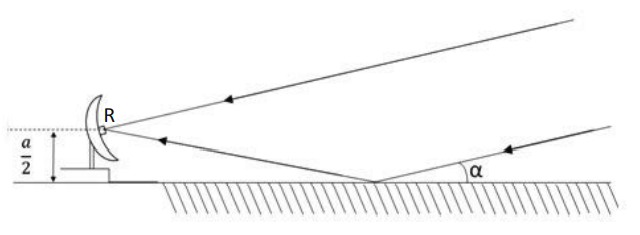
If the instantaneous angle of the star above the horizon is denoted \(\alpha\), the receiver \(R\) will detect the first interference maximum when \(\alpha=\)
(a)
\(\arcsin{\left(\frac{\lambda}{a}\right)^{1/3}}\)
(b)
\(\arcsin{\left(\frac{\lambda}{2a}\right)^{1/3}}\)
(c)
\(\arcsin{\frac{\lambda}{a}}\)
(d)
\(\arcsin{\frac{\lambda}{2a}}\)
Check Answer
Option d
Q.No:4 TIFR-2022
A commercial advertisement for a solar power converter claims that when the temperature of the plate (area 1.6 \(m^2\)) absorbing \(20\%\) of the solar energy (solar constant is about 1.36 kW \(m^{-2}\) \(s^{-1}\)) reaches 1270 C and the rest of the device is at room temperature (\(27^\circ\) C), the system will deliver a power of 100 W.
If a prospective customer comes to you for advice about buying this device, your advice should be that
(a)
it is an efficient device for the given specifications.
(b)
the power delivered is very small for the given specifications.
(c)
the advertisement is false and the device cannot deliver so much power.
(d)
other similar devices are available which can deliver 1.5-2.0 times the power with the same specifications.
Check Answer
Option a
Q.No:5 TIFR-2022
The value of the integral
\[\int_{-\pi/2} ^{+\pi/2} dx \hspace{1mm} cosh \hspace{1mm} kx^2 \hspace{1mm} sin^2 \hspace{0.5mm} x\]
in the large-\(k\) limit, will be
(a)
\(\frac{1}{k\pi} \hspace{1mm} e^{k\pi^2/4}\)
(b)
\(cosh \hspace{0.5mm} (\frac{\pi^2}{4})\)
(c)
\(\frac{1}{k^2\pi^2} \hspace{1mm} cosh \hspace{0.5mm} (\frac{\pi^2}{4})\)
(d)
\(\frac{1}{2k\pi} \hspace{1mm} e^{k\pi^2/4}\)
Check Answer
Option a
Q.No:6 TIFR-2022
A thyratron consists of a tube filled with Xenon gas which can be used as a highpower electrical switch. Electrons are emitted from a cathode \(K\) heated by a filament \(F\), and made to accelerate to some energy \(E\) by a voltage \(V\) applied across the anode plate \(P\).
Electrons that scatter from the Xe atoms get deviated from their path and hit the shield \(S\), which is a conducting envelope that transports the electrons back to ground potential (see figure on the right). The rest of
the electrons strike the plate and contribute to the plate current \(i_P\).
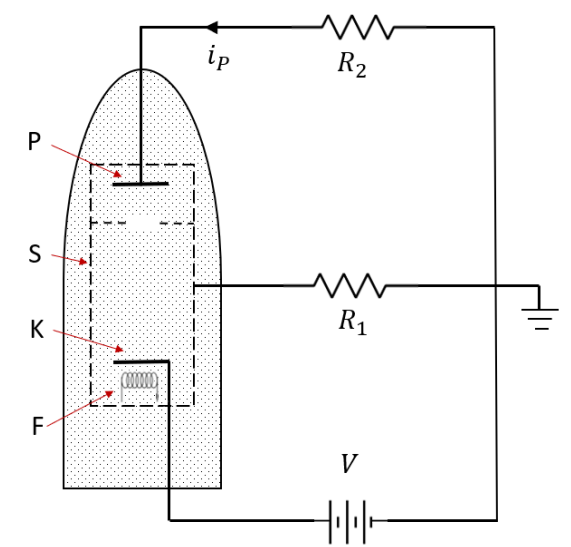
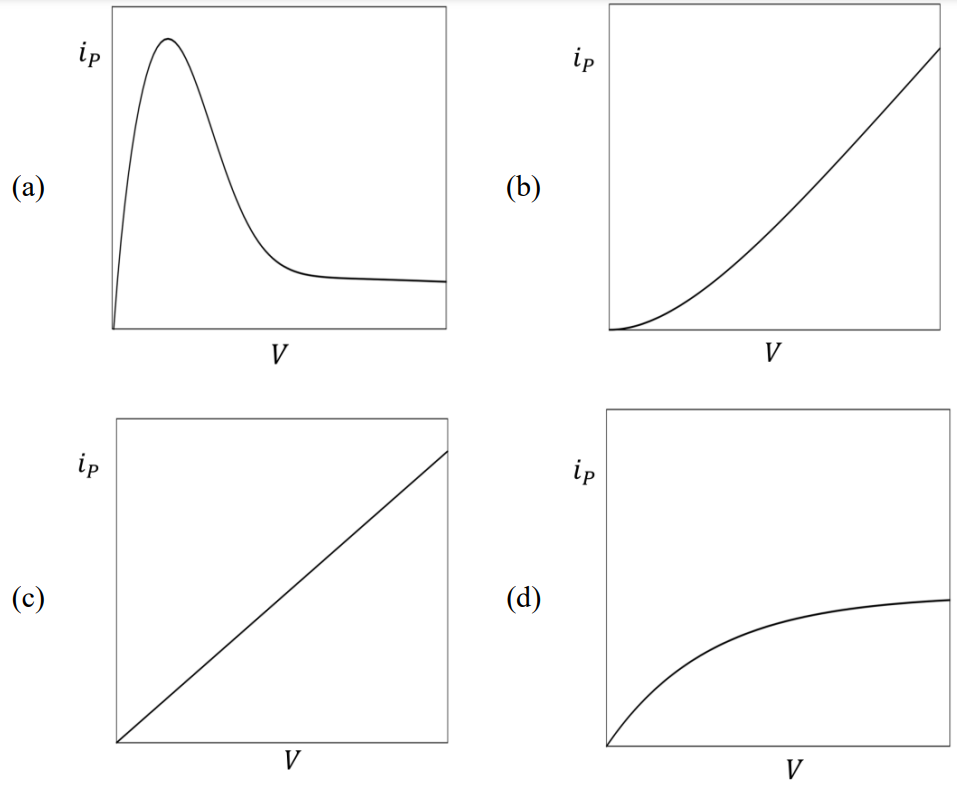
Which of the following graphs of the variation of the plate current \(i_P\) with increase in the accelerating voltage \(V\) could indicate the wave nature of the electron ?
Check Answer
Option a
Q.No:7 TIFR-2022
From the knowledge that you already have about the length of one year and the fact that the Sun subtends \(0.5^\circ\) in the sky, the average density of the Sun can be computed in kg-\(m^{-3}\) as
(a)
\(1.7 \times 10^3\)
(b)
\(7.5 \times 10^3\)
(c)
\(1.7 \times 10^2\)
(d)
\(7.5 \times 10^2\)
Check Answer
Option a
Q.No:8 TIFR-2023
A faint star is known to emit light of a given frequency at an average rate of 10 photons per minute. An astronomer plans to measure this rate using a photon-counting detector. If she wants to measure the rate to an accuracy of \(5\%\), approximately how long should be the exposure time?
(a)
10 minutes
(b)
40 minutes
(c)
1 hour
(d)
20 minutes
Check Answer
Option b
Q.No:9 TIFR-2023
Consider a regular tetrahedron ABCD, as shown in the figure below. Let the point O be its centre.
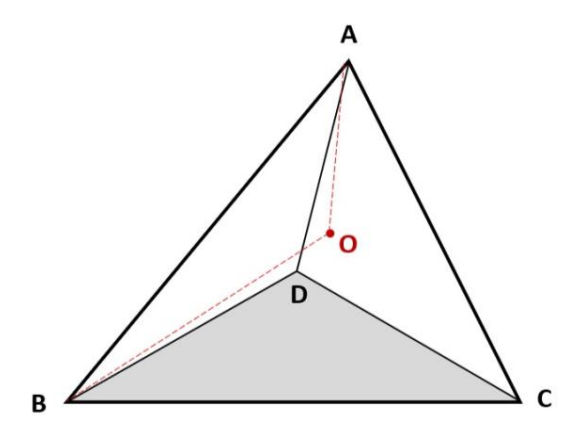
The value of the angle AOB must be
(a)
\(cos^{-1} (-1/3)\)
(b)
\(cos^{-1} (-4/5)\)
(c)
\(cos^{-1} (-\sqrt{4/5})\)
(d)
\(2\pi/3\)
Check Answer
Option a
Q.No:10 TIFR-2023
Calculate the integral
\[\int_0 ^{\infty} \frac{dx}{\sqrt{x} (x^2+1)}\]
(a)
\(\pi \sqrt{2}\)
(b)
\(2\pi \)
(c)
\(\frac{\pi}{\sqrt{2}}\)
(d)
\(\frac{\pi}{2}\)
Check Answer
Option a
Q.No:11 TIFR-2023
In an experiment that measures the angular distribution of the emission of particles, the angular distribution function is defined as
\[f(\theta)=\frac{n(\theta)}{n(\pi/2)}\]
where \(n(\theta)\) is the number of particles detected at an angle \(\theta\).
If for a certain sample, we count
\[\frac{\Delta f}{f}|_{\theta=\pi/4}\]
in this measurement at \(\theta=\pi/4\) would be approximately
(a)
\(1.350 \hspace{0.5mm} \%\)
(b)
\(0.7070 \hspace{0.5mm} \%\)
(c)
\(0.013 \hspace{0.5mm} \%\)
(d)
\(0.018 \hspace{0.5mm} \%\)
Check Answer
Option a
Q.No:12 TIFR-2023
The angular position of a star is found to change by an amount of 0.2 arc seconds (relative to the very distant background stars) when measured by a telescope on the Earth on two different nights separated by exactly six months. Note that the distance between the Earth and Sun is known to be approximately \(1.5 \times 10^{13}\) cm.
If the energy flux received from the star is \(F=10^{-7}\) erg \(s^{-1} cm^{-2}\), what is the approximate value of its luminosity?
(a)
\(10^{29}\) erg \(s^{-1}\)
(b)
\(10^{31}\) erg \(s^{-1}\)
(c)
\(10^{33}\) erg \(s^{-1}\)
(d)
\(10^{35}\) erg \(s^{-1}\)