
CAUTION : Try solving the problem yourself for at least 5–10 minutes before clicking the AI Assistant. In the exam hall, you will be on your own.
Q.No:1 JEST-2013
\({^{238} U}\) decays with a half life of \(4.51\times 10^9\) years, the decay series eventually ending at \({^{206} Pb}\), which is stable. A rock sample analysis shows that the ratio of the numbers of atoms of \({^{206} Pb}\) to \({^{238} U}\) is \(0.0058\). Assuming that all the \({^{206} Pb}\) has been produced by the decay of \({^{238} U}\) and that all other half-lives in the chain are negligible, the age of the rock sample is
(a) \(38\times 10^6\) years
(b) \(48\times 10^6\) years
(c) \(38\times 10^7\) years
(d)
\(48\times 10^7\) years
Check Answer
Option a
Q.No:2 JEST-2019
A cyclotron can accelerate deuteron to \(16 MeV\). If the cyclotron is used to accelerate \(\alpha\)-particles, what will be their energy? Take the mass of deuteron to be twice the mass of proton and mass of alpha particles to be four times the mass of proton.
(A)
\(8 MeV\)
(B)
\(16 MeV\)
(C)
\(32 MeV\)
(D)
\(64 MeV\)
Check Answer
Option C
Q.No:1 TIFR-2012
A proton is accelerated to a high energy \(E\) and shot at a nucleus of Oxygen \(({^{16}_{8} O})\). In order to penetrate the Coulomb barrier and reach the surface of the Oxygen nucleus, \(E\) must be at least
(a)
\(3.6 MeV\)
(b)
\(1.8 MeV\)
(c)
\(45 MeV\)
(d)
\(180 MeV\)
Check Answer
Option a
Q.No:2 TIFR-2012
In a nuclear reactor, Plutonium \(({^{239}_{94} Pu})\) is used as fuel, releasing energy by its fission into isotopes of Barium \(({^{146}_{54} Ba})\) and Strontium \(({^{91}_{38} Sr}) \)through the reaction
\[
{^{239}_{94} Pu}+{^{1}_{0} n}\to {^{146}_{56} Ba}+{^{91}_{38} Sr}+3\times {^{1}_{0} n}
\]
The binding energy (B.E.) per nucleon of each of these nuclides is given in the table below:

Using this information, one can estimate the number of such fission reactions per second in a \(100 MW\) reactor as
(a)
\(3.9 \times 10^{18}\)
(b)
\(7.8 \times 10^{18}\)
(c)
\(5.2 \times 10^{19}\)
(d)
\(5.2 \times 10^{18}\)
(e)
\(8.9 \times 10^{17}\)
Check Answer
Option a
Q.No:3 TIFR-2013
Let \(E_N\) be the energy released when one mole of pure \({^{235} U}\) undergoes controlled fission, and \(E_C\) be the energy released when one mole of pure carbon undergoes complete combustion. The ratio \(E_N/E_C\) will have the order of magnitude
(a)
\(10^4\)
(b)
\(10^8\)
(c)
\(10^9\)
(d)
\(10^6\)
Check Answer
Option d
Q.No:4 TIFR-2014
An alpha particle of energy \(E\) is shot towards a gold nucleus \(({^{197}_{79} Au})\). At distances much larger than the nuclear size \(R_N\), the dominant force is the Coulomb repulsion, but at distances comparable to the nuclear size the dominant force is the strong nuclear attraction. These combine to form a potential barrier of height \(V_C\). If \(E<V_C\), the probability that the alpha particle will fuse with the gold nucleus can be written (in terms of a dimensionless positive constant \(k\)) as
(a)
zero
(b)
\(\frac{kE}{\sqrt{k^2 E^2+V_C^2}}\)
(c)
\(k\left(1-\frac{E}{V_C}\right)\)
(d)
\(\exp{\left(-\frac{kV_C}{E}\right)}\)
Check Answer
Option d
Q.No:5 TIFR-2014
A standard radioactive source is known to decay by emission of \(\gamma\) rays. The source is provided to a student in a thick sealed capsule of unbreakable plastic and she is asked to find out the half-life. Which of the following would be the most useful advice to the student?
(a)
The half-life cannot be measured because the initial concentration of the source is not given.
(b)
Mount the source in front of a gamma ray detector and count the number of photons detected in one hour.
(c)
Measure the mass of the source at different times with an accurate balance having a least count of \(1 mg\). Plot these values on a curve and fit it with an exponential decay law.
(d)
Mount the source in front of a gamma ray detector and count the number of photons detected in a specific time interval. Repeat this experiment at different times and note how the count changes.
Check Answer
Option d
Q.No:6 TIFR-2014
In a beta decay experiment, an electromagnet \(M\) and a detector \(D\) are used to measure the energy of electrons (\(\beta^{-}\)), as shown in the figure.

The detector \(D\) is capable of detecting either electrons (\(\beta^{-}\)) or positrons (\(\beta^{+}\)). Now the \(\beta^{-}\) source is replaced with a \(\beta^{+}\) source, and we would like to measure the energy of the positrons (\(\beta^{+}\) using the same setup. Which of the following is correct?
(a)
This can be done quite easily, if the polarity of current in the coils of the electromagnet is reversed.
(b)
This can be done trivially, without changing anything, since the detector \(D\) can detect either \(\beta^{-}\) or \(\beta^{+}\).
(c)
There is no way to do this with the given set up, since \(\beta^{+}\) will have to be converted into \(\beta^{-}\), which is obviously not possible.
(d)
This cannot be done since the magnet does not have a symmetric shape.
Check Answer
Option a
Q.No:7 TIFR-2015
Which of the following radioactive decay chains is it possible to observe?
(a)
\({^{206}_{82} Pb}\to {^{202}_{80} Hg}\to {^{202}_{79} Au}\)
(b)
\({^{210}_{83} Bi}\to {^{210}_{84} Po}\to {^{206}_{82} Pb}\)
(c)
\({^{214}_{88} Ra}\to {^{210}_{86} Rn}\to {^{207}_{82} Pb}\)
(d)
\({^{206}_{82} Pb}\to {^{202}_{80} Hg}\to {^{202}_{79} Au}\)
Check Answer
Option b
Q.No:8 TIFR-2015
In an experiment, \({^{197}_{79} Au}\) nuclei were bombarded with neutrons leading to formation of \({^{198}_{79} Au}\), which is unstable. The half-life of \({^{198}_{79} Au}\) was measured to be \(2.25\) days and it was found later that this measured half-life was an underestimate by \(10\%\). The corresponding percentage error in the estimated population of \({^{198}_{79} Au}\) after \(9\) days is
(a)
\(10\%\)
(b)
\(25\%\)
(c)
\(2.5\%\)
(d)
\(15\%\)
Check Answer
Option b
Q.No:9 TIFR-2016
The Weizs{\" a}cker semi-empirical mass formula for an odd nucleus with \(Z\) protons and \(A\) nucleons may be written as
\[
M(Z, A)=\alpha_1 A+\alpha_2 A^{2/3}+\alpha_3 Z+\alpha_4 Z^2
\]
where the \(\alpha_i\) are constants independent of \(Z, A\). For a given \(A\), if \(Z_A\) is the number of protons of the most stable isobar, the total energy released when an unstable nuclide undergoes a single \(\beta^{-}\) decay to \((Z_A, A)\) is
(a)
\(\alpha_3\)
(b)
\(\alpha_4\)
(c)
\(\alpha_4-\alpha_3\)
(d)
\(\alpha_1+\alpha+2\)
Check Answer
Option b
Q.No:10 TIFR-2020
Consider the nuclear decay chain of radio-Bismuth to Polonium to Lead, i.e.
\[
{^{219}_{83} Bi}\to {^{210}_{84} Po}\to {^{206}_{82} Pb}
\]
where \({Pb}-206 ({^{206}_{82} Pb})\) is a stable nucleus, and \({Bi}-210 ({^{219}_{83} Bi})\) and \({Po}-206 ({^{210}_{84} Po})\) are radioactive nuclei with half lives of about \(5\) days and \(138\) days respectively.
If we start with a sample of pure \({Bi}-210 ({^{219}_{83} Bi})\), then a possible graph for the time evolution of the number of nuclei of these three species will be

Check Answer
Option a
Q.No:11 TIFR-2021
In an experiment, a counting device is used to record the number of charged particles passing through it. Once this counter records a charged particle, it does not respond for a short interval of time, called the `dead time' of that counter.
This device is used to count the charged particles emitted by a particular radioactive source. It is found that if the source emits 20,000 counts/second at random intervals, the counter records 19,000 particles per second on an average.
It follows that the counter dead time must be
(a)
2.63 microseconds
(b)
2.63 nanoseconds
(c)
50.0 milliseconds
(d)
2.63 seconds
Check Answer
Option a
Q.No:12 TIFR-2021
A radioactive tritium atom in its ground state undergoes a beta decay
\[
{^{3}_{1} H}\to {^{3}_{2} He^{+}}+e^{-}
\]
where the \({^{3}_{2} He}\) nucleus is stable. The probability that this beta decay will be followed immediately by emission of a photon is
(a)
\(0.3\)
(b)
zero
(c)
\(0.7\)
(d)
\(0.5\)
Check Answer
Option a
Q.No:13 TIFR-2022
In a hydrogenic atom of atomic number \(Z\), the probability amplitude that the nucleus will capture an electron from its own K-shell is proportional to the overlap between the nuclear wave-function
\[\psi_n (\vec{r})= \frac{1}{\sqrt{8 \pi r_N ^3}} e^{r/r_N}\]
and the electron wave-function
\[\psi_e (\vec{r})=\frac{Z^{3/2}}{\sqrt{8 \pi a_0 ^3}} e^{}-Zr/a_0\]
where \(a_0\) is the Bohr radius and \(r_N\) is the nuclear radius, which is known to vary as \(r_N \propto Z^{0.37}\). The probability of electron capture, to a very good approximation, will be proportional to \(Z^\alpha\) where \(\alpha\) is
(a)
4.11
(b)
2.22
(c)
2.05
(d)
1.11
Check Answer
Option a
Q.No:14 TIFR-2022
Natural potassium contains a radioactive component of \(^{40}K\) that has two decay modes.
-- In the first mode, \(^{40}K\) undergoes a \(\beta\) decay to the ground state of \(^{40}Ca\).
-- In the second mode, \(^{40}K\) undergoes an electron capture to the excited state of \(^{40}Ar\), followed by a single \(\gamma\) transition to the ground state of \(^{40}Ar\).
The amount of radioactive \(^{40}K\) in a natural potassium (atomic weight of 39.089) sample is known to be 0.0118 percent. It is also known that in the decay of \(^{40}K\), for every 100 \(\beta\) particles emitted, there number of \(\gamma\)-photons emitted is 12.
If the number of \(\beta\)-particles emitted per second by 1 kg of natural potassium is\(2.7 \times 10^4\), the mean lifetime of \(^{40}K\) in years is
(b)
\(1.9 \times 10^9\)
(b)
\(1.3 \times 10^9\)
(b)
\(1.7 \times 10^9\)
(b)
\(1.1 \times 10^9\)
Check Answer
Option a
Q.No:15 TIFR-2022
Three students A, B and C are given identical counters and each is asked to measure the number of gamma rays emitted per second by a given radioactive source. They are expected to perform the counting many times and find the mean and the standard deviation. The students find the following:

If a counting experiment conducted previously by the instructor on this same sample with another identical counter had recorded exactly 30,000 gamma rays in a minute, then which of the following interpretations is valid?
(a)
The measurement by student B is too precise to be believable.
(b)
The measurement of student B is more correct than that of student A.
(c)
The measurements of A and C have too large standard deviations.
(d)
The measurement of C is much more precise than that of A.
Check Answer
Option a
Q.No:16 TIFR-2023
A beam of photons of 1 MeV energy each is shot at a 10 mm thick lead brick (see figure).
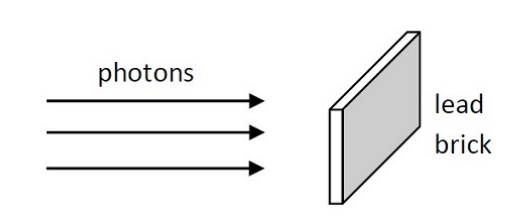
Given that the density of the lead is 11.29 g-c\(m^{-3}\), its atomic mass is 207.2 a.m.u., and also that the interaction cross-section for these photons with a lead atom is \(10^{-23} cm^2\), the fraction of the incident photons that cross the brick without losing any energy is
(a)
\(33 \%\)
(b)
\(72 \%\)
(c)
\(28 \%\)
(d)
\(67 \%\)
Check Answer
Option b
Q.No:17 TIFR-2024
A student measures the radioactive decay of a material with a half-life of 13,000 years with a Geiger counter. In the laboratory notebook, the student records the following number of decays every 10 seconds:
158, 146, 145, 163, 154, 163, 160, 160, 152, 157, 154, 156, 149, 168, 152
The teacher suspects that the experiment was not done properly and the student created the numbers manually.
Why would the teacher have such a suspicion?
(a) The variance is much less than the mean, unlike what is expected for a Poisson distribution.
(b) The standard deviation is much less than the variance, as expected for a Poisson distribution.
(c) The median is less than the mean, unlike what is expected for a Poisson distribution.
(d) The median is greater than the mean, as expected for a Poisson distribution.
Check Answer
Option a
Q.No:18 TIFR-2024
Oxygen (O) nuclei (\( Z = 8 \)) can be approximated as non-interacting protons and neutrons filling up orbitals in the following order.
\[ 1s_{1/2}, 1p_{3/2}, 1p_{1/2}, 1d_{5/2}, 2s_{1/2}, 1d_{3/2}, \ldots \]
where the subscript specifies the \( J \) quantum number. Given the binding energy of O (\( A = 15 \)) is 111.96 MeV, O (\( A = 16 \)) is 127.62 MeV, and O (\( A = 17 \)) is 131.76 MeV, what is the difference between the energies of the \( 1p_{1/2} \) and the \( 1d_{5/2} \) orbitals?
(a) 11.52 MeV
(b) 15.66 MeV
(c) 4.14 MeV
(d) 19.81 MeV
Check Answer
Option a
Q.No:19 TIFR-2024
A beam of neutrons is incident normally upon a thick sheet of Cadmium. The mass density of Cadmium is \( \rho = 8.6 \text{ g cm}^{-3} \). The absorption cross-section of neutrons on Cadmium nuclei is \( 2.5 \times 10^{-20} \text{ cm}^2 \). The atomic weight of Cadmium is known to be \( 112.40 \text{ g/mol} \). You may take \( N_A = 6.02 \times 10^{23} \).
At what depth is the intensity of the beam reduced by a factor \( 1/e \)?
(a) \( 9 \text{ }\mu\text{m} \)
(b) \( 9 \text{ fm} \)
(c) \( 9 \text{ nm} \)
(d) \( 900 \text{ fm} \)
Check Answer
Option a
Q.No:20 TIFR-2024
A particular counting system has an average background rate of 50 counts/min. A decaying radioisotope source was introduced and the total 168 counts were measured in one minute. After a delay of 24 hrs, the system measured total 91 counts in one minute. If these measurements were used for determining the half-life (\( \tau \)) of the source and if the average background rate, and the time have no errors, the \% error (\( 100 \times \sigma_{\tau}/\tau \)) in the calculated half-life value due to counting statistics would be:
(a) 24.3 \%
(b) 21.2 \%
(c) 25.7 \%
(d)18.2 \%