
Q.No:1 JAM-2015
The following figure shows a double slit Fraunhofer diffraction pattern produced by two slits, each of width \(a,\) separated by a distance \(b\),\(a<b\). Which of the following statements are correct?

(A)
Reducing \(a\) increases the separation between consecutive primary maxima
(B)
Reducing \(a\) increases the separation between consecutive secondary maxima
(C)
Reducing \(b\) increases the separation between consecutive primary maxima
(D)
Reducing \(b\) increases the separation between consecutive secondary maxima
Check Answer
Option A,D
Q.No:2 JAM-2015
A unit cube made of a dielectric material has a polarization \(\vec{P}=3\hat{i}+4\hat{j}\) units.The edges of the cube are parallel to the Cartesian axes. Which of the following statements are true?
(A)
The cube carries a volume bound charge of magnitude 5 units
(B)
There is a charge of magnitude 3 units on both the surfaces parallel to the y-z plane
(C)
There is a charge of magnitude 4 units on both the surfaces parallel to the x-z plane
(D)
There is a net non-zero induced charge on the cube
Check Answer
Option B,C
Q.No:3 JAM-2015
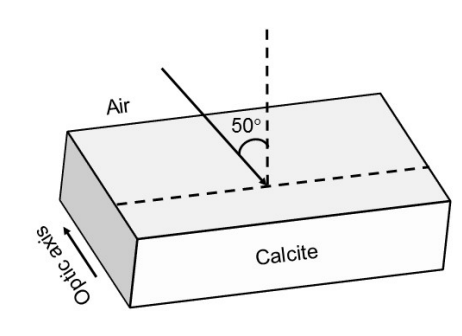
Unpolarized light is incident on a calcite plate at an angle of incidence \(50^\circ\) as shown in the figure.Take \(n_0=1.6584\) and \(n_e=1.4864\) for calcite. The angular separation (in degrees) between the two emerging rays within the plate is ___________.
Check Answer
Ans 3.4-3.6
Q.No:4 JAM-2015
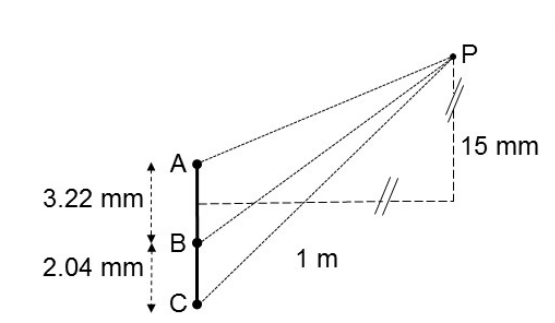
For the arrangement given in the following figure, the coherent light sources A, B and C have individual intensities of 2 mW/\(m^2\), 2 mW/\(m^2\) and 5 mW/\(m^2\), respectively at point P. The wavelength of each of the sources is 600 nm. The resultant intensity at point P (in mW/\(m^2\)) _________________.
Check Answer
Ans 5
Q.No:5 JAM-2016
Light travelling between two points takes a path for which
(A)
time of flight is always minimum.
(B)
distance is always minimum.
(C)
time of flight is extremum.
(D)
distance is extremum.
Check Answer
Option C
Q.No:6 JAM-2016
The minimum length of a plane mirror to see the entire full-length image of an object is half of the object’s height. Suppose \(\delta\) is the distance between eye and top of the head of a person of height \(h\). The person will be able to see his entire full-length image with a mirror of height \(h/2\) fixed on the wall
(A)
when the bottom edge of mirror is kept \(h/2\) above the floor
(B)
when the bottom edge of mirror is kept \((h+ \delta)/2\) above the floor.
(C)
when the bottom edge of mirror is kept (\(h- \delta)/2\) above the floor.
(D)
when the centre of the mirror is at the same height as centre of the person.
Check Answer
Option C
Q.No:7 JAM-2016
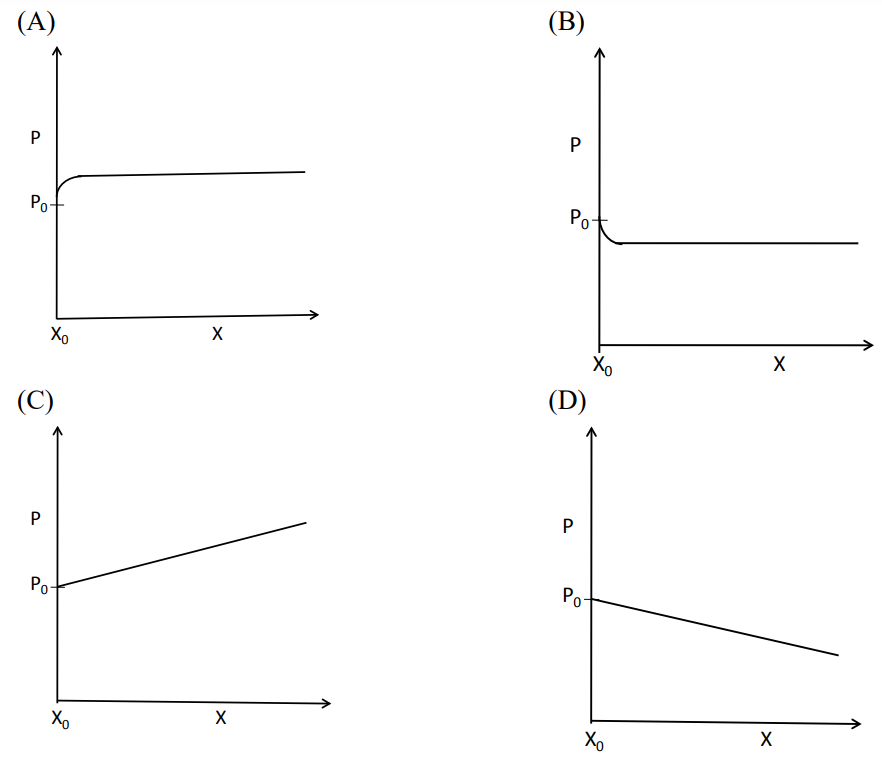
An incompressible, non-viscous fluid is injected into a conical pipe at its orifice as schematically shown in the figure. The pressure at the orifice of area \(A_0\) is \(P_0\). Neglecting the effect of gravity and assuming streamline flow, which one of the following plots correctly predicts the pressure along
axis of the cone?

Check Answer
Option A
Q.No:8 JAM-2016
Consider a spherical dielectric material of radius \('a'\), centered at origin. If the polarization vector \(\vec{P}=P_0 \hat{e}_x\), where \(P_0\) is a constant of appropriate dimensions, then
\((\hat{e}_x, \hat{e}_y\) and \(\hat{e}_y\) are unit vectors in Cartesian−coordinate system.)
(A)
the bound volume charge density is zero.
(B)
the bound surface charge density is zero at (0,0,a).
(C)
the electric field is zero inside the dielectric.
(D)
the sign of the surface charge density changes over the surface.
Check Answer
Option A,B,D
Q.No:9 JAM-2016
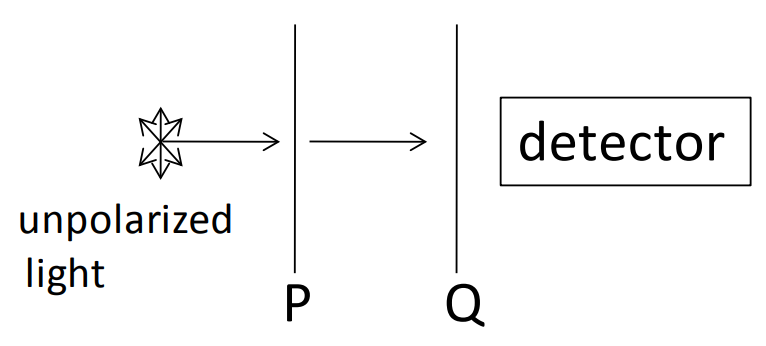
In the optical arrangement as shown below, the axes of two polarizing sheets \(P\) and \(Q\) are oriented such that no light is detected. Now when a third polarizing sheet \((R)\) is placed in between \(P\) and \(Q\), then light is detected. Which of the following statement(s) is(are) true?
(A)
Polarization axes of \(P\) and \(Q\) are perpendicular to each other.
(B)
Polarization axis of \(R\) is not parallel to \(P\).
(C)
Polarization axis of \(R\) is not parallel to \(Q\).
(D)
Polarization axes of \(P\) and \(Q\) are parallel to each other.
Check Answer
Option A,B,C
Q.No:10 JAM-2016
A slit has width \('d'\) along the x-direction. If a beam of electrons, accelerated in y-direction to a particular velocity by applying a potential difference of \(100 \pm 0.1\)kV passes through the slit, then, which of the following statement(s) is(are) correct?
(A)
The uncertainty in the position of electrons in x-direction before passing the slit is zero.
(B)
The momentum of electrons in x-direction is \(\sim \hbar /d\) immediately after passing the slit.
(C)
The uncertainty in the position of electrons in y-direction before passing the slit is zero.
(D)
The presence of the slit does not effect the uncertainty in momentum of electron in y-direction
Check Answer
Option B,D
Q.No:11 JAM-2016
When sunlight is focused on a paper using a bi-convex lens, it starts to burn in the shortest time if the lens is kept \(0.5\) m above it. If the radius of curvature of the lens is \(0.75\) m then, the refractive index of the material is _____________ .
Check Answer
Ans 1.73-1.77
Q.No:12 JAM-2017
Which of the following is due to inhomogeneous refractive index of earth’s atmosphere?
(A)
Red colour of the evening Sun
(B)
Blue colour of the sky
(C)
Oval shape of the evening Sun
(D)
Large apparent size of the evening Sun
Check Answer
Option C
Q.No:13 JAM-2017
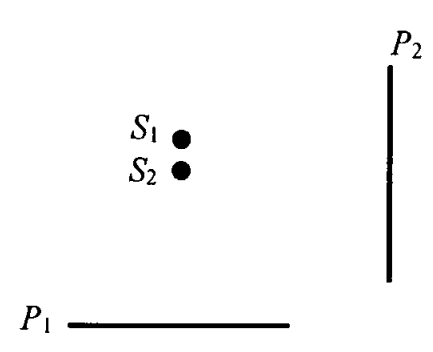
Consider two coherent point sources (\(S_1\) and \(S_2\)) separated by a small distance along a vertical line and two screens \(P_1\) and \(P_2\) as shown in Figure. Which one of the choices represents the shapes of the interference fringes at the central regions on the screens?
(A)
Circular on \(P_1\) and straight line on \(P_2\)
(B)
Circular on \(P_1\) and Circular on \(P_2\)
(C)
Straight line on \(P_1\) and straight line on \(P_2\)
(D)
Straight line on \(P_1\) and Circular on \(P_2\)
Check Answer
Option A
Q.No:14 JAM-2017
An anti-reflection film coating of thickness \(0.1\mu\)m is to be deposited on a glass plate for normal incidence of light of wavelength \(0.5\mu\)m. What should be the refractive index of
the film?
(Specify your answer to two digits after the decimal point)
Check Answer
Ans 1.25
Q.No:15 JAM-2017
In an electron microscope, electrons are accelerated through a potential difference of 200kV . What is the best possible resolution of the microscope?
(Specify your answer in picometers to two digits after the decimal point)
Check Answer
Ans 2.30-3.20
Q.No: 16 JAM-2017
Intensity versus distance curve for a double slit diffraction experiment is shown in the figure below. If the width of each of the slits is \(0.7\mu\)m, what is the separation between
the two slits in micrometers?

Check Answer
Ans 3.48-3.52
Q.No:17 JAM-2018
Consider a convex lens of focal length \(f\). A point object moves towards the lens along its axis between \(2f\) and \(f\). If the speed of the object is \(V_0\), then its image would move with speed \(V_I\). Which of the following is correct?
(A)
\(V_I=V_0\); the image moves away from the lens.
(B)
\(V_I=-V_0\); the image moves towards the lens.
(C)
\(V_I>V_0\);the image moves away from the lens.
(D)
\(V_I<V_0\);the image moves away from the lens.
Check Answer
Option C
Q.No:18 JAM-2018
Two beams of light in the visible range \((400\) nm - \(700\) nm) interfere with each other at a point. The optical path difference between them is \(5000\) nm. Which of the following wavelengths will interfere constructively at the given point?
(A)
\( 416.67\) nm
(B)
\(555.55\) nm
(C)
\(625\) nm
(D)
\(666.66\) nm
Check Answer
Option A,B,C
Q.No:19 JAM-2018
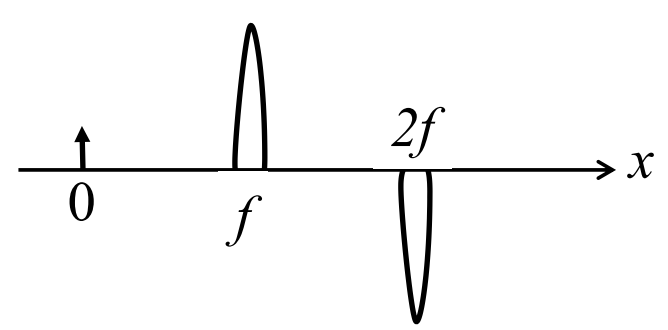
Consider a convex lens of focal length \(f\). The lens is cut along a diameter in two parts. The two lens parts and an object are kept as shown in the figure. The images are formed at following distances from the object:
(A)
\(2f\)
(B)
\(3f\)
(C)
\(4f\)
(D)
\(\infty\)
Check Answer
Option B,C,D OR C,D
Q.No:20 JAM-2018
In a grating with grating constant \(d=a+b\), where \(a\) is the slit width and \(b\) is the separation between the slits, the diffraction pattern has the fourth order missing. The value of \(\frac{b}{a}\) is _________________.
(Specify your answer as an integer.)
Check Answer
Ans 3
Q.No:21 JAM-2018
Consider a slit of width 18 µm which is being illuminated simultaneously with light of orange color (wavelength 600 nm) and of blue color (wavelength 450 nm). The diffraction pattern is observed on a screen kept at a distance in front of the slit. The smallest angle at which only the orange color is observed is \(\theta_1\) and the smallest angle at which only the blue color is observed is \(\theta_2\).The angular difference \(\theta_2-\theta_1\) 1 (in degrees) is _______________.
(Specify your answers upto two digits after the decimal point.)
Check Answer
Ans 0.45-0.55
Q.No:22 JAM-2019
A thin lens of refractive index \(3/2\) is kept inside a liquid of refractive index \(4/3\). If the focal length of the lens in air is 10 cm, then its focal length inside the liquid is
(A)
10 cm
(B)
30 cm
(C)
40 cm
(D)
50 cm
Check Answer
Option C
Q.No:23 JAM-2019
Light of wavelength \(\lambda\) (in free space) propagates through a dispersive medium with refractive index \(n(\lambda)=1.5+0.6\lambda\). The group velocity of a wave travelling inside this medium in units of \(10^8\)m/s is
(A)
1.5
(B)
2.0
(C)
3.0
(D)
4.0
Check Answer
Option B
Q.No:24 JAM-2019
The maximum number of intensity minima that can be observed in the Fraunhofer diffraction pattern of a single slit (width 10 µm) illuminated by a laser beam (wavelength 0.630 \(\mu\)m) will be
(A)
4
(B)
7
(C)
12
(D)
15
Check Answer
Option D
Q.No:25 JAM-2019
Light of wavelength 680 nm is incident normally on a diffraction grating having 4000 lines/cm. The diffraction angle (in degrees) corresponding to the third-order maximum is __________________.
(Round off to 2 decimal places)
Check Answer
Ans 54.67-54.71
Q.No:26 JAM-2019
An object of 2 cm height is placed at a distance of 30 cm in front of a concave mirror with radius of curvature 40 cm. The height of the image is __________________ cm.
Check Answer
Ans 4
Q.No:27 JAM-2019
The \(7^{th}\) bright fringe in the Young’s double slit experiment using a light of wavelength 550 nm shifts to the central maxima after covering the two slits with two sheets of different refractive indices \(n_1\) and \(n_2\) but having same thickness 6 \(\mu\)m. The value of \(|n_1-n_2|\) is ____________.
(Round off to 2 decimal places)
Check Answer
Ans 0.63-0.65
Q.No:28 JAM-2020
The intensity of the primary maximum in a two-slit interference pattern is given by \(I_2\) and the intensity of the primary maximum in a three-slit interference pattern is given by \(I_3\). Assuming the
far-field approximation, same slit parameters and intensity of the incident light in both the cases, \(I_2\) and \(I_3\) are related as
(A)
\(I_2=\frac{3}{2}I_3\)
(B)
\(I_2=\frac{9}{4}I_3\)
(C)
\(I_2=\frac{2}{3}I_3\)
(D)
\(I_2=\frac{4}{9}I_3\)
Check Answer
Option D
Q.No:29 JAM-2020
A short rod of length \(L\) and negligible diameter lies along the optical axis of a concave mirror at a distance of 3 m. The focal length of the mirror is 1 m and \(L\ll m\) . If \(L'\) is the length of image of
the object in the mirror, then
(A)
\(\frac{L'}{L}=4\)
(B)
\(\frac{L'}{L}=2\)
(C)
\(\frac{L'}{L}=\frac{1}{16}\)
(D)
\(\frac{L'}{L}=\frac{1}{4}\)
Check Answer
Option D
Q.No:30 JAM-2020
Consider a thin bi-convex lens of relative refractive index n = 1.5. The radius of curvature of one surface of the lens is twice that of the other. The magnitude of larger radius of curvature in units of
the focal length of the lens is ____________ (Round off to 1 decimal place).
Check Answer
Ans 1.4-1.6
Q.No:31 JAM-2020
Consider a retarder with refractive indices \(n_e=1.551\) and \(n_0=1.542\) along the extraordinary and ordinary axes, respectively. The thickness of this retarder for which a left circularly polarized light of wavelength 600 nm will be converted into a right circularly polarized light is ________________ \(\mu\)m
(Round off to 2 decimal places)
Check Answer
Ans 33.32-33.34
Q.No:32 JAM-2020
In a Compton scattering experiment, the wavelength of incident X-rays is 0.500 Angstrom. If the Compton wavelength \(\lambda_c\) is 0.024 Angstrom, the value of the longest wavelength possible for the scattered X-ray is __________ Angstrom.(Specify up to 3 decimal places)
Check Answer
Ans 0.548
Q.No:33 JAM-2021
An experiment with a Michelson interferometer is performed in vacuum using a laser of wavelength 610 nm. One of the beams of the interferometer passes through a small glass cavity 1.3 cm long. After the cavity is completely filled with a medium of refractive index \(n\), 472 dark fringes are counted to move past a reference line. Given that the speed of light is \(3 \times 10^8\) m/s, the value of \(n\) is
(A)
1.01
(B)
1.04
(C)
1.06
(D)
1.10
Check Answer
Option A
Q.No:34 JAM-2021
Arrange the following telescopes, where \(D\) is the telescope diameter and \(\lambda\) is the wavelength, in order of decreasing resolving power:
I. \(D\) = 100 m, \(\lambda\)=21 cm
II. \(D\) = 2 m, \(\lambda\)=500 nm
III. \(D\) = 1 m, \(\lambda\)=100 nm
IV. \(D\) = 2 m, \(\lambda\)=10 mm
(A)
III, II, IV, I
(B)
II, III, I, IV
(C)
IV, III, II, I
(D)
III, II, I, IV
Check Answer
Option D
Q.No:35 JAM-2021
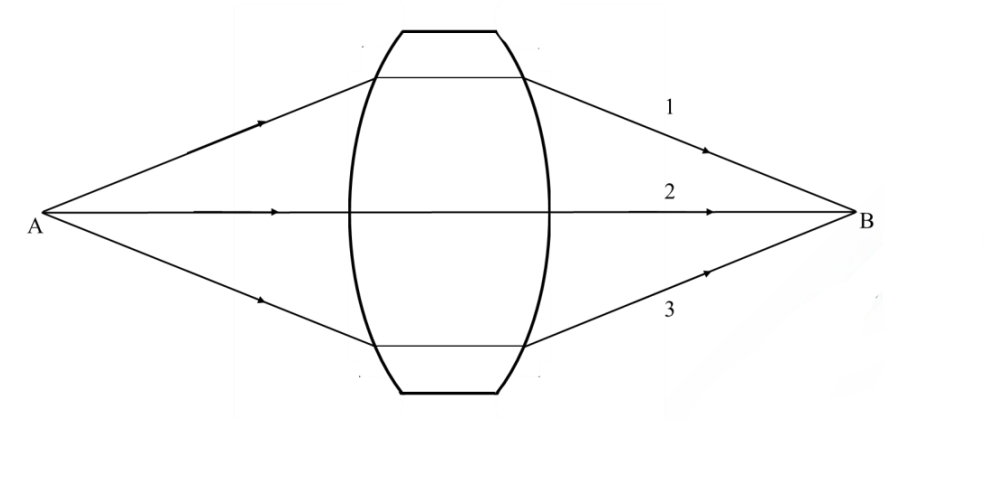
In the figure below, point \(A\) is the object and point \(B\) is the image formed by the lens. Let \(l_1 , l_2\) and \(l_3\) denote the optical path lengths of the three rays 1, 2 and 3, respectively. Identify
the correct statement.
(A)
\(l_1= l_2 =l_3\)
(B)
\(l_1> l_2 <l_3\)
(C)
\(l_1= l_3 <l_2\)
(D)
\(l_1= l_3 >l_2\)
Check Answer
Option A
Q.No:36 JAM-2021
The condition for maxima in the interference of two waves \(A \hspace{1mm} e^{i(\frac{k_0}{2}(\sqrt{3}x+y)-\omega t)}\) and \(A \hspace{1mm} e^{i(\frac{k_0}{\sqrt2}(x+y)-\omega t)}\) is given in terms of the wavelength \(\lambda\) and \(m\), an integer, by
(A)
\((\sqrt{3}-\sqrt{2})x + (1-\sqrt{2})y=2m\lambda\)
(B)
\((\sqrt{3}+\sqrt{2})x + (1-\sqrt{2})y=2m\lambda\)
(C)
\((\sqrt{3}-\sqrt{2})x - (1-\sqrt{2})y=m\lambda\)
(D)
\((\sqrt{3}-\sqrt{2})x + (1-\sqrt{2})y=(2m+1)\lambda\)
Check Answer
Option A
Q.No:37 JAM-2021
A linearly polarized light falls on a quarter wave plate and the emerging light is found to be elliptically polarized. The angle between the fast axis of the quarter wave plate and the plane of polarization of the incident light, can be
(A)
\(30^\circ\)
(B)
\(45^\circ\)
(C)
\(90^\circ\)
(D)
\(180^\circ\)
Check Answer
Option A
Q.No:38 JAM-2021
A beam of light traveling horizontally consists of an unpolarized component with intensity \(I_0\) and a polarized component with intensity \(I_p\). The plane of polarization is oriented at an angle \(\theta\) with respect to the vertical. The figure shows the total intensity \(I_{total}\) after the light passes through a polarizer as a function of the angle \(\alpha\), that the axis of the polarizer makes
with respect to the vertical. Identify the correct statement(s).

(A)
\(\theta=125^\circ\)
(B)
\(I_p=5\) W/\(m^2\)
(C)
\(I_0=17.5\) W/\(m^2\)
(D)
\(I_0=10\) W/\(m^2\) ; \(I_p=20\) W/\(m^2\)
Check Answer
Option D
Q.No:39 JAM-2021
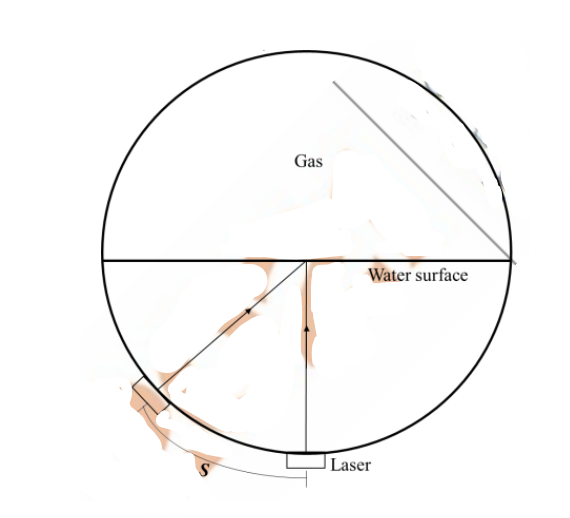
The figure shows the cross-section of a hollow cylindrical tank, 2.2 m in diameter, which is half filled with water (refractive index of 1.33). The space above the water is filled with a gas of unknown refractive index. A small laser moves along the bottom surface and aims a light beam towards the center (see figure). When the laser moves a distance of \(S\) = 1.09 m or beyond from the lowest point in the water, no light enters the gas. Identify the correct statement(s) (speed of light is \(3 \times 10^8\) m/s).
(A)
The refractive index of the gas is 1.05
(B)
The time taken for the light beam to travel from the laser to the rim of the tank when \(S<\)1.09 m is 8.9 ns
(C)
The time taken for the light beam to travel from the laser to the rim of the tank when \(S>\)1.09 m is 9.7 ns
(D)
The critical angle for the water-gas interface is \(56.77^\circ\)
Check Answer
Option B,C,D
Q.No:40 JAM-2021
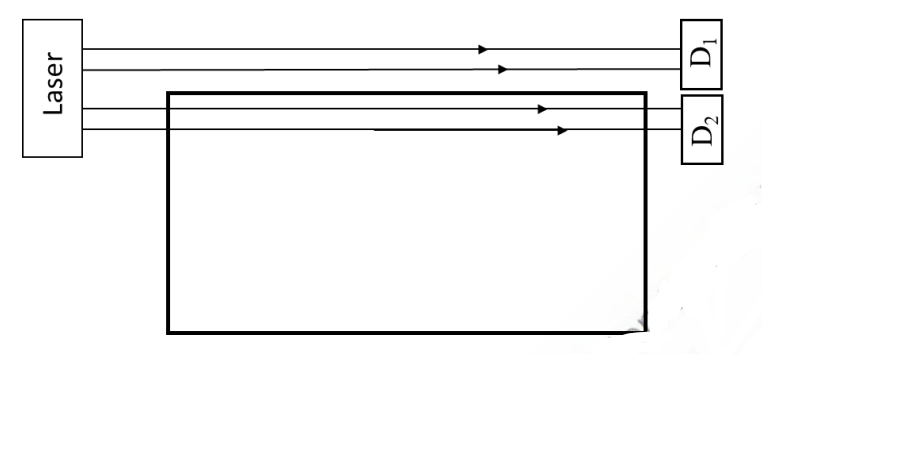
A laser beam shines along a block of transparent material of length 2.5 m. Part of the beam goes to the detector \(D_1\) while the other part travels through the block and then hits the detector \(D_2\). The time delay between the arrivals of the two light beams is inferred to be 6.25 ns. The speed of light c = \(3 \times 10^8\) m/s. The refractive index of the block is _________________ (Round off to two decimal places).
Check Answer
Ans 1.73-1.77
Q.No:41 JAM-2021
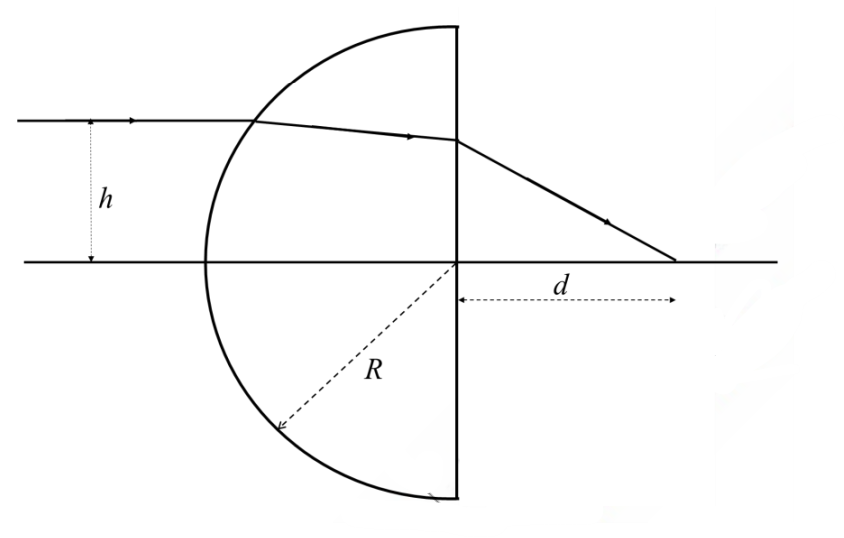
Consider a hemispherical glass lens (refractive index is 1.5) having radius of curvature \(R = 12\) cm for the curved surface. An incoming ray, parallel to the optical axis, is incident on the curved surface at a height \(h = 1\) cm above the optical axis, as shown in the figure. The
distance \(d\) (from the flat surface of the lens) at which the ray crosses the optical axis is _________________ cm (Round off to two decimal places).
Check Answer
Ans 15.81-16.01
Q.No:42 JAM-2021
A thin film of alcohol is spread over a surface. When light from a tunable source is incident normally, the intensity of reflected light at the detector is maximum for \(\lambda\)= 640 nm and minimum for \(\lambda\) = 512 nm. Taking the refractive index of alcohol to be 1.36 for both the given wavelengths, the minimum thickness of the film would be __________ nm (Round off to two decimal places).
Check Answer
Ans 470.56-470.62
Q.No:43JAM-2022
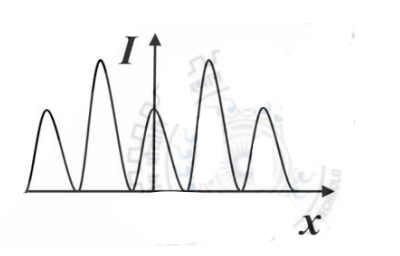
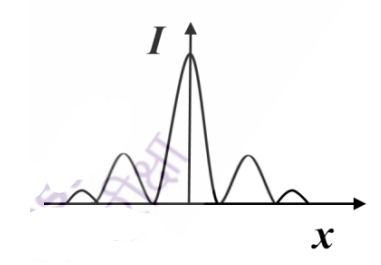
Which one of the following figures correctly depicts the intensity distribution for Fraunhofer diffraction due to a single slit? Here, \(x\) denotes the distance from the centre of the central fringe and \(I\) denotes the intensity.


Check Answer
Option C
Q.No:44 JAM-2022
A normal human eye can distinguish two objects separated by 0.35 m when
viewed from a distance of 1.0 km. The angular resolution of eye is ___________ seconds (Round off to the nearest integer).
Check Answer
Ans 71-73
Q.No:45 JAM-2022
The critical angle of a crystal is \(30^\circ\). Its Brewster angle is _________________ degrees (Round off to the nearest integer).
Check Answer
Ans 27 OR 63
Q.No:46 JAM-2017
Unpolarized light of intensity \(I_0\) passes through a polarizer \(P_1\). The light coming out of the polarizer falls on a quarter-wave plate with its optical axis at \(45^\circ\) with respect to the polarization axis of \(P_1\) and then passes through another polarizer \(P_2\) with its polarization
axis perpendicular to that of \(P_1\) . The intensity of the light coming out of \(P_2\) is \(I\) . The ratio \(I_0/I\) is _____________________.
(Specify your answer to two digits after the decimal point)
Check Answer
Ans 4
Q.No:47 JAM-2018
Which one of the following arrangements of optical components can be used to distinguish between an unpolarised light and a circularly polarised light?

Check Answer
Option C
Q.No:48 JAM-2018
The plane of polarisation of a plane polarized light rotates by \(60^\circ\) after passing through a wave plate. The pass-axis of the wave plate is at an angle \(\alpha\) with respect to the plane of polarisation of the incident light. The wave plate and \(\alpha\) are
(A)
\(\lambda/4 , 60^\circ\)
(B)
\(\lambda/2 , 30^\circ\)
(C)
\(\lambda/2 , 120^\circ\)
(D)
\(\lambda/4 , 30^\circ\)
Check Answer
Option B OR C
Q.No:49 JAM-2020
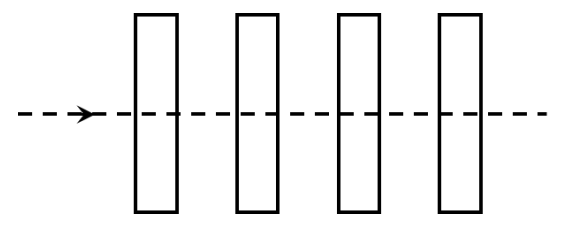
A beam of unpolarized light of intensity \(I_0\) falls on a system of four identical linear polarizers placed in a line as shown in the figure. The transmission axes of any two successive polarizers make an angle of \(30^\circ\) with each other. If the transmitted light has intensity \(I\), the ratio \(\frac{I}{I_0}\) is
(A)
\(\frac{81}{256}\)
(B)
\(\frac{9}{16}\)
(C)
\(\frac{27}{64}\)
(D)
\(\frac{27}{128}\)
Check Answer
Option D
Q.No:50 JAM-2015
The electric field of a light wave is given by \(\vec{E}=E_0[\hat{i}\hspace{1mm} sin(\omega t-k z) +\hat{j}\hspace{1mm} sin(\omega t-k z- \frac{\pi}{4})\). The
polarization state of the wave is
(A)
Left handed circular
(B)
Right handed circular
(C)
Left handed elliptical
(D)
Right handed elliptical
Check Answer
Option C
Q.No:51 JAM-2017
Unpolarized light is incident on a combination of polarizer, \(a \hspace{1mm} \lambda/2\) plate and \(a \hspace{1mm} \lambda/2\) and \(a \hspace{1mm} \lambda/4\) plate kept one after the other. What will be the output polarization for the following
configurations?
Configuration 1: Axes of the polarizer, the \( \lambda/2\) plate and the \( \lambda/4\) plate are all parallel to
each other
Configuration 2: The \( \lambda/2\) plate is rotated by \(45^\circ\) with respect to configuration 1.
Configuration 3: The \( \lambda/4\)plate is rotated by \(45^\circ\) with respect to configuration 1.
(A)
Linear for configuration 1, linear for configuration 2, circular for configuration 3.
(B)
Linear for configuration 1 , circular for configuration 2, circular for configuration 3.
(C)
Circular for configuration 1, circular for configuration 2, circular for configuration 3.
(D)
Circular for configuration 1, linear for configuration 2, circular for configuration 3.
Check Answer
Option A
Q.No:52 JAM-2020
Three sinusoidal waves of the same frequency travel with the same speed along the positive xdirection. The amplitudes of the waves are \(a, a/2\) and \(a/3\),and the phase constants of the waves are \(\pi/2 , \pi \) and \(3\pi/2\), respectively. If \(A_m\) and \(\varphi_m\) are the amplitude and phase constant of the wave resulting from the superposition of the three waves, which of the following is/are correct?
(A)
\(A_m=\frac{5}{6}a\)
(B)
\(\varphi_m=\frac{\pi}{2}+tan^{-1}(\frac{3}{4})\)
(C)
\(A_m=\frac{7}{6}a\)
(D)
\(\varphi_m=tan^{-1}(\frac{2}{3})\)
Check Answer
Option A,B
Q.No:53 JAM-2023
A linearly polarized light of wavelength 590 nm is incident normally on the surface of a 20 \(\mu\)m thick quartz film. The plane of polarization makes an angle \(30^\circ\) with the optic axis. Refractive indices of ordinary and extraordinary waves differ by 0.0091, resulting in a phase difference of \(f \pi\) between them after transmission. The value of \(f\) (rounded off to two decimal places) and the state of polarization of the transmitted light is
A) 0.62 and linear
B) 0.62 and elliptical
C) -0.38 and elliptical
D) 0.5 and circular
Check Answer
Option B
Q.No:54 JAM-2023
An oil film in air of thickness 255 nm is illuminated by white light at normal incidence. As a consequence of interference, which colour will be predominantly visible in the reflected light?
Given the refractive index of oil = 1.47
A) Red (\(\sim\)650 nm)
B) Blue (\(\sim\)450 nm)
C) Green (\(\sim\)500 nm)
D) Yellow (\(\sim\)560 nm)
Check Answer
Option C
Q.No:55 JAM-2023
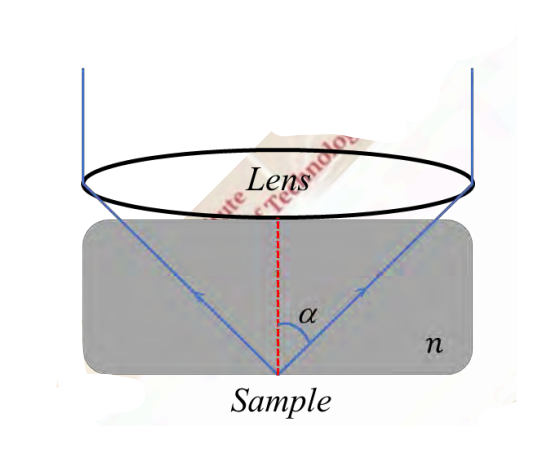
An objective lens with half angular aperture \(\alpha\) is illuminated with light of wavelength \(\lambda\). The refractive index of the medium between the sample and the objective is \(n\). The lateral resolving power of the optical system can be increased by
A) decreasing both \(\lambda\) and \(\alpha\)
B) decreasing \(\lambda\) and increasing \(\alpha\)
C) increasing both \(\alpha\) and \(n\)
D) decreasing \(\lambda\) and increasing \(n\)
Check Answer
Option B,C,D
Q.No:56 JAM-2023
In a Newton’s rings experiment (using light of free space wavelength \(580\text{nm}\)), there is an air gap of height \(d\) between the glass plate and a plano-convex lens (see figure). The central fringe is observed to be bright.
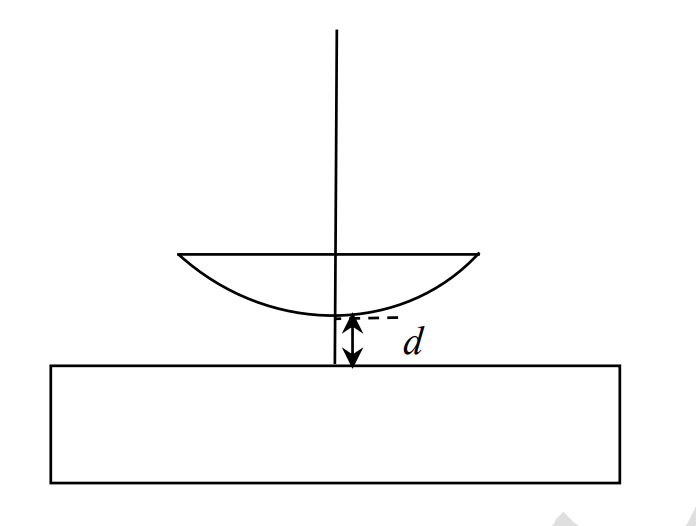
The least possible value of \(d\) (in nm) is:
A) 145
B) 290
C) 580
D) 72.5
Check Answer
Option A
Q.No: 57 JAM-2023
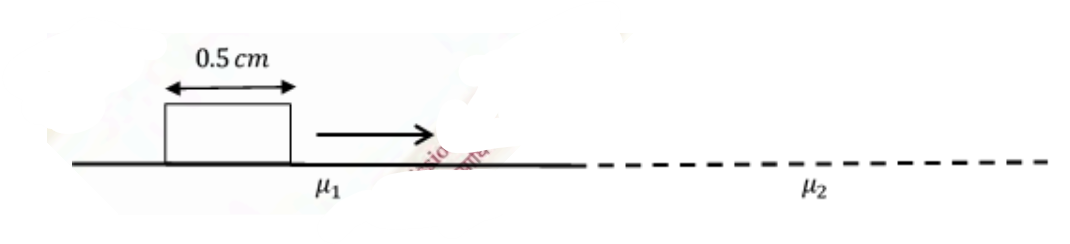
A rectangular pulse of width 0.5 cm is travelling to the right on a taut string (shown by full line in the figure) that has mass per unit length \(\mu_1\). The string is attached to another taut string (shown by dashed line) of mass per unit length \(\mu_2\). If the tension
in both the strings is the same, and the transmitted pulse has width 0.7 cm, the ratio \(\mu_1/\mu_2\) is ________
Check Answer
Ans 1.94 -1.98
Q.No:57 JAM-2024
Linearly polarized light (free space wavelength \(\lambda_0 = 600\text{nm}\)) is incident normally on a retarding plate (\(n_e - n_o = 0.05\) at \(\lambda_0 = 600\text{nm}\)). The emergent light is observed to be linearly polarized, irrespective of the angle between the direction of polarization and the optic axis of the plate. The minimum thickness (in \(\mu m\)) of the plate is:
A) 6
B) 3
C) 2
D) 1
Check Answer
Option A
Q.No:58 JAM-2024
Suppose that there is a dispersive medium whose refractive index depends on the wavelength as given by \( n(\lambda) = n_0 + \frac{a}{\lambda^2} - \frac{b}{\lambda^4} \). The value of \( \lambda \) at which the group and phase velocities would be the same, is:
A) \( \sqrt{\frac{2b}{a}} \)
B) \( \sqrt{\frac{b}{2a}} \)
C) \( \sqrt{\frac{3b}{a}} \)
D) \( \sqrt{\frac{b}{3a}} \)
Check Answer
Option A
Q.No:59 JAM-2024
When a system of multiple long narrow slits (width \( 2\mu m \) and period \( 4\mu m \)) is illuminated with a laser of wavelength \( 600nm \). There are \( 40 \) minima between the two consecutive principal maxima observed in its diffraction pattern. Then maximum resolving power of the system is ________________
Check Answer
Ans 246
Q.No:60 JAM-2024
Consider a thick biconvex lens (thickness \( t = 4 \) cm and refractive index \( n = 1.5 \)) whose magnitudes of the radii of curvature \( R_1 \) and \( R_2 \), of the first and second surfaces are 30 cm and 20 cm, respectively. Surface 2 is silvered to act as a mirror. A point object is placed at point A on the axis (OA = 60 cm) as shown in the figure. If its image is formed at point Q, the distance \( d \) between O and Q is _______________________cm. (Rounded off to two decimal places)
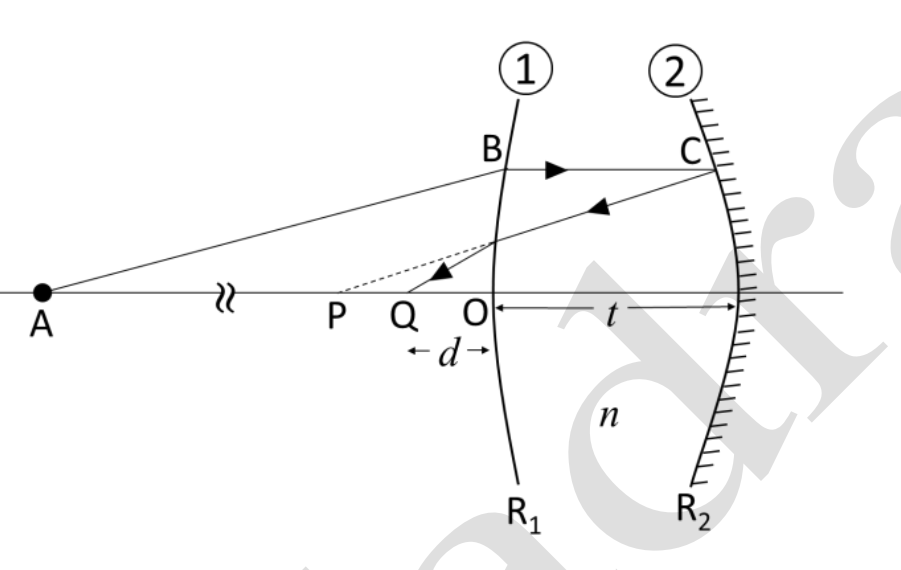
Check Answer
Ans 3.55-3.90
Q.No:61 JAM-2024
If two traveling waves, given by
\( y_1 = A_0 \sin(kx - \omega t) \) and \( y_2 = A_0 \sin(\alpha kx - \beta \omega t) \)
are superposed, which of the following statements is correct?
A) For \( \alpha = \beta = 1 \), the resultant wave is a standing wave
B) For \( \alpha = \beta = -1 \), the resultant wave is a standing wave
C) For \( \alpha = \beta = 2 \), the carrier frequency of the resultant wave is \( \frac{3}{2} \omega \)
D) For \( \alpha = \beta = 2 \), the carrier frequency of the resultant wave is \( 3\omega \)
Check Answer
Option C
Q.No:62 JAM-2025
Two parallel light rays (① and ②) are incident from air on a system
consisting of media P, Q, and air, as shown in the figure.
The incident angle is 45°.
Ray ① passes through medium P, air, and medium Q, while ray ② passes
through media P and Q before leaving the system.
After passing through the system, the angular deviation (in radians)
between the two rays is
[The dimensions of the media and their refractive indices
(\(n_a, n_P, n_Q\)) are shown in the figure]

A) 0
B) \(\tan^{-1}\!\sqrt{\frac{3}{2}}\)
C) \(\tan^{-1}\!\sqrt{\frac{2}{3}}\)
D) \(\tan^{-1}\!\sqrt{\frac{1}{3}}\)
Check Answer
Option A
Q.No:63 JAM-2025
For a two-slit Fraunhofer diffraction, each slit is 0.1 mm wide and the
separation between the two slits is 0.8 mm.
The total number of interference minima between the first diffraction
minima on both sides of the central maxima is
A) 16
B) 18
C) 8
D) 9
Check Answer
Option A
Q.No:64 JAM-2025
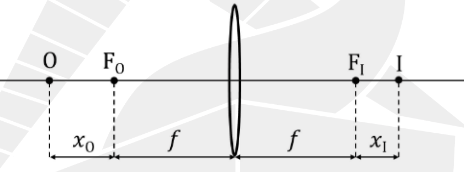
For a thin convex lens of focal length f, the image of an object at O is
formed at I, as shown in the figure.
The distances of object and image from the two focal points (\(F_O\) and \(F_I\)
are \(x_O\) and \(x_I\), respectively.
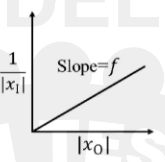
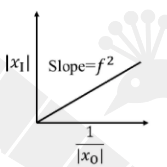
Which of the following graphs correctly represent(s) the variation of
the quantities shown in the figure?


Check Answer
Option A,C
Q.No:65 JAM-2025
The shortest distance between an object and its real image formed by a
thin convex lens of focal length 20 cm is ______ cm. (in integer)
Check Answer
ANS 80
Q.No:66 JAM-2025
A light beam given by
\[
\vec{E}(z,t) = E_{01}\sin(kz-\omega t)\,\hat{i}
+ E_{02}\sin\!\left(kz-\omega t+\frac{\pi}{6}\right)\hat{j}
\]
passes through an ideal linear polarizer whose transmission axis is
tilted by \(60^\circ\) from the x-axis (in the x–y plane).
If \(E_{01} = 4\ \text{V/m}\) and \(E_{02} = 2\ \text{V/m}\),
the electric field amplitude of the emerging light beam from the
polarizer is ______ V/m. (up to two decimal places)
Check Answer
ANS 3.59 to 3.63
Q.No:67 JAM-2025
A wedge-shaped thin film is formed using a soap-water solution.
The refractive index of the film is 1.25.
At near normal incidence, when the film is illuminated by a
monochromatic light of wavelength 600 nm, 10 interference fringes
per cm are observed.
The wedge angle (in radians) is ______ × \(10^{-5}\). (in integer)