
Q.No:1 GATE-2012
Which one of the following sets corresponds to fundamental particles?
(A)
proton, electron and neutron
(B)
proton, electron and photon
(C)
electron, photon and neutrino
(D)
quark, electron and meson
Check Answer
Option C
Q.No:2 GATE-2012
Deuteron has only one bound state with spin parity \(1^{+}\), isospin \(0\) and electric quadrupole moment \(0.286 efm^2\). These data suggest that the nuclear forces are having
(A)
only spin and isospin dependence
(B)
no spin dependence and no tensor components
(C)
spin dependence but no tensor components
(D)
spin dependence along with tensor components
Check Answer
Option D
Q.No:3 GATE-2012
Choose the CORRECT statement from the following.
(A)
Neutron interacts through electromagnetic interaction
(B)
Electron does not interact through weak interaction
(C)
Neutrino interacts through weak and electromagnetic interaction
(D)
Quark interacts through strong interaction but not through weak interaction
Check Answer
Option A
Q.No:4 GATE-2013
The decay process \(n\to p^{+}+e^{-}+\bar{v}_{e}\) violates
(A)
baryon number
(B)
lepton number
(C)
isospin
(D)
strangeness
Check Answer
Option C
Q.No:5 GATE-2013
The isospin (I) and baryon number (B) of the up quark is
(A)
I=1, B=1
(B)
I=1, B=1/3
(C)
I=1/2, B=1
(D)
I=1/2, B=1/3
Check Answer
Option D
Q.No:6 GATE-2013
Consider the decay of a pion into a muon and an anti-neutrino \(\pi^{-}\to \mu^{-}+\bar{v}_{\mu}\) in the pion rest frame. \(m_{\pi}=139.6 MeV/c^2, m_{\mu}=105.7 MeV/c^2, m_{\nu}\approx 0\) The energy (in MeV) of the emitted neutrino, to the nearest integer is ________________
Check Answer
Ans 30
Q.No:7 GATE-2014
Which one of the following high energy processes is allowed by conservation laws?
(A)
\(p+\bar{p}\to \Lambda^0+\Lambda^0\)
(B)
\(\pi^{-}+p\to \pi^{0}+n\)
(C)
\(n\to p+e^{-}+\nu_{e}\)
(D)
\(\mu^{+}\to e^{+}+\gamma\)
Check Answer
Option B
Q.No:8 GATE-2014
Which one of the following three-quark states (\(qqq\)), denoted by \(X\), CANNOT be a possible baryon? The corresponding electric charge is indicated in the superscript.
(A)
\(X^{++}\)
(B)
\(X^{+}\)
(C)
\(X^{-}\)
(D)
\(X^{--}\)
Check Answer
Option D
Q.No:9 GATE-2014
Consider the process \(\mu^{+}+\mu^{-}\to \pi^{+}+\pi^{-}\). The minimum kinetic energy of the muons (\(\mu\)) in the centre of mass frame required to produce the pion (\(\pi\)) pairs at rest is _____________ MeV. (Given: \(m_{\mu}=105 MeV/c^2, m_{\pi}=140 MeV/c^2\)).
Check Answer
Ans 34.9-35.1
Q.No:10 GATE-2015
The decay \(\mu^{+}\to e^{+}+\gamma\) is forbidden, because it violates
(A)
momentum and lepton number conservations
(B)
baryon and lepton number conservations
(C)
angular momentum conservation
(D)
lepton number conservation
Check Answer
Option D
Q.No:11 GATE-2015
A particle with rest mass \(M\) is at rest and decay into two particles of equal rest masses \(\frac{3}{10}M\) which move along the \(z\) axis. Their velocities are given by
(A)
\(\vec{\nu}_1=\vec{\nu}_2=(0.8c)\hat{z}\)
(B)
\(\vec{\nu}_1=-\vec{\nu}_2=(0.8c)\hat{z}\)
(C)
\(\vec{\nu}_1=-\vec{\nu}_2=(0.6c)\hat{z}\)
(D)
\(\vec{\nu}_1=(0.6c)\hat{z}; \vec{\nu}_2=(-0.8c)\hat{z}\)
Check Answer
Option B
Q.No:12 GATE-2016
In the \(SU(3)\) quark model, the triplet of mesons \((\pi^{+}, \pi^{0}, \pi^{-})\) has
(A)
\(\text{Isospin}=0, \text{Strangeness}=0\)
(B)
\(\text{Isospin}=1, \text{Strangeness}=0\)
(C)
\(\text{Isospin}=1/2, \text{Strangeness}=+1\)
(D)
\(\text{Isospin}=1/2, \text{Strangeness}=-1\)
Check Answer
Option B
Q.No:13 GATE-2016
Consider the reaction \({^{54}_{25} Mn}+e^{-}\to {^{54}_{24} Cr}+X\). The particle \(X\) is
(A)
\(\gamma\)
(B)
\(\nu_{e}\)
(C)
\(n\)
(D)
\(\pi^{0}\)
Check Answer
Option B
Q.No:14 GATE-2016
Which of the following statements is NOT correct?
(A)
A deuteron can be disintegrated by irradiating it with gamma rays of energy \(4 MeV\).
(B)
A deuteron has no excited states.
(C)
A deuteron has no electric quadrupole moment.
(D)
The \({}^1 S_0\) state of deuteron cannot be formed.
Check Answer
Option C
Q.No:15 GATE-2016
A particle of rest mass \(M\) is moving along the positive \(x\)-direction. It decays into two photons \(\gamma_1\) and \(\gamma_2\) as shown in the figure. The energy of \(\gamma_1\) is \(1 GeV\) and the energy of \(\gamma_2\) is \(0.82 GeV\). The value of \(M\) (in units of \(GeV/c^2\)) is ___________. (Give your answer upto two decimal places)

Check Answer
Ans 1.40-1.45
Q.No:16 GATE-2017
Which one of the following conservation laws is violated in the decay \(\tau^{+}\to \mu^{+} \mu^{+} \mu^{-}\)
(A)
Angular momentum
(B)
Total Lepton number
(C)
Electric charge
(D)
Tau number
Check Answer
Option D
Q.No:17 GATE-2017
Electromagnetic interactions are:
(A)
C conserving
(B)
C non-conserving but CP conserving
(C)
CP non-conserving but CPT conserving
(D)
CPT non-conserving
Check Answer
Option A
Q.No:18 GATE-2017
In the nuclear reaction \({^{13} C_{6}}+\nu_{e}\to {^{13} N_{7}}+X\), the particle \(X\) is
(A)
and electron
(B)
an anti-electron
(C)
a muon
(D)
a pion
Check Answer
Option A
Q.No:19 GATE-2017
The \(\pi^{+}\) decays at rest to \(\mu^{+}\) and \(\nu_{\mu}\). Assuming the neutrino to be massless, the momentum of the neutrino is ________________ MeV/c. (up to two decimal places) (\(m_{\pi}=139 MeV/c^2, m_{\mu}=105 MeV/c^2\)).
Check Answer
Ans 29.50-30.10
Q.No:20 GATE-2018
Among electric field (\(\vec{E}\)), magnetic field (\(\vec{B}\)), angular momentum (\(\vec{L}\)), and vector potential (\(\vec{A}\)), which is/are \({\bf odd}\) under parity (space inversion) operation?
(A)
\(\vec{E}\) only
(B)
\(\vec{E}\) \& \(\vec{A}\) only
(C)
\(\vec{E}\) \& \(\vec{B}\) only
(D)
\(\vec{B}\) \& \(\vec{L}\) only
Check Answer
Option B
Q.No:21 GATE-2018
The elementary particle \(\Xi^0\) is placed in the baryon decuplet, shown below, at

(A)
P
(B)
Q
(C)
R
(D)
S
Check Answer
Option C
Q.No:22 GATE-2018
In the decay, \(\mu^{+}\to e^{+}+\nu_{e}+X\), what is \(X\)?
(A)
\(\gamma\)
(B)
\(\bar{\nu}_{e}\)
(C)
\(\nu_{\mu}\)
(D)
\(\bar{\nu}_{\mu}\)
Check Answer
Option C
Q.No:23 GATE-2019
Considering baryon number and lepton number conservation laws, which of the following processes is/are allowed?
(i) \(p\to \pi^{0}+e^{+}+\nu_{e}\)
(ii) \(e^{+}+\nu_{e}\to \mu^{+}+\nu_{\mu}\)
(A)
both (i) and (ii)
(B)
only (i)
(C)
only (ii)
(D)
neither (i) nor (ii)
Check Answer
Option C
Q.No:24 GATE-2019
A massive particle \(\mathbf{X}\) in free space decays spontaneously into two photons. Which of the following statements is true for \(\mathbf{X}\)?
(A)
\(\mathbf{X}\) is charged
(B)
Spin of \(\mathbf{X}\) must be greater than or equal to \(2\)
(C)
\(\mathbf{X}\) is a boson
(D)
\(\mathbf{X}\) must be a baryon
Check Answer
Option C
Q.No:25 GATE-2019
Low energy collision (\(s\)-wave scattering) of pion (\(\pi^{+}\)) with deuteron (\(d\)) results in the production of two protons (\(\pi^{+}+d\to p+p\)). The relative orbital angular momentum (in units of \(\hbar\)) of the resulting two-proton system for this reaction is
(A)
\(0\)
(B)
\(1\)
(C)
\(2\)
(D)
\(3\)
Check Answer
Option B
Q.No:26 GATE-2020
A particle \(X\) is produced in the process \(\pi^{+}+p\to K^{+}+X\) via the strong interaction. If the quark content of the \(K^{+}\) is \(u\bar{s}\), the quark content of \(X\) is
(A)
\(c\bar{s}\)
(B)
\(uud\)
(C)
\(uus\)
(D)
\(u\bar{d}\)
Check Answer
Option C
Q.No:27 GATE-2020
Particle \(A\) with angular momentum \(j=\frac{3}{2}\) decays into two particles \(B\) and \(C\) with angular momenta \(j_1\) and \(j_2\), respectively. If \(\left|\frac{3}{2}, \frac{3}{2}\right\rangle_A=\alpha|1, 1\rangle_B\otimes \left|\frac{1}{2}, \frac{1}{2}\right\rangle_C\), the value of \(\alpha\) is ______________________.
Check Answer
Ans 1
Q.No:28 GATE-2021
A particle \(Y\) undergoes strong decay \(Y\to \pi^{-}+\pi^{-}\). The isospin of \(Y\) is ___________.
Check Answer
Ans 2
Q.No:29 GATE-2021
The Gell-Mann-Okuba mass formula defines the mass of baryons as \(M=M_0+aY+b\left[I(I+1)-\frac{1}{4}Y^2\right]\), where \(M_0, a\) and \(b\) are constants, \(I\) represents the isospin and \(Y\) represents the hypercharge. If the mass of \(\Sigma\) hyperons is same as that of \(\Lambda\) hyperons, then the correct option(s) is(are)
(A)
\(M\propto I(I+1)\)
(B)
\(M\propto Y\)
(C)
\(M\) does not depend on \(I\)
(D)
\(M\) does not depend on \(Y\)
Check Answer
Option B_C
Q.No:30 GATE-2023
The \(\Xi ^{0*}\) particle is a member of the Baryon decuplet with isospin state \(| I, I_3\rangle = |\frac{1}{2}, \frac{1}{2}\rangle \) and strangeness quantum number \(-2\). In the quark model, which one of the following is the flavour part of the \(\Xi ^{0*}\) wavefunction?
(A)
\(\frac{1}{\sqrt{2}} (uss-ssu)\)
(B)
\(\frac{1}{\sqrt{3}} (uss+sus+ssu)\)
(C)
\(\frac{1}{\sqrt{2}} (uss+ssu)\)
(D)
\(\frac{1}{\sqrt{3}} (uss-sus+ssu)\)
Check Answer
Option B
Q.No:31 GATE-2023
The deuteron is a bound state of a neutron and a proton. Which of the following statements is(are) CORRECT?
(A)
The deuteron has a finite value of electric quadrupole moment due to nonspherical electronic charge distribution
(B)
The magnetic moment of the deuteron is equal to the sum of the magnetic moments of the neutron and the proton
(C)
The deuteron state is an admixture of \(^3 S_1\) and \(^3D_1\) states
(D)
The deuteron state is an admixture of \(^3 S_1\) and \(^3P_1\) states
Check Answer
Option A, C
Q.No:32 GATE-2023
In a hadronic interaction, \(\pi^ 0\)'s are produced with different momenta, and they immediately decay into two photons with an opening angle \(\theta\) between them. Assuming that all these decays occur in one plane, which one of the following figures depicts the behaviour of \(\theta\) as a function of the \(\pi ^0\) momentum \(p\)?
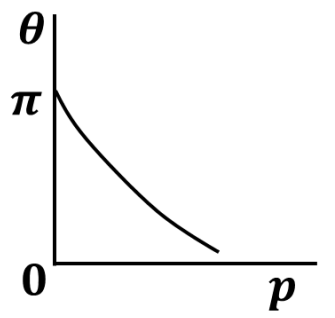
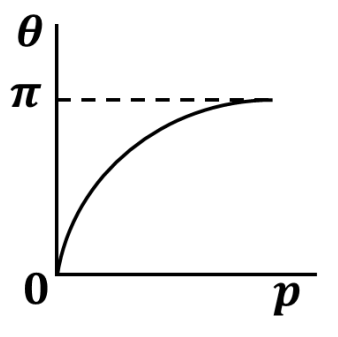
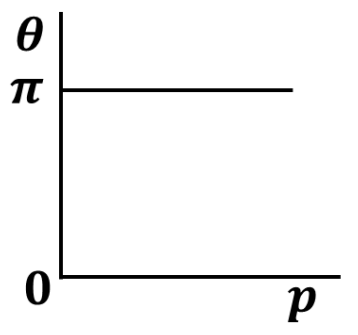

Check Answer
Option A
Q.No:33 GATE-2023
A slow moving \(\pi^-\) particle is captured by a deuteron (\(d\)) and this reaction produces two neutrons (\(n\)) in the final state, i.e., \(\pi^- +d\to n+n\). Neutron and deuteron have even intrinsic parities, whereas \(\pi^-\) has odd intrinsic parity. \(L\) and \(S\) are the orbital and spin angular momenta, respectively of the system of two
neutrons. Which of the following statements regarding the final two-neutron state is(are) CORRECT?
(A)
It has odd parity
(B)
\(L+S\) is odd
(C)
\(L=1 , S=1\)
(D)
\(L=2 , S=0\)
Check Answer
Option A, C
Q.No:34 GATE-2023
In pion nucleon scattering, the pion and nucleon can combine to form a short lived bound state called the \(\Delta\) particle (\(\pi +n \to \Delta\)). The masses of the pion, nucleon and the \(\Delta\) particle are 140 MeV/\(c^2\), 938 MeV/\(c^2\) and 1230 MeV/\(c^2\), respectively. In the lab frame, where the nucleon is at rest, what is the minimum
energy (in MeV/\(c^2\), rounded off to one decimal place) of the pion to produce the \(\Delta\) particle?
Check Answer
Ans 326.9-327.1
Q.No:35 GATE-2023
An \(\alpha\)-particle is emitted from the decay of Americium (\(Am\)) at rest, i.e., \(^{241} _{94} Am \to ^{237} _{92} U +\alpha\). The rest masses of \(^{241} _{94} Am ,^{237} _{92} U \) and \(\alpha\) are 224.544
GeV/\(c^2\), 220.811 GeV/\(c^2\) and 3.728 GeV/\(c^2\) respectively. What is the kinetic energy (in MeV/\(c^2\), rounded off to two decimal places) of the \(\alpha\)-particle?
Check Answer
Ans 4.90-4.94
Q.No:36 GATE-2024
Let \( P \), \( Q \) and \( R \) be three different nuclei. Which one of the following nuclear processes is possible?
(A) \( \nu_e + \, ^A_ZP \rightarrow \, ^A_{Z+1}Q + e^- \)
(B) \( \nu_e + \, ^A_ZP \rightarrow \, ^A_{Z-1}R + e^+ \)
(C) \( \nu_e + \, ^A_ZP \rightarrow \, ^A_ZP + e^+ + e^- \)
(D) \( \nu_e + \, ^A_ZP \rightarrow \, ^A_ZP + \gamma \)
Check Answer
Option A
Q.No:37 GATE-2024
Consider the induced nuclear fission reaction
\[
^{235}_{92}U + n \rightarrow \, ^{93}_{37}Rb + \, ^{141}_{55}Cs + 2n
\]
where neutron momenta in both initial and final states are negligible. The ratio of the kinetic energies (KE) of the daughter nuclei,
\[
\frac{KE(^{93}_{37}Rb)}{KE(^{141}_{55}Cs)}
\]
is____________
(A) \(\frac{93}{141}\)
(B) \(\frac{141}{93}\)
(C) \(1\)
(D) \(0\)
Check Answer
Option B
Q.No:38 GATE-2024
Decays of mesons and baryons can be categorized as weak, strong and electromagnetic decays depending upon the interactions involved in the processes. Which of the following option is/are true?
(A) \(\pi^0 \rightarrow \gamma\gamma\) is a weak decay
(B) \(\Lambda^0 \rightarrow \pi^0 + p\) is an electromagnetic decay
(C) \(K^0 \rightarrow \pi^+ + \pi^-\) is a weak decay
(D) \(\Delta^{++} \rightarrow p + \pi^+\) is a strong decay
Check Answer
Option C,D
Q.No:39 GATE-2025
Which one of the following baryons has strangeness quantum number \(S = -1\)?
A) \(\Sigma^{*0}\)
B) \(n\)
C) \(\Xi^{*0}\)
D) \(\Delta^{0}\)
Check Answer
Option A
Q.No:40 GATE-2025
Which of the following consideration(s) is/are showing that nuclear beta decay,
\(n \rightarrow p + e^{-} + \bar{\nu}_{e}\),
has to be a three-body decay?
A) Continuous distribution of the electron energy
B) Spin of the final state
C) Mass of the electron
D) Mass of the proton
Check Answer
Option A,B
Q.No:41 GATE-2025
The \(\Delta^{+}\) baryon with spin \(\frac{3}{2}\), at rest, decays to a proton and a pion
\((\Delta^{+} \rightarrow p + \pi^{0})\).
The \(\Delta^{+}\) has positive intrinsic parity and \(\pi^{0}\) has negative intrinsic parity.
The orbital angular momentum of the proton–pion system (in integer) is ______
Check Answer
ANS 1
Q.No:42 GATE-2025
Cyclotrons are used to accelerate ions like deuterons \((d)\) and \(\alpha\) particles.
Keeping the magnetic field same for both, \(d\) and \(\alpha\) are extracted with energies
10 MeV and 20 MeV with extraction radii \(r_{d}\) and \(r_{\alpha}\), respectively.
Taking the masses
\(M_{d} = 2000 \text{ MeV}/c^{2}\) and
\(M_{\alpha} = 4000 \text{ MeV}/c^{2}\),
the value of \(\frac{r_{\alpha}}{r_{d}}\) (in integer) is ______