
Q.No:1 TIFR-2013
A particle \(P\), of rest mass \(M\) and energy \(E\), suddenly decays into two particles \(A\) and \(B\) of rest masses \(m_A\) and \(m_B\) respectively, and both particles move along the straight line in which \(P\) was moving. A possible energy \(E_A\) of the particle \(A\) will be
(a)
\(\frac{E}{2}\left\{1+\left(\frac{m_A-m_B}{M}\right)^2\right\}\)
(b)
\(\frac{E}{2}\left\{1-\left(\frac{m_A^2-m_B^2}{M^2}\right)^2\right\}\)
(c)
\(\frac{E}{2}\left\{1+\left(\frac{m_A+m_B}{M}\right)^2\right\}\)
(d)
\(\frac{E}{2}\left\{1+\left(\frac{m_A^2-m_B^2}{M^2}\right)^2\right\}\)
Check Answer
Option d
Q.No:2 TIFR-2013
A spin-\(1/2\) particle \(A\) decays to two other particles \(B\) and \(C\). If \(B\) and \(C\) are of spin-\(1/2\) and spin-\(1\) respectively, then a complete list of the possible values of the orbital angular momentum of the final state (i.e. \(B+C\)) is
(a)
\(0, 1\)
(b)
\(1/2, 3/2\)
(c)
\(0, 1, 2\)
(d)
\(0, \pm 1\)
Check Answer
Option c
Q.No:3 TIFR-2013
A gold foil, having \(N(0)\) number of \({^{197} Au}\) nuclides per \(cm^2\), is irradiated by a beam of thermal neutrons with a flux of \(F\) neutrons- \(cm^{-2} s^{-1}\). As a result, the nuclide \({^{198} Au}\), with a half-life \(\tau\) of several years, is produced by the reaction
\[
{^{197} Au}+n\to {^{198} Au}+\gamma
\]
which has a cross section of \(\sigma cm^2\). Assuming that the gold foil has \(100\%\) abundancy of \({^{197} Au}\) nuclides, the maximum number of \({^{198} Au}\) nuclides that can accumulate at any time in the foil is proportional to
(a)
\(\sigma \tau F N(0)\)
(b)
\(\frac{\tau}{\sigma F} N(0)\)
(c)
\(\frac{1}{\sigma \tau F}N(0)\)
(d)
\(\frac{\sigma F}{\tau} N(0)\)
Check Answer
Option a
Q.No:4 TIFR-2013
The process of electron capture
\[
p+e^{-}\to n+\nu_{e}
\]
takes place at the quark level through the Feynman diagram

Check Answer
Option c
Q.No:5 TIFR-2014
A spin-\(2\) nucleus absorbs a spin-\(1/2\) electron and is then observed to decay to a stable nucleus in two stages, recoiling against an emitted invisible particle in the first stage and against an emitted spin-\(1\) photons in the second stage. If the stable nucleus is spinless, then the set of all possible spin values of the invisible particle is
(a)
\(\{1/2, 5/2\}\)
(b)
\(\{3/2, 7/2\}\)
(c)
\(\{1/2, 3/2, 5/2\}\)
(d)
\(\{1/2, 3/2, 5/2, 7/2\}\)
Check Answer
Option d
Q.No:6 TIFR-2014
It is well-known that the energy of the Sun arises from the fusion of hydrogen nuclei (protons) inside the core of the Sun. This takes place through several mechanisms, each resulting in emission of energy.
Which of the following reactions is NOT possible during the proton fusion inside the Sun?
(a)
\({^{1}_{1} H}+{^{1}_{1} H}\to {^{2}_{2} He}\)
(d)
\({^{2}_{1} H}+{^{1}_{1} H}\to {^{3}_{2} He}\)
(c)
\({^{1}_{1} H}+{^{1}_{1} H}\to {^{2}_{1} H}+e^{+}+\nu_{e}\)
(d)
\({^{1}_{1} H}+{^{1}_{1} H}+{^{1}_{1} H}+{^{1}_{1} H}\to {^{4}_{2} H}+2e^{+}\)
Check Answer
Option d
Q.No:7 TIFR-2014
The interaction strength of the recently-discovered Higgs boson (mass approximately \(125 GeV/c^2\)) with any other elementary particle is proportional to the mass of that particle. Which of the following decay processes will have the greatest probability?
(a)
Higgs boson decaying to a top quark \(+\) a top anti-quark.
(b)
Higgs boson decaying to a bottom quark \(+\) a bottom anti-quark.
(c)
Higgs boson decaying to an electron and a positron.
(d)
Higgs boson decaying to a neutrino-antineutrino pair.
Check Answer
Option b
Q.No:8 TIFR-2015
Consider the following reactions involving elementary particles:
Which of the following statements is true for strong interactions?
\(\pi^{-}+p\to K^{-}+\Sigma^{+}\)
\(K^{-}+p\to K^{-}+\rho^{+}\)
(a)
(A) and (B) are both forbidden
(d)
(B) is allowed but (A) is forbidden
(c)
(A) is allowed but (B) is forbidden
(d)
(A) and (B) are both allowed
Check Answer
Option a
Q.No:9 TIFR-2016
In a fixed target experiment, a proton of total energy \(200 GeV\) is bombarded on a proton at rest and produces a nucleus \({}^{Z}_{A} N\) and its anti-nucleus \({}^{Z}_{A} \overline{N}\)
\[
p+p\to {}^{Z}_{A} N + {}^{Z}_{A} \overline{N} + p + p
\]
The heaviest nucleus \({}^{Z}_{A} N\) that can be created has atomic mass number \(A=\)
(a)
\(15\)
(b)
\(9\)
(c)
\(5\)
(d)
\(4\)
Check Answer
Option d
Q.No:10 TIFR-2016
Consider a process in which atoms of Actinium-226 \(({^{226}_{89} Ac})\) get converted to atoms of Radium-226 \(({^{226}_{88} Ra})\) and the yield of energy is \(0.64 MeV\) per atom. This occurs through
(a)
Both \(p\to n+e^{+}+\nu_{e}\) and \(p+e^{-}\to n+\nu_{e}\)
(b)
Both \(p\to n+e^{+}+\nu_{e}\) and \(n\to p+e^{-}+\bar{\nu}_{e}\)
(c)
Only \(p\to n+e^{+}+\nu_{e}\)
(d)
Only \(p+e^{-}\to n+\nu_{e}\)
Check Answer
Option d
Q.No:11 TIFR-2016
Consider the hyperon decay (1) \(\Gamma\to n+\pi^{0}\) followed by (2) \(\pi^{0}\to \gamma \gamma\). If the isospin component, baryon number and strangeness quantum numbers are denoted by \(I_Z, B\) and \(S\) respectively, then which of the following statements is completely correct?
(a)
In (1) \(I_Z\) is not conserved, \(B\) is conserved, \(S\) is not conserved; In (2) \(I_Z\) is conserved, \(B\) is conserved, \(S\) is conserved.
(b)
In (1) \(I_Z\) is conserved, \(B\) is not conserved, \(S\) is not conserved; In (2) \(I_Z\) is conserved, \(B\) is conserved, \(S\) is conserved.
(c)
In (1) \(I_Z\) is not conserved, \(B\) is conserved, \(S\) is not conserved; In (2) \(I_Z\) is not conserved, \(B\) is conserved, \(S\) is conserved.
(d)
In (1) \(I_Z\) is not conserved, \(B\) is conserved, \(S\) is conserved; In (2) \(I_Z\) is conserved, \(B\) is conserved, \(S\) is conserved.
Check Answer
Option a
Q.No:12 TIFR-2017
Cosmic ray muons, which decay spontaneously with proper lifetime \(2.2 \hspace{1mm}\mu\text{s}\), are produced in the atmosphere, at a height of \(5 \hspace{1mm}\text{km}\) above sea level. These move straight downwards at \(98\%\) of the speed of light.
Find the percent ratio \(100\times (N_A/N_B)\) of the number of muons measured at the top of two mountains \(A\) and \(B\), which are at heights 4,848 \text{m} and 2,682 \text{m} respectively above mean sea level
Check Answer
Ans 23
Q.No:13 TIFR-2017
A deuteron of mass \(M\) and binding energy \(B\) is struck by a gamma ray photon of energy \(E_{\gamma}\), and is observed to disintegrate into a neutron and a proton. If \(B\ll Mc^2\), the minimum value of \(E_{\gamma}\) must be
(a)
\(2B+\frac{B^2}{2Mc^2}\)
(b)
\(B+\frac{B^2}{Mc^2}\)
(c)
\(\frac{1}{2}\left(3B+\frac{B^2}{Mc^2}\right)\)
(d)
\(\frac{1}{2}\left(2B+\frac{B^2}{Mc^2}\right)\)
Check Answer
Option d
Q.No:14 TIFR-2017
A subatomic particle \(\psi\) and its excited state \(\psi^*\) have rest masses \(3.1 \hspace{1mm}\text{GeV}/c^2\) and \(3.7 \hspace{1mm}\text{GeV}/c^2\) respectively. A table of its assigned quantum numbers is given below.

If \(\pi^{0*}\) is an excited state of \(\pi^0\) with a mass of about \(1.3 \hspace{1mm}\text{GeV}/c^2\), which of the following reactions is possible when the above quantum numbers are conserved?
(a)
\(\psi^*\to \gamma \gamma\)
(b)
\(\psi^*\to \psi \pi^+ \pi^-\)
(c)
\(\psi^*\to \pi^0 \pi^0\)
(d)
\(\psi^*\to \psi \pi^{0*}\)
Check Answer
Option b
Q.No:15 TIFR-2019
The table below gives the properties of four unstable particles \(\mu^{+}, \pi^{+}, n^{0}, \Lambda^{0}\)

If arranged in order of DECREASING decay lifetime, the above list will read
(a)
\(n^{0}, \mu^{+}, \pi^{+}, \Lambda^{0}\)
(b)
\(\mu^{+}, \Lambda^{0}, n^{0}, \pi^{+}\)
(c)
\(n^{0}, \Lambda^{0}, \mu^{+}, \pi^{+}\)
(d)
\(\pi^{+}, n^{0}, \mu^{+}, \Lambda^{0}\)
Check Answer
Option a
Q.No:16 TIFR-2020
A spin-\(2\) nucleus absorbs a spin-\(1/2\) electron and is then observed to decay to a stable nucleus in two stages, recoiling against an emitted invisible particle in the first stage and against an emitted spin-\(1\) photon in the second stage. If the stable nucleus is spinless, then the spin of the invisible particle is
(a)
\(3/2\) or \(5/2\)
(b)
\(3/2\)
(c)
\(1/2\) or \(3/2\)
(d)
\(1/2\)
Check Answer
Option a
Q.No:17 TIFR-2020
Two atomic nuclei A and B have masses such that \(m(B)=2m(A)\). In the laboratory frame, the nucleus B is kept stationary, while the nucleus A is given a kinetic energy \(300 \hspace{1mm}\text{MeV}\) and made to collide with B. It is found that the two nuclei fuse to form a compound nucleus C.
If the \(Q\)-value of the reaction is \(−30 \hspace{1mm}\text{MeV}\), the excitation energy of the compound nucleus can be estimated as
(a)
\(81 \hspace{1mm}\text{MeV}\)
(b)
\(170 \hspace{1mm}\text{MeV}\)
(c)
\(330 \hspace{1mm}\text{MeV}\)
(d)
\(270 \hspace{1mm}\text{MeV}\)
Check Answer
Option b
Q.No:18 TIFR-2020
Which of the following decays is forbidden?
(a)
\(\pi^{0}\to \gamma+\gamma\)
(b)
\(K^{0}\to \pi^{+}+\pi^{-}+\pi^{0}\)
(c)
\(\mu^{-}\to e^{-}+\nu_{e}+\bar{\nu}_{\mu}\)
(d)
\(n^{0}\to p^{+}+e^{-}+\bar{\nu}_e\)
Check Answer
Option c
Q.No:19 TIFR-2021
Consider the \(s\)-wave capture of a pion \(\pi^{-}\) by a deuteron \(d\) in its ground state, which then produces two neutrons, i.e.
\[
\pi^{-}+d\to n+n
\]
If we consider the two neutrons in the final state, they will satisfy
(a)
\(L=1, S=1\)
(b)
\(L=0, S=1\)
(c)
\(L=1, S=0\)
(d)
\(L=0, S=1\)
Check Answer
Option c
Q.No:20 TIFR-2022
Two particles, as specified in the table below, both enter a region of uniform magnetic field in a direction perpendicular to the field direction.
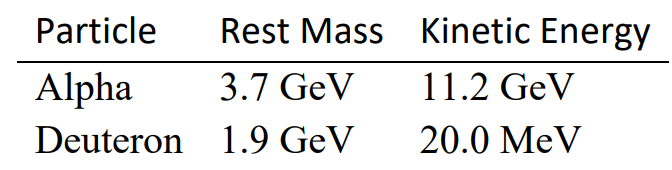
If both the particles then follow circular trajectories in the magnetic field, the ratio of their time periods for one full revolution must be
(a)
4.0
(b)
3.0
(c)
2.0
(d)
1.0
Check Answer
Option a
Q.No:21 TIFR-2022
There are two conceivable channels by which a vector \(\rho^\circ\) meson can decay into a pair of pseudoscalar pions. These are
\[\rho^\circ \to \pi^\circ +\pi ^\circ \hspace{4mm} \text{and} \hspace{4mm} \rho^\circ \to \pi^+ +\pi ^-\]
The probability that the decay takes place through the process \(\rho^\circ \to \pi^+ +\pi ^-\) is approximately
(a)
1
(b)
\(m_{\pi^\circ}/2m_{\pi^+}\)
(c)
\(m_{\pi^+} ^2/m_{\rho} ^2\)
(d)
zero
Check Answer
Option a
Q.No:22 TIFR-2023
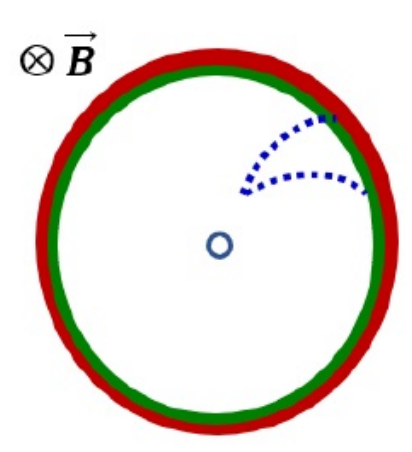
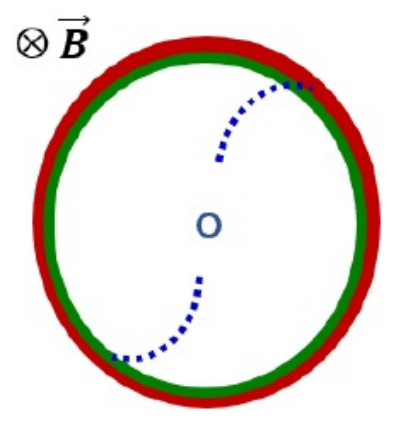
The figure below shows on the right a sketch of an electron-positron collider experiment where the innermost detector (shaded dark green) is a tracking system which records the tracks of charged particles which pass through it. On the left of the figure, a cross-sectional view of the same tracking system is shown. The narrow (white) pipe in the centre is where electrons and positrons are injected as shown and collide in the centre. (On the left it appears as a small central circle.) Inside the tracking system there is a strong uniform magnetic field collinear with the \(e^+\) direction.

In one of the \(e^+ e^-\) collisions, a high energy \(K_S ^0\) meson is produced that subsequently
\[K_S ^0 \to \pi^+ +\pi^-\]
A possible representation of the tracks (dotted lines) of the pions \(\pi^{\pm}\) in the tracking system would be


Check Answer
Option c
Q.No:23 TIFR-2024
A massive particle moving at a speed of \( \frac{4c}{5} \) collides with an identical particle at rest. What would be the speed of the second particle in the center-of-mass frame after the collision?
(a) \( \frac{c}{2} \)
(b) \( \frac{2c}{5} \)
(c) \( \frac{c}{\sqrt{2}} \)
(d) \( \frac{2\sqrt{2}c}{5} \)
Check Answer
Option a
Q.No:24 TIFR-2024
Consider an unstable bound state \( B \) of a proton (\( p \)) with an antiproton (\( \bar{p} \)), which is in the S-state (\( \ell = 0 \)) in the spin-singlet configuration. When this state \( B \) decays, which of the following final states will \underline{NOT} be possible?
(a) \( \gamma + \gamma + \gamma \)
(b) \( \mu^+ + \mu^- + \gamma \)
(c) \( \gamma + \gamma \)
(d) \( e^+ + e^- + \gamma \)
Check Answer
Option a
Q.No:25 TIFR-2025
Consider the alpha decay of \(^{224}\mathrm{U}\) at rest, to \(^{220}\mathrm{Th}\).
The atomic masses are given below:
\[
M_{224\mathrm{U}} = 224.0276\ \text{amu}, \quad
M_{220\mathrm{Th}} = 220.0158\ \text{amu}, \quad
M_{4\mathrm{He}} = 4.0026\ \text{amu}.
\]
What is the estimate of the kinetic energy of the emitted alpha \((^{4}\mathrm{He})\) particle?
(One amu corresponds to \(931.5\ \text{MeV}/c^{2}\).)
A) \(8.4163\ \text{MeV}\)
B) \(8.5698\ \text{MeV}\)
C) \(8.7261\ \text{MeV}\)
D) \(8.1066\ \text{MeV}\)