
Q.No:1 GATE-2012
Given \(\vec{F}=\vec{r}\times \vec{B}\), where \(\vec{B}=B_0(\hat{i}+\hat{j}+\hat{k})\) is a constant vector and \(\vec{r}\) is the position vector. The value of \(\oint_C \vec{F}\cdot d\vec{r}\), where \(C\) is a circle of unit radius centered at origin is,

(A)
\(0\)
(B)
\(2\pi B_0\)
(C)
\(-2\pi B_0\)
(D)
\(1\)
Check Answer
Option C
Q.No:2 GATE-2013
For a scalar function \(\varphi\) satisfying the Laplace equation, \(\nabla \varphi\) has
(A)
zero curl and non-zero divergence
(B)
non-zero curl and zero divergence
(C)
zero curl and zero divergence
(D)
non-zero curl and non-zero divergence
Check Answer
Option C
Q.No:3 GATE-2013
If \(\vec{A}\) and \(\vec{B}\) are constant vectors, then \(\nabla(\vec{A}\cdot \vec{B}\times \vec{r})\) is
(A)
\(\vec{A}\cdot \vec{B}\)
(B)
\(\vec{A}\times \vec{B}\)
(C)
\(\vec{r}\)
(D)
Zero
Check Answer
Option B
Q.No:4 GATE-2014
The unit vector perpendicular to the surface \(x^2+y^2+z^2=3\) at the point \((1, 1, 1)\) is
(A)
\(\frac{\hat{x}+\hat{y}-\hat{z}}{\sqrt{3}}\)
(B)
\(\frac{\hat{x}-\hat{y}-\hat{z}}{\sqrt{3}}\)
(C)
\(\frac{\hat{x}-\hat{y}+\hat{z}}{\sqrt{3}}\)
(D)
\(\frac{\hat{x}+\hat{y}+\hat{z}}{\sqrt{3}}\)
Check Answer
Option D
Q.No:5 GATE-2015
Four forces are given below in Cartesian and spherical polar coordinates.
(i) \(\vec{F}_1=K\exp{(-r^2/R^2)}\hat{r}\)
(ii) \(\vec{F}_2=K(x^3 \hat{y}-y^3 \hat{z})\)
(iii) \(\vec{F}_3=K(x^3 \hat{x}+y^3 \hat{y})\)
(iv) \(\vec{F}_4=K(\hat{\phi}/r)\)
where \(K\) is a constant. Identity the correct option.
(A)
(iii) and (iv) are conservative but (i) and (ii) are not
(B)
(i) and (ii) are conservative but (iii) and (iv) are not
(C)
(ii) and (iii) are conservative but (i) and (iv) are not
(D)
(i) and (iii) are conservative but (ii) and (iv) are not
Check Answer
Option D
Q.No:6 GATE-2016
The direction of \(\vec{\nabla}f\) for a scalar field \(f(x, y, z)=\frac{1}{2}x^2-xy+\frac{1}{2}z^2\) at the point \(P(1, 1, 2)\) is
(A)
\(\frac{(-\hat{j}-2\hat{k})}{\sqrt{5}}\)
(B)
\(\frac{(-\hat{j}+2\hat{k})}{\sqrt{5}}\)
(C)
\(\frac{(\hat{j}-2\hat{k})}{\sqrt{5}}\)
(D)
\(\frac{(\hat{j}+2\hat{k})}{\sqrt{5}}\)
Check Answer
Option B
Q.No:7 GATE-2018
In spherical polar coordinates \((r, \theta, \phi)\), the unit vector \(\hat{\theta}\) at \((10, \pi/4, \pi/2)\) is
(A)
\(\hat{k}\)
(B)
\(\frac{1}{\sqrt{2}}(\hat{j}+\hat{k})\)
(C)
\(\frac{1}{\sqrt{2}}(-\hat{j}+\hat{k})\)
(D)
\(\frac{1}{\sqrt{2}}(\hat{j}-\hat{k})\)
Check Answer
Option D
Q.No:8 GATE-2023
Consider the vector field \(\vec{V}\) consisting of the velocities of points on a thin horizontal disc of radius \(R=2m\), moving anticlockwise with uniform angular speed \(\omega=2\) rad/sec about an axis passing through its center. If \(V=|\vec{V}|\), then which of the following options is(are) CORRECT ? (In the options, \(\hat{r}\) and \(\hat{\theta}\) are unit vectors corresponding to the plane polar coordinates \(r\) and \(\theta\)).
You may use the fact that in cylindrical coordinates (\(z, \phi , z\)) (s is the distance from the z-axis), the gradient, divergence, curl and Laplacian operators are:
\(\vec{\nabla}=\frac{\partial f}{\partial s}\hat{s} +\frac{1}{s}\frac{\partial f}{\partial \phi } \hat{\phi}+ \frac{\partial f}{\partial z }\hat{z}\);
\(\vec{\nabla} \cdot \vec{A}=\frac{1}{s} \frac{\partial}{\partial s}(s \hspace{0.5mm} A_s)+\frac{1}{s} \frac{\partial A_{\phi}}{\partial \phi} +\frac{\partial A_z}{\partial z}\);
\(\vec{\nabla}\times \vec{A}=(\frac{1}{s}\frac{\partial A_{z}}{\partial \phi}-\frac{\partial A_{\phi}}{\partial z})\hat{s}+(\frac{\partial A_{s}}{\partial z}-\frac{\partial A_{z}}{\partial s})\hat{\phi}+\frac{1}{s}(\frac{\partial }{\partial s} (s A_\phi ) -\frac{\partial A_{s}}{\partial \phi}) \hat{z}\);
\(\vec{\nabla}^2 f=\frac{1}{s}\frac{\partial }{\partial s}(s \frac{\partial f}{\partial s})+\frac{1}{s^2}\frac{ \partial^2 f}{\partial \phi^2}+\frac{ \partial^2 f}{\partial z^2}\)
(A)
\(\vec{\nabla} V =2\hat{r}\)
(B)
\(\vec{\nabla} \cdot V =2\)
(C)
\(\vec{\nabla} \times \vec{V}=4\hat{z}\), where \(\hat{z}\) is a unit vector perpendicular to the (\(r, \theta\)) plane
(D)
\(\vec{\nabla}^2 V =\frac{4}{3}\) at \(r=1.5\) m
Check Answer
Option A, C, D
Q.No:9 GATE-2024
Consider a vector field \(\vec{F} = (2xz + 3y^2)\hat{y} + 4yz^2\hat{z}\). The closed path (\(\Gamma\): A \(\rightarrow\) B \(\rightarrow\) C \(\rightarrow\) D \(\rightarrow\) A) in z = 0 plane is shown in figure.

\[
\oint_{\Gamma} \vec{F} \cdot d\vec{l} \text{ denotes the line integral of } \vec{F} \text{ along the closed path } \Gamma.\]
Which of the following option is/are true?\\
{MSQ}
(A) \(\oint_{\Gamma} \vec{F} \cdot d\vec{l} = 0\)
(B) \(\vec{F}\) is non-conservative
(C) \(\nabla \cdot \vec{F} = 0\)
(D) \(\vec{F}\) can be written as the gradient of a scalar field
Check Answer
Option A, B
Q.No:10 GATE-2024
Consider a volume integral
\[
I = \int_V \nabla^2 \left(\frac{1}{r}\right) dV
\]
over a volume \( V \), where \( r = \sqrt{x^2 + y^2 + z^2} \). Which of the following statement is/are correct?
(A) \( I = -4\pi \), if \( r = 0 \) is inside the volume \( V \)
(B) Integrand vanishes for \( r \neq 0 \)
(C) \( I = 0 \), if \( r = 0 \) is not inside the volume \( V \)
(D) Integrand diverges as \( r \rightarrow \infty \)
Check Answer
Option A, B,C
Q.No:1 CSIR Dec-2014
(1)
\(\vec{\mathbf{\nabla}}\cdot \vec{\mathbf{r}}=0\) and \(\vec{\mathbf{\nabla}}\times \vec{\mathbf{r}}=\vec{\mathbf{r}}/r\)
(2)
\(\vec{\mathbf{\nabla}}\cdot \vec{\mathbf{r}}=0\) and \(\nabla^2 r=0\)
(3)
\(\vec{\mathbf{\nabla}}\cdot \vec{\mathbf{r}}=3\) and \(\nabla^2 \vec{\mathbf{\nabla}}=\vec{\mathbf{\nabla}}/r^2\)
(4)
\(\vec{\mathbf{\nabla}}\cdot \vec{\mathbf{r}}=3\) and \(\vec{\mathbf{\nabla}}\times \vec{\mathbf{r}}=0\)
Check Answer
Option 4
Q.No:2 CSIR Dec-2019
The values of \(a\) and \(b\) for which the force \(\mathbf{F}=(axy+z^3)\hat{i}+x^2\hat{j}+bxz^2 \hat{k}\) is conservative are
(1)
\(a=2, b=3\)
(2)
\(a=1, b=3\)
(3)
\(a=2, b=6\)
(4)
\(a=3, b=2\)
Check Answer
Option 1
Q.No:3 CSIR Feb-2022
The volume integral \(\iint_V\int \vec{A}.(\vec{\nabla}\times \vec{A})d^3x \), is over a region \(V\) bounded by a surface \(sum\) (an
infinitesimal area element being \(\hat{n}ds\) , where \(\hat{n}\) is the outward unit normal). If it changes to \(I+\Delta I\) when the vector \(\vec{A}\)
is changed to \(A+\Delta \Lambda\) , then \(\Delta I\) can be expressed as
(1)
\(\iint_V\int \vec{\Delta}.(\vec{\Delta}\Lambda\times\vec{A})d^3x\)
(2)
\(\iint_V\int\Delta^2\Lambda d^3x\)
(3)
\(-\oint_{\sum}(\vec{\Delta}\Lambda\times\vec{A}).\hat{n}ds\)
(4)
\(\oint_{\sum}\Delta^2\Lambda.\hat{n}ds\)
Check Answer
Option 3
Q.No: 4 CSIR June-2024
Vorticity of a vector field \(\vec{B}\) is defined as \(\vec{V} = \vec{\nabla} \times \vec{B}\). Given \(\vec{B} = kxyz\hat{r}\), where \(k\) is a constant, which one of the following is correct?
1) Vorticity is a null vector for all finite \(x, y, z\).
2) Vorticity is parallel to the vector field everywhere.
3) The angle between vorticity and vector field depends on \(x, y, z\).
4) Vorticity is perpendicular to the vector field everywhere.
Check Answer
Option 4
Q.No:1 JEST-2013
The vector field \(xz\hat{i}+y\hat{j}\) in cylindrical polar coordinates is
(a)
\(\rho(z\cos^2{\phi}+\sin^2{\phi})\hat{e}_{\rho}+\rho\sin{\phi}\cos{\phi}(1-z)\hat{e}_{\phi}\)
(b)
\(\rho(z\cos^2{\phi}+\sin^2{\phi})\hat{e}_{\rho}+\rho\sin{\phi}\cos{\phi}(1+z)\hat{e}_{\phi}\)
(c)
\(\rho(z\sin^2{\phi}+\cos^2{\phi})\hat{e}_{\rho}+\rho\sin{\phi}\cos{\phi}(1+z)\hat{e}_{\phi}\)
(d)
\(\rho(z\sin^2{\phi}+\cos^2{\phi})\hat{e}_{\rho}+\rho\sin{\phi}\cos{\phi}(1-z)\hat{e}_{\phi}\)
Check Answer
Option a
Q.No:2 JEST-2016
Given the condition \(\nabla^2 \Phi=0\), the solution of the equation \(\nabla^2 \Psi=k\vec{\nabla}\Phi\cdot \vec{\nabla}\Phi\) is given by:
(A)
\(\Psi=k\Phi^2/2\)
(B)
\(\Psi=k\Phi^2\)
(C)
\(\Psi=k\Phi\ln{\Phi}\)
(D)
\(\Psi=k\Phi\ln{\Phi}/2\)
Check Answer
Option A
Q.No:3 JEST-2017
The temperature in a rectangular plate bounded by the lines \(x=0, y=0, x=3\) and \(y=5\) is \(T=xy^2-x^2 y+100\). What is the maximum temperature difference between two points on the plate?
Check Answer
Ans 38
Q.No:4 JEST-2017
What is the equation of the plane which is tangent to the surface \(xyz=4\) at the point \((1, 2, 2)\)?
(A)
\(x+2y+4z=12\)
(B)
\(4x+2y+z=12\)
(C)
\(x+4y+z=0\)
(D)
\(2x+y+z=6\)
Check Answer
Option D
Q.No:5 JEST-2019
Suppose \(\psi\vec{A}\) is a conservative vector, \(\vec{A}\) is a non-conservative vector and \(\psi\) is non-zero scalar everywhere. Which one of the following is true?
(A)
\((\nabla\times \vec{A})\cdot \vec{A}=0\)
(B)
\(\vec{A}\times \nabla \psi=\vec{0}\)
(C)
\(\vec{A}\cdot \nabla \psi=0\)
(D)
\((\nabla\times \vec{A})\times \vec{A}=\vec{0}\)
Check Answer
Option A
Q.No:6 JEST-2019
Let \(\vec{r}\) be the position vector of a point on a closed contour \(C\). What is the value of the line integral \(\oint \vec{r}.d\vec{r}\)?
(A)
\(0\)
(B)
\(\frac{1}{2}\)
(C)
\(1\)
(D)
\(\pi\)
Check Answer
Option A
Q.No:7 JEST-2019
What is the angle (in degrees) between the surfaces \(y^2+z^2=2\) and \(y^2-x^2=0\) at the point \((1, -1, 1)\)?
Check Answer
Ans 60
Q.No:8 JEST-2021
Let \(ABCDEF\) be a regular hexagon. The vector \(\overrightarrow{AB}+\overrightarrow{AC}+\overrightarrow{AD}+\overrightarrow{AE}+\overrightarrow{AF}\) will be
(a)
\(0\)
(b)
\(\overrightarrow{AD}\)
(c)
\(2\overrightarrow{AD}\)
(d)
\(3\overrightarrow{AD}\)
Check Answer
Option d
Q.No:9 JEST-2023
Given the vector \(\vec{v}=y \hat{i}+3x \hat{j}\), what is the value of the line integral
\[\oint \vec{v} \cdot d \vec{r}\]
along the unit circle (centered at the origin) in an anti-clockwise direction?
(a) \(\frac{2 \pi}{3}\)
(b) \(\pi\)
(c) \(0\)
(d) \(2\pi\)
Check Answer
Option d
Q.No:10 JEST-2023
Which of the following vanishes identically?
(a) \(\nabla \times \frac{((y+x) \hat{i}+(y-x) \hat{j})}{x^2+y^2}\)
(b) \(\nabla \times \frac{(y \hat{i}-x \hat{j})}{x^2+y^2}\)
(c) \(\nabla \times \frac{(x \hat{i}+y \hat{j})}{x^2+y^2}\)
(d) \(\nabla \cdot [\frac{(x \hat{i}+y \hat{j}+x \hat{k})}{(x^2+y^2+z^2)^{3/2}}]\)
Check Answer
Option c
Q.No:11 JEST-2024
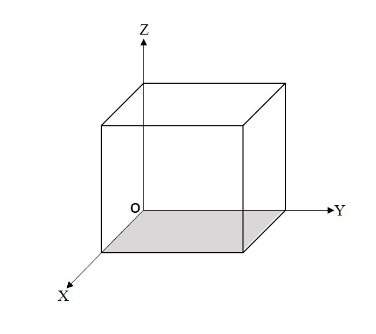
A magnetic vector potential is given as \( \vec{A} = 6\hat{i} + yz^2\hat{j} + (3y + z)\hat{k} \). Find the corresponding outgoing magnetic flux through the five faces (excluding the shaded one) of a unit cube with one corner at the origin, as shown in the figure.
Check Answer
Ans 0
Q.No:12 JEST-2025
A particle is moving under the force field given by \(\vec{F}=k\vec{r}\), where \(k\) is a positive constant. The difference in work done (in arbitrary units) if the particle moves from point A \((-1,0,0)\) to point B \((1,0,0)\) following semi–circular paths in the clockwise and anti-clockwise directions on the X–Y plane will be
a) \(0\)
b) \(2\pi k\)
c) \(\pi k\)
d) \(\frac{1}{2}\pi k\)
Check Answer
Option a
Q.No:13 JEST-2025
Evaluate \(\vec{\nabla}\cdot (r^{4}\,\vec{r})\), where \(\vec{r}\) represents a three–dimensional position vector.
a) \(7r^{4}\)
b) \(4r^{4}\)
c) \(5r^{4}\)
d) \(0\)
Check Answer
Option a
Q.No:1 TIFR-2013
Consider the surface corresponding to the equation
\[
4x^2+y^2+z=0
\]
A possible unit tangent to this surface at the point \((1, 2, -8)\) is
(a)
\(\frac{1}{\sqrt{5}}\hat{i}-\frac{2}{\sqrt{5}}\hat{j}\)
(b)
\(\frac{1}{5}\hat{j}-\frac{4}{5}\hat{k}\)
(c)
\(\frac{4}{9}\hat{i}-\frac{8}{9}\hat{j}+\frac{1}{9}\hat{k}\)
(d)
\(-\frac{1}{\sqrt{5}}\hat{i}+\frac{3}{\sqrt{5}}\hat{j}-\frac{4}{\sqrt{5}}\hat{k}\)
Check Answer
Option a
Q.No:2 TIFR-2015
Which of the following vectors is parallel to the surface \(x^2 y+2xz=4\) at the point \((2, -2, 3)\)?
(a)
\(+6\hat{i}-2\hat{j}-5\hat{k}\)
(b)
\(+6\hat{i}+2\hat{j}+5\hat{k}\)
(c)
\(-6\hat{i}-2\hat{j}+5\hat{k}\)
(d)
\(+6\hat{i}-2\hat{j}+5\hat{k}\)
Check Answer
Option d
Q.No: 3 TIFR-2019
Consider the surface defined by \(ax^2+by^2+cz+d=0\), where \(a, b, c\) and \(d\) are constants. If \(\hat{n}_1\) and \(\hat{n}_2\) are unit normal vectors to the surface at the points \((x, y, z)=(1, 1, 0)\) and \((0, 0, 1)\) respectively, and \(\hat{m}\) is a unit vector normal to both \(\hat{n}_1\) and \(\hat{n}_2\), then \(\hat{m}=\)
(a)
\(\frac{-a\hat{\mathbf{i}}+b\hat{\mathbf{j}}}{\sqrt{a^2+b^2}}\)
(b)
\(\frac{b\hat{\mathbf{i}}-a\hat{\mathbf{j}}}{\sqrt{a^2+b^2}}\)
(c)
\(\frac{2a\hat{\mathbf{i}}+2b\hat{\mathbf{j}}-c\hat{\mathbf{k}}}{\sqrt{4a^2+4b^2+c^2}}\)
(d)
\(\frac{a\hat{\mathbf{i}}-b\hat{\mathbf{j}}+c\hat{\mathbf{k}}}{\sqrt{a^2+b^2+c^2}}\)
Check Answer
Option b
Q.No: 4 TIFR-2022
Consider the two-dimensional polar integral
\[P=\int dr \hspace{0.5mm} d\theta \hspace{0.5mm} r^{19} \hspace{0.5mm} e^{-r^2} \hspace{0.5mm} sin^8 \theta \hspace{0.5mm} cos^{11} \theta\]
If the integration is over only the first quadrant \((0\leq \theta \leq \pi/2)\), the value of \(P\) is
(a)
180
(b)
\(88 \pi\)
(c)
\(20160\)
(d)
\( 16 \pi\)
Check Answer
Option a
Q.No: 5 TIFR-2023
A surface is given by
\[4x^2y-2xy^2+3z^3=0\]
Which one of the following is a vector normal to it at the point \((2,3,1)\) ?
(a)
\(30\hat{i}-8\hat{j}+9\hat{k}\)
(b)
\(30\hat{i}-8\hat{j}-9\hat{k}\)
(c)
\(15\hat{i}-4\hat{j}+18\hat{k}\)
(d)
\(30\hat{i}+8\hat{j}-9\hat{k}\)
Check Answer
Option a
Q.No: 6 TIFR-2024
A surface is given by
\[
2x^3z + 4y^2z + 3z^2 = 81
\]
Which of the following is a vector tangential to it at the point on the surface with coordinates \((x, y, z) = (1,2,3)\)?
(a) \( 2\mathbf{\hat{i}} - 3\mathbf{\hat{j}} + 3\mathbf{\hat{k}} \)
(b) \( 18\mathbf{\hat{i}} + 48\mathbf{\hat{j}} + 36\mathbf{\hat{k}} \)
(c) \( -3\mathbf{\hat{i}} + 2\mathbf{\hat{j}} + 6\mathbf{\hat{k}} \)
(d) \( -3\mathbf{\hat{i}} - 2\mathbf{\hat{j}} + 6\mathbf{\hat{k}} \)
Check Answer
Option a
Q.No: 7 TIFR-2025
Consider the triangle subtended on the surface of a sphere of radius \(1\) by joining the
points \(\left(\frac{1}{2},\frac{\sqrt{3}}{2},0\right)\), \(\left(-\frac{1}{2},\frac{\sqrt{3}}{2},0\right)\), and \((0,0,1)\) with arcs of great circles. The area
subtended by this triangle on the surface of the sphere is given by:
(Hint: Drawing a figure might help.)
a) \(\frac{\pi}{3}\)
b) \(\frac{\sqrt{3}\,\pi}{2}\)
c) \(\sqrt{3}\,\pi\)
d) \(\frac{2\pi}{3}\)
Q.No.1 Discussion :
Ans
Q.No.2 Discussion :
Ans
Q.No.3 Discussion :
Ans
Q.No.4 Discussion :
Ans
Q.No.5 Discussion :
Ans
Q.No.6 Discussion :
Q.No.7 Discussion :
Ans
Q.No.8 Discussion :
Ans
Q.No.9 Discussion :
Q.No.10 Discussion :
Q.No.11 Discussion :
c
Q.No.12 Discussion :
a
Q.No.13 Discussion :
Q.No.14 Discussion :
Q.No.15 Discussion :
Q.No.16 Discussion :
Answer: A
Q.No.17 Discussion :
Answer
Q.No.18 Discussion :
Question no 18
Q.No.19 Discussion :
JEST 2021
Q.No.20 Discussion :
Q.No.21 Discussion :
Q.No.22 Discussion :
Q.No.23 Discussion :
Q.No.24 Discussion :